How to rebrand in Klaviyo
You will learn
Learn how to change your domain name during a rebrand and best practices for maintaining good deliverability throughout the change.
Before you begin
Form a rebranding strategy.
When rebranding, you will likely pursue 1 of 3 options:
- Use a new domain with your existing Klaviyo account
Follow the steps below to adequately prepare your audience and edit any key marketing copy. - Merge Klaviyo accounts
If you're merging 2 Klaviyo accounts, such as if your company has purchased or merged with another that uses Klaviyo, follow the steps below to update your account and inform your audience. - Set up an entirely new Klaviyo account
Starting fresh? Skip this guide if you want to set up a new Klaviyo account. Instead, check out our course on Getting started with Klaviyo.
Prepare your account for the change
Before starting to rebrand, there are a few action items that you must accomplish to maintain good deliverability and communicate accurate information to your customers. Follow these best practices before making any sweeping changes to your account:
- Update your ecommerce integration.
- Ensure your ecommerce store and integration reflect your new brand name, logos, and URLs.
- Enable onsite tracking and any other important tracking features you use with Klaviyo; for example, Added to Cart events for Shopify users
- Review our guide to warming your sending infrastructure.
- Plan to warm your sending infrastructure when your rebrand introduces a newly registered domain or a domain you have never used to send email. A new domain needs its own sending reputation even if you keep the same Klaviyo account. Review our guide to warming your domain before proceeding.
- Notify your customers
- Inform customers of your rebranding ahead of time to avoid confusion and prevent issues with deliverability. Create email (and SMS, if applicable) campaigns that alert your subscribers about the name and brand changes prior to the first send with your new domain name.
- What to include in customer notifications:
- Email campaign: Create a text-based email to draw subscribers’ attention that includes both current and new branding. Your current brand content will help subscribers identify your business, and the new content will show them what they can expect in the future.
- SMS campaign: Include the current brand name, new brand name, and, if possible, an image of the new logo. Linking to a page that shows off your new branding can also help inform your subscribers.
What to tell customers (click to expand)
Transparency is key when it comes to maintaining a positive relationship with your loyal customers. In the email or SMS landing page, explain the following:
- Your new brand and logo
- Any content or product changes
- The domain name that they will soon receive emails from
- The reason for the name change (e.g., rebranding, merging, etc.)
In your email, you can add buttons to ask customers if they still want to receive marketing messages from your new brand. Their answer, yes or no, is saved as a profile property. This email-link method does not work directly in SMS messages. Saving the response does not change email or SMS consent.
Use the response property together with each channel’s marketing consent to create 2 segments for customers who want to keep receiving messages: 1 for email and 1 for SMS. Exclude customers who answer no from future sends. Creating a segment does not unsubscribe its members, and email suppression does not unsubscribe someone from SMS. For email subscribers who do not respond, use a sunset flow to try to re-engage them, then suppress those who remain unengaged.
Swoon email example (click to expand)
For example, Swoon, formerly Be Mixed, merged Klaviyo accounts to consolidate their product into one brand. They kept the name Swoon and discarded Be Mixed; all the while, they communicated this change to customers via campaign emails to make the change more seamless.

Update your Klaviyo account
- Update your sending domain
- This step applies if you're changing over to a new domain. If you are merging accounts, and thus keeping the name and domain of an account that already exists, skip this step.
- Follow the instructions in our guide on setting up a branded sending domain. If you're moving to a newly registered domain, you will need to warm your infrastructure. Complete verification and activation before sending from the new domain.
- Adjust your brand information in Klaviyo
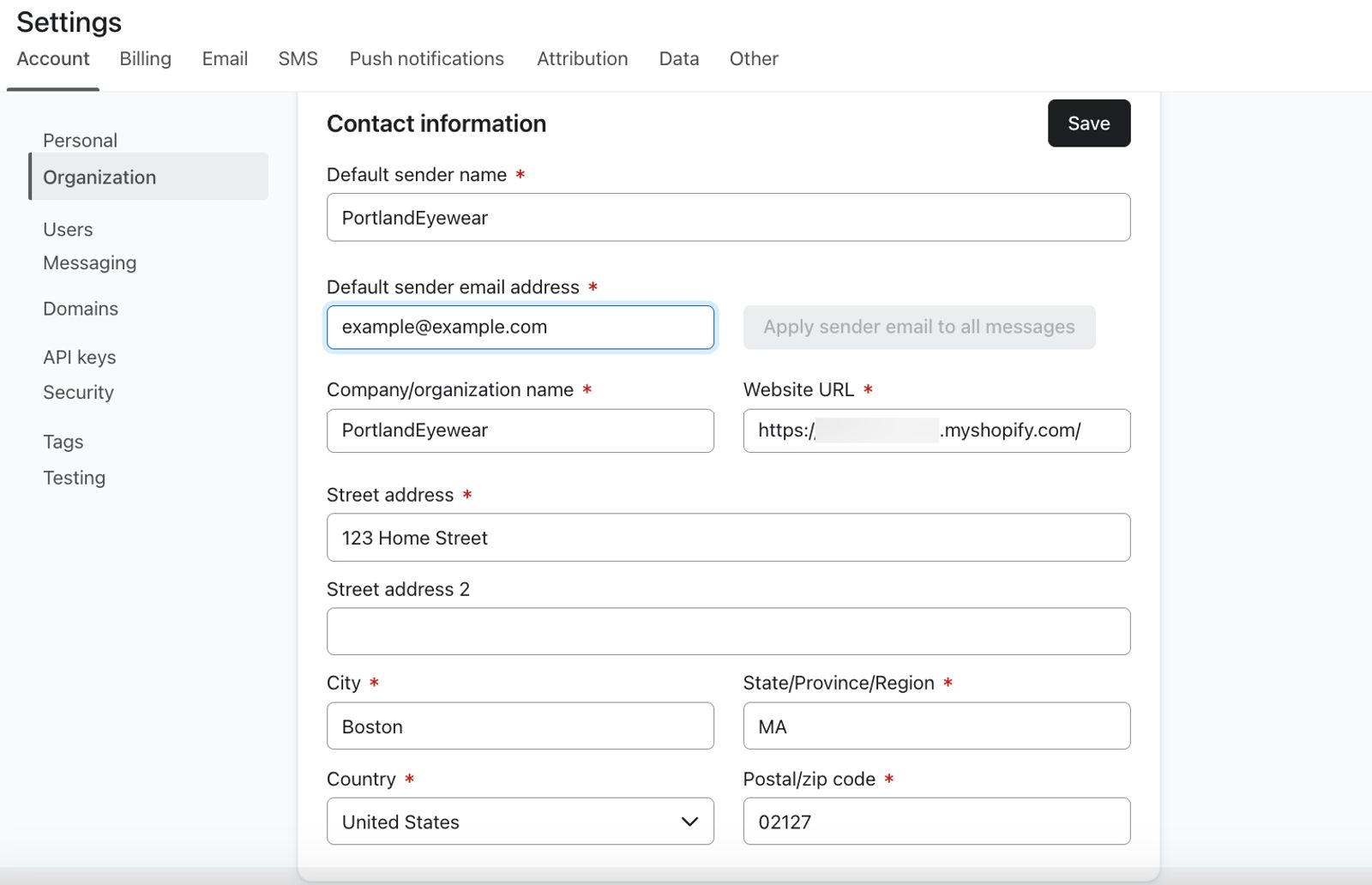
- Once your domain name is updated or, for those simply merging accounts, you have informed your customer base that a change is imminent, edit your brand details within Klaviyo by selecting your account name, then Settings > General > Account. From here, update:
- Default sender name and Default sender email address, which identify who your emails are from.
- Other details that changed during your rebrand, including Company name and Website URL.
- Be sure to Save all changes.
- If the Update existing addresses window opens after saving, choose how to update addresses in flows and campaigns, then click Confirm choices. You can also reopen it with Apply sender email to all messages when that button is available.
- Review sender names and email addresses in existing flow messages and unsent campaigns before resuming sends. The bulk address update does not change sender names, and draft campaigns created more than 60 days ago need individual checks.
- Once your domain name is updated or, for those simply merging accounts, you have informed your customer base that a change is imminent, edit your brand details within Klaviyo by selecting your account name, then Settings > General > Account. From here, update:
- Refresh your brand library
- Head to Content > Media & brand to upload new content (e.g., images, brand assets, fonts, etc.) to align with your rebranding, as well as preview, delete, and update existing content and settings.
- Edit content in flows, campaigns, and templates
- In addition to sender details, update flow content, unsent campaigns, and saved email templates to reflect the new branding. This includes any:
- Copy in your emails or SMS messages
- Subject line content
- Linked content
- Template URLs
- If you merge accounts, make sure you have permission to clone in both accounts. Set the flows in the account you are retiring to draft, then clone the flows and templates you need to the account you are keeping. Review the destination triggers, filters, and message content, and keep cloned flows in draft until you have finished transferring profiles. Then set the flows you want to use live.
- You can also create new templates to start from scratch if you choose to redesign your store content entirely. For more information on editing your templates, head to create, edit, delete, and manage templates.
- In addition to sender details, update flow content, unsent campaigns, and saved email templates to reflect the new branding. This includes any:
Transferring profiles and engagement data
Before importing, set list-triggered flows in the destination account to draft if you do not want imported contacts to receive those messages. Check the import results and consent details before turning those flows live again.
If you merge accounts, transfer the profile data you need to the account you intend to keep. You can export your main list to a CSV file and then import it into a list in that account. Include the email and SMS consent details you need, and map them during import. Do not mark all imported contacts as subscribed unless they have consented to that channel.
Carry over email suppressions before sending from the destination account. Export the addresses that should remain suppressed, then import them into its suppression list. This is separate from importing subscribers into a list.
A list or segment CSV does not transfer individual open and click events. When exporting, select Last Open and Last Click if you want those engagement dates. Import them as custom date properties, such as Previous account last open and Previous account last click, and use those properties to segment customers in the destination account. They do not recreate the original engagement history or qualify as engagement events for guided warming.
Warm your domain
Warming helps build your sending reputation by starting with engaged subscribers and gradually increasing email volume. Follow the standard warming process for a newly registered domain or one you have never used to send email. New Klaviyo accounts with engagement events, such as opens and clicks, or a Klaviyo-built integration that syncs those events should also follow that process. For other accounts without engagement events, including transfers with only date-based properties such as last open or last click, follow the platform introduction process. Guided warming notifications depend on your account’s sending volume and engagement events; they are not required to follow a warming plan.
Existing Klaviyo customers moving to a branded sending domain do not need to warm again if the domain has been registered for at least 30 days and has already been used to send email, including in your from-address. This exception does not apply when your rebrand introduces a newly registered or previously unused domain.
Additional resources
- How to change your account name
Learn how to change your account's organization name (also called your "company name") in Klaviyo. Knowing how to do this is helpful if your company is rebranding, there’s a mistake in the current name, or you simply want to edit it in some way.
- Understanding which warming process to use in Klaviyo
Learn how to choose the right warming process in Klaviyo, so you can establish a strong initial sender reputation and be viewed favorably by inbox providers.
- Understanding branded vs. shared sending domains
Learn more about branded sending domains (also known as dedicated sending domains), how they differ from shared sending domains, and when they may be beneficial for your business to use. In the world of email marketing, your sending infrastructure, including your sending domain, is very important. Sending domains are a key component of your email infrastructure, that to help build a positive reputation and promote domain alignment.
- Guide to building a brand voice