How Klaviyo billing works
Only Owners and Admins can edit Klaviyo billing settings.
Learn how Klaviyo bills customers for Profiles and Emails, Mobile Messaging, Social Marketing, Composer, Reviews, Advanced Klaviyo Data Platform (formerly CDP), Marketing Analytics, Customer Hub, Helpdesk, and Customer Agent.
This article is for customers who are not using manual billing (contract billing).
Understanding Klaviyo’s products and plan types
All Klaviyo plans are billed on a monthly basis, which starts the day you begin a paid plan.
There are several products available:
- Klaviyo Marketing
- Profile and Email
- Mobile Messaging (SMS, MMS, WhatsApp, and other mobile channels)
- Social Marketing
- Composer
- Reviews
- Klaviyo Service
- Customer Hub
- Customer Agent
- Helpdesk
- Klaviyo Data Platform
- Advanced Klaviyo Data Platform, or KDP (previously called CDP)
- Klaviyo Analytics
- Marketing Analytics
- Klaviyo Success & Support
View and change your billing plan
To view your plans, follow these steps:
- Click your organization’s name in the bottom left corner.
- Click Billing.
Once in the Overview tab, you’ll be able to view the plans you are currently paying for. The Monthly Total reflects the upcoming monthly total you will pay if you do not make any changes to your account before your billing cycle renews.
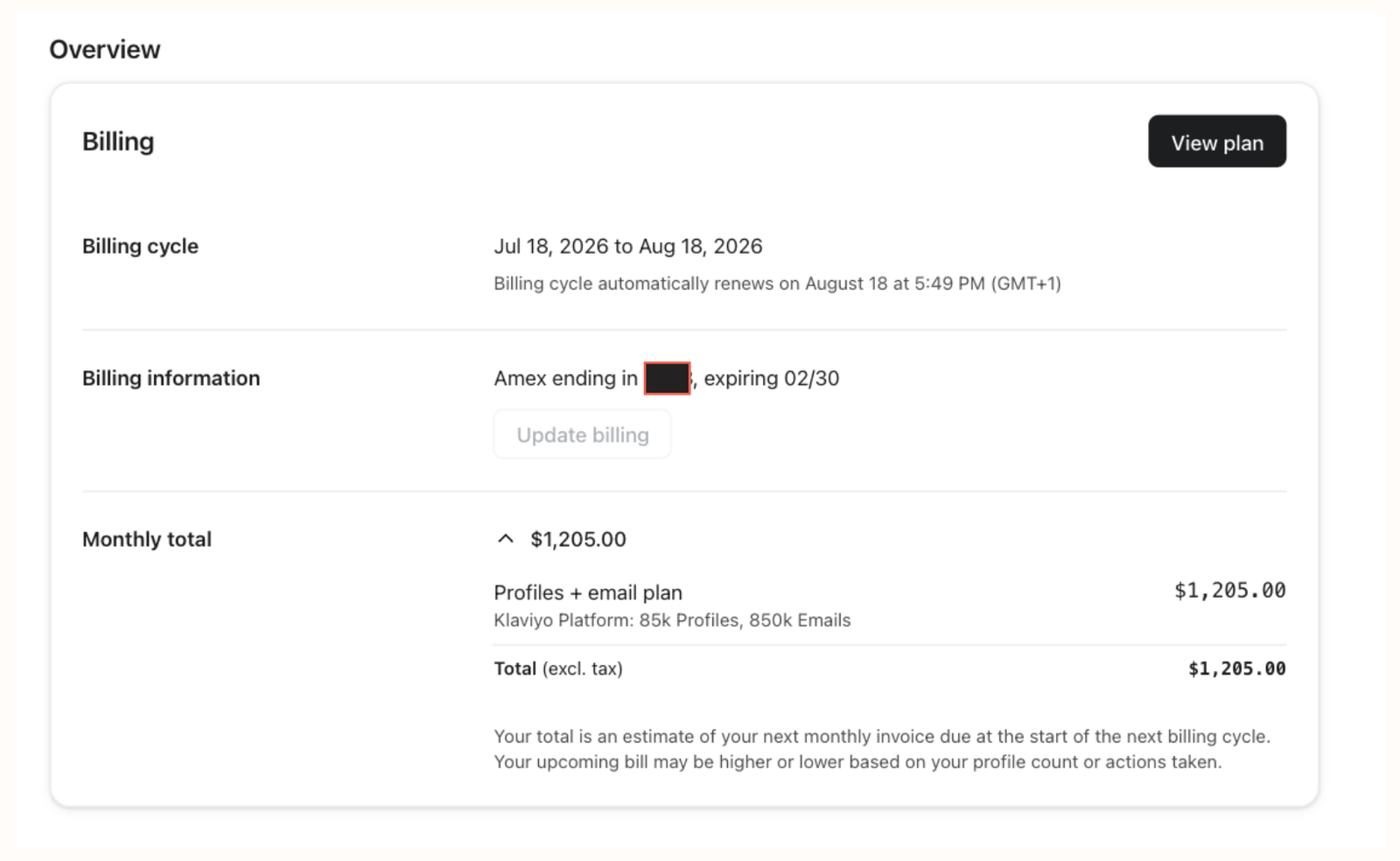
You can also view the cost of other Klaviyo plans when changing plans. To do so:
- Select your account name in the bottom left.
- Navigate to Billing > Overview and click Change plan.
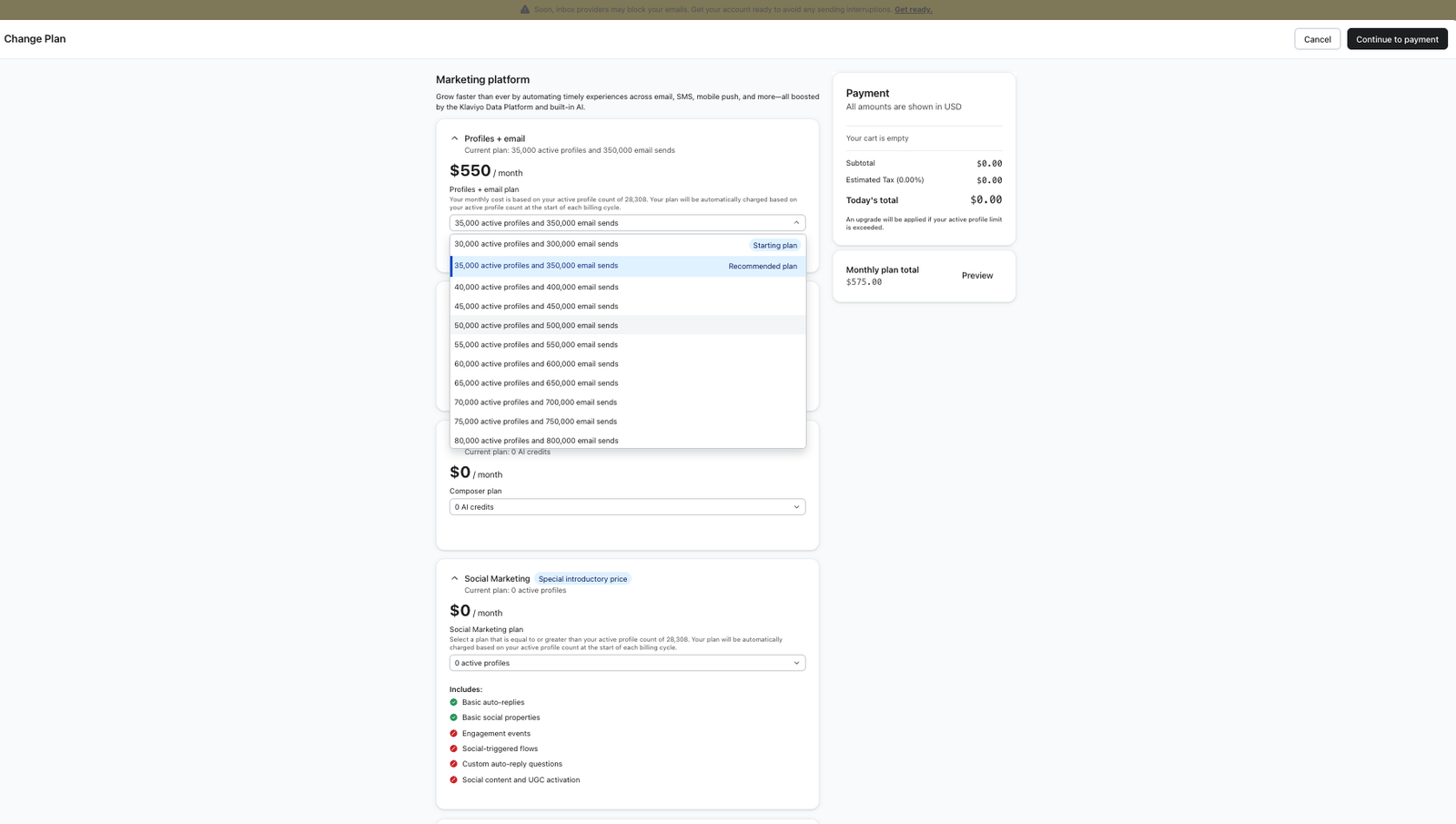
- Open the dropdown under a plan type to view all the plans.
- Select a plan to view its cost.
If you use manual billing, your contract determines your plans and billing terms. See Understanding manual billing.
Upgrading and downgrading
Changing your plan
To change plans, click your account name, then go to Billing > Overview and click Change plan. For the complete steps, see How to add or change a plan in Klaviyo.
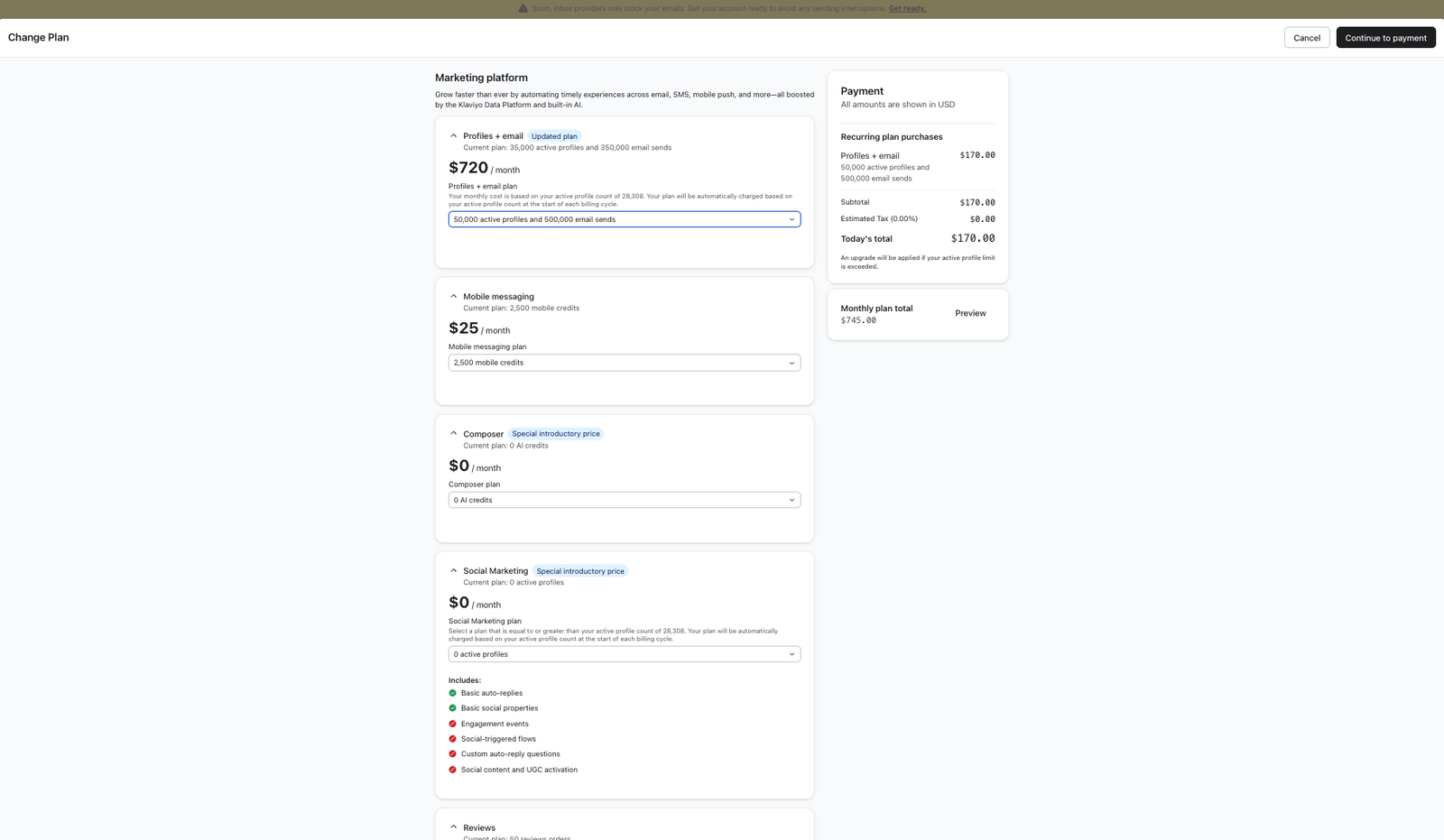
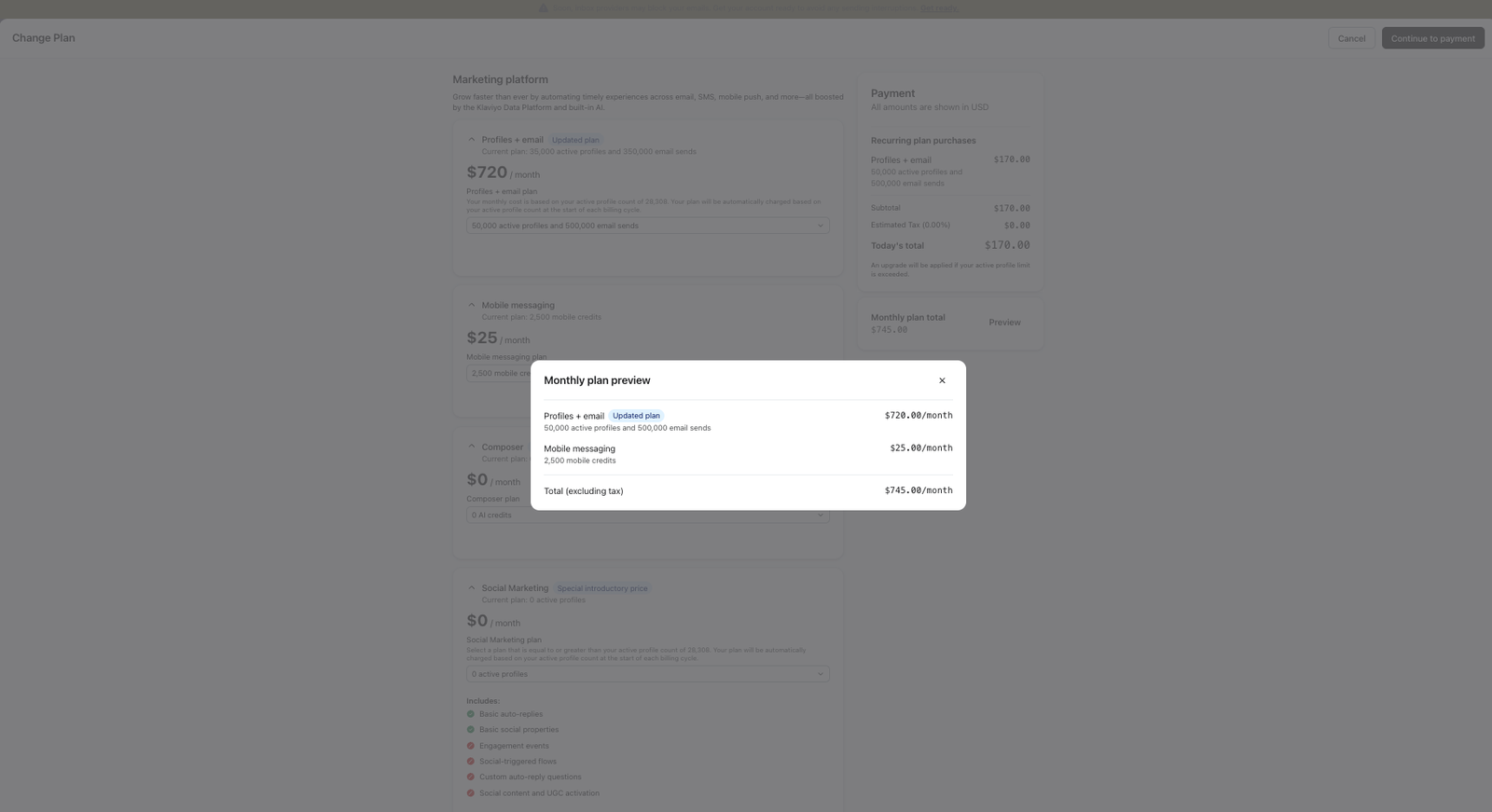
The checkout summary updates as you select plans so you can review the cost before confirming your changes.
Review the amount due today and the monthly total for your selected plans before you confirm.
In checkout, you can review:
- Recommended plans based on your usage.
- Discounts and estimated tax.
- The cost difference between your current plan and the plan you select.
Open checkout from Billing > Overview > Change plan.
The Change plan button only appears if you have Billing access, are not purely manually billed, and can modify account-family plans. If you're on a contract, you won't see this button; instead, you'll see a notice that your account is on a contract, prompting you to contact your Klaviyo representative.
Upgrading
When you upgrade (either manually or automatically), it takes effect immediately (when the limit is crossed for auto-upgrade, or right away at checkout for a manual upgrade). You then stay on that plan until you upgrade again or downgrade.
For plans that are not prorated, an upgrade charges the difference between your current plan and the new plan for the current billing cycle. Customer Hub, Marketing Analytics, and Advanced KDP upgrades are prorated for the time remaining in the cycle. In subsequent cycles, you pay the full amount of the new plan.
You cannot upgrade if there's an outstanding invoice in your account.
Downgrading
When downgrading:
- To downgrade your Profiles and Email plan, the lower plan must cover your active profile count. For example, a plan that allows 50,000 active profiles can cover exactly 50,000. Check your updated count after a cleanup before selecting a plan.
- It does not take effect immediately: the change is typically scheduled for your next billing cycle.
- If you upgrade before the downgrade takes effect, it cancels the scheduled downgrade.
- Klaviyo does not offer refunds for mid-cycle downgrades.
- You cannot downgrade if there is an outstanding invoice for your account.
To review plan changes in the updated billing layout, open Payments & Invoices and select Plan change history. Invoices show the reason for a charge; plan change history shows changes to your plans. If your account uses the earlier layout, review Payment history.
What will I see in checkout when upgrading or downgrading?
Does changing my plan reset my billing date?
No. Upgrading or downgrading never changes your billing date. The only way to reset it is to cancel your account and later resubscribe, which starts a new billing date from scratch.
When do billing plans renew?
All Klaviyo plans renew automatically on a monthly basis. The exact date depends on your personal billing cycle:
- Free plans always renew on the first of the month.
- Paid plans renew on the date your account began to pay for Klaviyo.
You're billed in advance for the upcoming cycle, not for the cycle that just ended, so your invoice covers the month ahead.
To view when your billing cycle renews:
- Click your organization name in the lower-left corner.
- Click Billing.
- Review the dates for your cycle, which are at the top of the page in the Overview tab.
Beginning on October 8, 2025, Klaviyo aligned customers’ usage cycles with their billing cycle. Your billing cycle is based on when you first signed up for a paid plan with Klaviyo, which you can view on the Billing Overview page. Historically, your usage cycle ended at midnight on that same day. With this new streamlined approach, your usage cycle and billing cycle will share the same date and time. Only the time is changing, the billing date remains the same, and there is no action needed on your part.
Your billing date remains the same and there is nothing that you need to do.
What is my billing cycle?
A billing cycle is the monthly period between billing dates. It is based on when you first signed up for a paid Klaviyo plan and is visible on your Overview page.
Will my billing date or time change?
No, your billing date and time remain the same. Your usage cycle aligns with your billing cycle.
Where can I see my billing date and time?
You can see your billing date and time in the Billing Overview page next to Billing Cycle.
Is there anything I need to do?
No, the change will occur automatically.
Can I change my billing cycle?
No, this is not supported right now.
Why are you making this change now?
We are always working to streamline our customer experiences. This particular change improves backend operations with little to no impact on customers.
Can I opt out of this change?
No, the change will occur automatically.
What happens if my usage period is longer or shorter this month?
The change this month will be less than a day and should not impact usage.
Managing payment methods and failed payments
Add or change your payment method
To update the card used for your Klaviyo subscription:
- Go to Billing from the menu in the bottom-left corner of your account.
- In Overview, find Payment method and click Change method.
- Enter your new card details and click Save. The saved card replaces the payment method used for future charges.
If you manage multiple Klaviyo accounts, repeat this in each account where you want to change the card.
What happens when a payment fails
If a payment fails (for example, due to insufficient funds, card expiry, or a bank/KYC block):
- Klaviyo will automatically retry the charge according to an internal retry schedule.
- You may see notices in your account and receive billing-related emails prompting you to update your payment method.
- If payment is not successful after repeated attempts, your plan may become restricted or your account may be temporarily locked until the issue is resolved.
After you update your card, Klaviyo will usually attempt billing again automatically on the next scheduled retry.
Why the "Retry payment" button may be greyed out
The Retry payment button in Billing > Overview schedules another attempt to collect a failed payment. It is unavailable when:
- There is no failed payment record to retry.
- The next retry is scheduled within 30 minutes of the current time, or was scheduled less than 30 minutes ago.
- A retry request is being submitted. If you are in a child account, manage payment retries from the parent account.
If the button remains unavailable after you have added a valid card and waited for a retry window, contact Support for help and include your account email and recent invoice ID.
Card blocked, KYC checks, or plan locked due to failed payments
If your bank or provider has blocked your card due to KYC (know your customer) checks or another compliance reason:
- Replace the blocked card with a valid card in Billing using the payment-method steps above.
- Ask your bank to confirm that online and international recurring payments to Klaviyo are allowed.
If your plan is locked or your account shows outstanding debt that you cannot clear via self-service:
- Take a screenshot of your Billing page, including any error message.
- Collect your latest invoice ID and account email.
- Contact Support so they can review and advise on next steps.
Profiles and Email
Profile and Email plans are based on both the number of:
- Active profiles in your account.
- Emails sent during the current billing cycle
Your paid Profiles and Email plan must cover your active profile count. If it does not, you will be moved to a profile-compliant plan for the next billing cycle. Reduce your active profile count before renewal if you want to stay within your current plan’s limit.
Your Profile and Email plan must be compliant with the number of active profiles you have at the end of your billing cycle. This means that if you have 7,000 Active Profiles, your plan must allow for at least that amount. You will be automatically upgraded to a profile-compliant plan at the end of each billing cycle, if you exceed your level of profile usage.
Your emails can be to any of your active profiles. You can send an equal amount across all of your profiles (10 to each), or send more to certain groups and less to others (e.g., 100 to group A, and 1 to group B).
What are active profiles?
Any profile, regardless of consent status, that can be emailed through Klaviyo is considered an active profile. This includes your subscribers and those who are added by general engagement (such as sharing their email on a store’s checkout page but not actually opting in).
Klaviyo charges for any messages that leave the system: any received or bounced emails count toward your plan limit, but skipped emails do not.
How profile counts affect your bill
Your Profiles and Email plan is based on active profiles, meaning profiles that can receive email through Klaviyo.
- Active profiles: Profiles with an email address that are not suppressed from email. A phone number alone does not make a profile count toward your Profiles and Email plan.
- Email-suppressed profiles: These profiles remain in your account for historical reporting, but are not included in your active email profile count once suppression is processed. Unsubscribing from SMS alone does not remove an otherwise emailable profile from this count.
- Deleted profiles: Profiles that you permanently remove from your account. Deleted profiles do not count toward your billable profile total going forward and cannot be recovered.
After a large cleanup, the profile count displayed in billing may take up to 72 hours to refresh. Checkout checks your current active profile count and can fall back to recorded usage if that check fails. See Understanding your account usage for information about the displayed count.
Double opt-in (confirmation) emails don't count toward your email send usage, regardless of your plan.
When suppression or deletion changes your billing tier
If you suppress or delete a large number of profiles, your billable profile count will decrease after Klaviyo finishes processing those changes. Once your billable profiles fall below the threshold for your current tier, you can select a lower plan.
For example:
- If you currently pay for a plan up to 210,000 profiles and you suppress or delete enough profiles so that only 50,000 remain billable, you become eligible to move to the tier that covers up to 50,000 profiles.
- Your Profiles and Email plan does not automatically downgrade just because you reduce profiles. Choose a lower tier after your active profile count updates, or enable auto-downgrade based on profiles when using flexible sending.
Steps to reduce profiles and downgrade your plan
- Review your current active profile count.
- Go to your account's billing or usage area to see how many profiles are currently billable.
- Suppress or delete profiles you no longer need.
- Suppress contacts you do not plan to market to (e.g., inactive leads, bounced addresses, or contacts that should not receive campaigns).
- Delete profiles you want to remove permanently from Klaviyo (for example, test data or contacts imported in error). Be careful: deletion cannot be undone.
- Wait for your active profile count to update.
- Klaviyo updates usage several times per day. After your changes are processed, check your billable profile total again.
- Select a lower billing tier.
- When your active profiles fit a lower tier, go to Billing > Overview > Change plan and complete checkout. The lower plan takes effect in your next billing cycle.
Reduce profiles and choose a lower plan before your billing cycle renews. Review the effective date in checkout so you know which cycle will use the new plan.
Profiles without email addresses or phone numbers
Some accounts contain profiles created from other systems (e.g., an ERP) that do not include email addresses or phone numbers.
- Profiles without an email address do not count toward your Profiles and Email plan. Delete them only if you no longer need their data; deleting them will not reduce the active email profile count.
- You can keep these profiles for historical data. They still count toward total-profile plans, such as Advanced KDP.
Always confirm your new billable profile count in the billing or usage view before changing your plan so that you select the most appropriate tier.
Mobile Messaging
If your Mobile Messaging plan uses dollar-based rates, you pay upfront for the monthly spend you expect to need, such as $15 or $25. Choose your plan based on how many messages you want to send and their recipients. The plan resets monthly, and unused dollars do not carry over. If your account uses credit-based pricing, your plan includes credits instead of a dollar balance.
For dollar-based plans, mobile message costs depend on the channel, recipient location, and other factors listed below. Check the rates associated with your plan when estimating usage.
If you purchase a Short Code subscription, those are billed separately from your Klaviyo Messaging plan.
What is a "rate," and what makes up my rate?
Your rate is the dollar price of a single message. Each rate reflects a combination of factors:
Factor | What it reflects |
Channel | SMS, MMS, WhatsApp, or RCS |
Country or region | Where the message is sent (Recipient location) |
Number type (US and Canada SMS only) | Toll-free vs. short code |
Carrier and provider costs | Built into the rate. |
Number of message segments | Character Limits |
To check your mobile rates or credit ratios, open the relevant mobile usage view and select View text message ratios or View WhatsApp ratios. In the updated layout, go to Billing > Overview and click View on the Mobile Messaging card. In the earlier layout, use Billing > Account usage.
What is a message segment?
Text messages allow for a certain number of characters:
- SMS has a limit of 160 characters normally, but only 70 characters when there's an emoji or special character.
- MMS always allows up to 1600 characters.
- WhatsApp template message bodies can contain up to 1,024 characters.
If an SMS exceeds its single-segment character limit, it is split into multiple message segments for delivery.
An SMS with multiple segments still appears as a single message on the recipient’s phone.
Multipart SMS includes a header that reduces each segment’s capacity to 153 characters for standard text or 67 characters when Unicode characters, such as emoji, are used. Each segment contributes to your message usage.
For SMS and MMS, skipped and inbound messages do not cost you, but failed deliveries do. WhatsApp template charges depend on delivery, as explained below.
Carrier fees
Mobile carriers charge fees to deliver messages to subscribers on their networks. These fees vary by country, carrier, and message type, and can change as carriers update their pricing.
Klaviyo bundles carrier fees into your plan rate. The rate shown for each message type and region is the all-in cost — there are no separate carrier fee line items on your invoice.
Comparing rates across providers
Not all providers include carrier fees in their advertised rates. Some show a base per-message rate and add carrier fees as a separate charge at billing, which means the rate you're quoted may not reflect what you'll actually pay.
When comparing messaging rates across platforms, ask whether the quoted rate includes carrier fees. With Klaviyo, it does.
Klaviyo follows Meta’s billing model: charging per template instead of per conversation. This means that there is a charge for any delivered marketing or utility/transactional template message.
In Klaviyo, WhatsApp messages are billed at a per-message rate using your Mobile Messaging plan. After you purchase a Mobile Messaging plan, you can use it for SMS, MMS, WhatsApp, or a combination.
How WhatsApp messages are billed
On dollar-based Mobile Messaging pricing, your free monthly allowance is $5. WhatsApp usage is charged at the per-message rate associated with your plan.
Because WhatsApp fees and currency may vary by region and plan type, you can always find your up-to-date WhatsApp pricing by checking your Billing page in Klaviyo or reviewing your Klaviyo order form or contract, which lists the price per WhatsApp message.
If you have questions about your specific WhatsApp rates or currency, contact Klaviyo Support or your account representative and include your account ID and region.
Removing or downgrading Mobile Messaging from your plan
You can stop paying for Mobile messaging while keeping your Klaviyo account and email plan active.
To reduce your paid Mobile Messaging plan, use Billing > Overview > Change plan. To cancel the plan, use Cancel plan instead. See how to cancel a plan for the confirmation steps.
How to downgrade a paid Mobile Messaging plan
- Go to your Billing page in Klaviyo.
- Click Change plan.
- Select a lower paid Mobile Messaging plan from the dropdown.
- Click Continue to payment, review the payment summary and effective date, then click Confirm or Confirm and Pay to submit your changes.
A paid downgrade takes effect at the start of your next billing cycle. Canceling a plan lets you choose when it ends; cancellation does not refund the unused portion of the current cycle.
What happens to Mobile Messaging flows and campaigns
When you cancel your Mobile Messaging plan, check your flows and campaigns:
- Flows containing live SMS messages are disabled when cancellation takes effect. Review these flows before relying on other messages within them to continue sending.
- Queued SMS campaigns are canceled when SMS cancellation takes effect. Review and reschedule the campaigns you want to send if you resume SMS later.
- The flows remain in your account so you can edit their messages and reactivate them when appropriate.
- Your Mobile settings and historical mobile data stay in your account so you can review past performance.
If you plan to stop mobile for an extended period, we recommend:
- Pausing or removing SMS messages from active flows.
- Updating any signup forms or automations that promote SMS-only experiences.
Re-enabling Mobile messaging later
If you decide to use Mobile again:
- Return to your Billing page.
- Use Change plan to add Mobile back to your plan.
- After adding Mobile Messaging again, review the flows disabled by cancellation and reactivate the flows and SMS messages you want to send. Reschedule canceled SMS campaigns as needed.
Klaviyo Social Marketing
Klaviyo Social Marketing connects social media engagement - DMs, comments, and tags, and user generated content (UGC) directly to unified Klaviyo customer profiles, turning followers into owned subscribers and social activity into actionable data.
Klaviyo Social Marketing pricing is based on your Active Profile Count.
Klaviyo Composer
Composer is Klaviyo's AI marketing agent. It analyzes your account, audits your work, recommends next steps, drafts content, and checks what you have built. Paid actions use credits from your plan; support questions are free.
Composer usage is measured in AI credits, based on the inputs submitted to and outputs generated by the AI model, including the size and complexity of your request.
Usage is dynamic. The same action can cost different amounts depending on the request, so two campaigns or two audits won't always cost exactly the same. We show estimated ranges, not fixed costs.
Review available Composer plans in Billing > Overview > Change plan. On the current paid Composer plan, use Flexible overages to add capacity, or choose None to stop using Composer at the plan limit. Legacy credit-based Composer plans can also offer Automatically upgrade. Manage these preferences in Billing > Preferences.
Some questions are free. Asking Composer for support or general information does not use any credits.
Klaviyo may update how credit usage is calculated. Credits are non-transferable and non-refundable. Unused paid-plan capacity expires at the end of each billing period and does not roll over. If you are still in a legacy Composer trial, see the legacy credits guide for its first-paid-month rollover rule.
See How Composer credits work (Legacy) if you are on an early adopter paid plan or still in your legacy 90-day trial.
Estimated Composer usage by action
Composer actions use different amounts of capacity depending on your request. The credit ranges below are estimates for credit-based plans, not maximum charges. Actual usage can exceed these ranges. Check your Composer usage panel for the amount used.
Action | Credit Cost (Estimate) |
Support | Free |
General information | Free |
Analyze data | 35-90 credits |
Audit text message content | 25-180 credits |
Audit a segment | 30-130 credits |
Audit a flow, form, or template | 10-450 credits |
Audit a campaign | 10-50 credits |
Create a campaign | 10-1000 credits |
Analyze or Auto-reply on Social | 5-80 credits |
Learn how your Composer plan works.
Klaviyo Reviews
Klaviyo Reviews is only available for Shopify and WooCommerce stores.
By using this product, you can collect, display, and manage your product reviews.
Klaviyo Reviews pricing is based on how many orders are placed on your website each month.
What counts as an “order”?
"Order" means when a "Ready to review" event is generated in the Klaviyo platform based on Customer's configuration. Each Ready to review event counts toward your Klaviyo reviews plan. A Ready to review event is triggered when:
- A certain number of days have elapsed since the order was fulfilled or delivered, depending on your settings, and
- The order is eligible for reviews
Can I exclude orders from being eligible for reviews?
You can make a product, customer, or order ineligible for reviews by applying the klaviyo_reviews_exclude tag to that item in your e-commerce platform.
Will I be charged for reviews that are ineligible?
Orders that are ineligible for review do not count toward your plan limit. The klaviyo_reviews_exclude tag does not apply retroactively (i.e., if a review request has already been sent, applying this tag cannot undo that action and it will still count toward your Klaviyo reviews billing plan).
Customer Hub
Customer Hub delivers a personalized customer accounts experience by combining personalization, merchandising, and self-service support into one on-site surface for shoppers.
Customer Hub is priced based on your active profile count, starting at $20 per month for up to 10,000 active profiles.
Helpdesk
Helpdesk brings AI and human agents into a unified workspace across email, chat, SMS, WhatsApp, and social.
Helpdesk is priced based on the amount of shopper-initiated tickets opened, starting at $10 per month for up to 50 tickets.
A ticket is a shopper-initiated message or, where applicable, a Customer Agent-initiated support escalation, sent through a supported channel that requires human agent support. A ticket becomes billable upon creation.
Helpdesk has AI spam detection, which reviews incoming messages from your customers and automatically flags tickets on any channel that are not legitimate customer outreach (iMessage auto-responses, email out-of-office responses, and spam or phishing attempts). These are not charged as tickets.
How is a ticket defined?
A ticket is a shopper-initiated message or, where applicable, a Customer Agent-initiated support escalation, sent through a supported channel that requires human agent support. A ticket becomes billable upon creation.
How long can tickets remain open?
Each Ticket remains open until it is automatically closed at a time period of 48 hours, or manually closed by the Customer, or closed through other rules-based automations, whichever occurs first.
What happens when tickets are closed?
Once a Ticket has closed, if the same shopper initiates another message that requires human agent support, a new Ticket will be created. Customers are separately responsible for any additional service usage that occurs in connection with a Ticket (e.g., SMS or email sends).
Am I charged for Spam tickets created in Helpdesk?
You are not charged for tickets in your Helpdesk spam folder, even if you later mark them as not spam.
Customer Agent
Customer Agent is a 24/7 AI assistant that helps before and after the purchase—answering questions, recommending products, and resolving issues instantly. Customer Agent is currently available on web chat, email, SMS, and WhatsApp.
Customer Agent is priced based on the number of shopper-initiated conversations resolved, starting at $50 per month for up to 75 conversations. A conversation is a shopper-initiated conversation on a supported channel that is handled end-to-end by Klaviyo’s Customer Agent.
How long can conversations remain open?
A Conversation becomes billable when the “Customer Agent” provides a response and 48 hours have passed with no response from the shopper.
What if the customer agent does not resolve the conversation?
Conversation consumption excludes conversations that are escalated to a human agent (including Helpdesk if applicable). You are separately responsible for any other Service consumption alongside an AI Conversation (e.g. Mobile messages or email).
Marketing Analytics
Marketing Analytics provides actionable customer and product insights that enable you to enrich your marketing strategy with additional data and use cases for better personalization. Marketing Analytics is not included in Klaviyo’s base email and profiles plan, and a subscription is required to access the associated functionality.
Marketing Analytics is priced based on your active profile count, starting at $100 per month for up to 13,500 active profiles.
What are active profiles?
Any profile, regardless of consent status, that can be emailed through Klaviyo is considered an active profile. This includes your subscribers and those who are added by general engagement (such as sharing their email on a store’s checkout page but not actually opting in).
This means that if you have 7,000 active profiles, your plan must allow for at least that amount.
How can I add Marketing Analytics to my account?
If you currently have an Advanced KDP plan, you must first cancel this before you can add Marketing Analytics. See how to cancel a plan in Klaviyo.
For everyone else, or once you cancel the KDP plan, simply follow the steps to adding or changing a plan.
Advanced Klaviyo Data Platform (previously called CDP)
Advanced Klaviyo Data Platform (KDP) was previously called CDP. From here, we’ll refer to it as “Advanced KDP.”
Advanced KDP is not included in Klaviyo’s base email and profiles plan, and a subscription is required to access the associated functionality.
Since Advanced KDP allows you to better understand all customers (not just the ones you send to), the plans are based on total profiles in your Klaviyo account.
Total profiles comprises any profile that is stored and tracked in Klaviyo, including:
- Subscribers (email, mobile messaging, push, etc.)
- Suppressions
- Non-subscribers
You can view your profile count by going to Audience > Profiles.
Why Advanced KDP is based on total profiles and not active profiles
With Advanced KDP, you are able to activate, transform, and analyze all profiles as well as the data associated with them. It doesn’t simply cover the profiles you’re marketing to (i.e., your active profiles).
This functionality helps you better understand your customers, their behaviors, and trends in order to refine your marketing and business strategies.
Here are some ways you can better understand your entire customer base, including suppressed profiles:
- Identify ways and segments of customers to re-engage by reviewing historical trends through RFM analysis and audience performance comparison.
- Decrease your unsubscribe rate by identifying patterns in opt-out behavior via funnel analysis.
- Personalize on-site experiences, regardless of subscription status, by using the Group membership API.
- Transform profile properties, promote data hygiene, and create a customer source of truth for trusted analysis via data transformation.
Proration for Customer Hub, Marketing Analytics, and Advanced Klaviyo Data Platform
Since October 24, 2025, purchases of Customer Hub, Marketing Analytics, and Advanced Klaviyo Data Platform have been prorated in the following situations:
- If you purchase one of these plans for the first time in the middle of your billing cycle
- If you upgrade one of these plans in the middle of their billing cycle
Your prorated payment will be calculated according to the amount of time remaining in your billing cycle. For example, if you purchase a $100 Marketing Analytics plan halfway through your billing cycle, you will only pay $50 for that cycle. In the following cycle, you will pay the full $100 for your plan.
Your emailed invoice shows the prorated charge. You can also download invoices from Billing > Payments & Invoices in the updated layout, or Billing > Payment history in the earlier layout. Proration applies automatically; you do not need to enable it.
Managing limits, billing preferences, and overages
What happens when you reach your plan’s limits depends on what type of product it is.
Consumption-based products like Email, Mobile Messaging, Composer, Helpdesk, and Customer Agent operate similarly when overages are incurred.
Marketing Analytics, Social Marketing, and Customer Hub are based on active profiles. Advanced KDP is based on total profiles, including suppressed profiles, and has its own usage-fee model.
Email and Mobile Messaging
For marketing products, what happens varies by which limit you reached (i.e., profile or send) as well as your product type:
Profile limit
When you exceed your plan’s active profile limit, Klaviyo does not stop you from sending or adding additional profiles. However, you are notified and will be moved to a higher plan tier (one with enough profiles) as of your next billing cycle. Profile enforcement is different from the Automatically upgrade setting, which is an optional setting that moves you to the next tier when you reach your message limit.
If you don’t want to be upgraded, you can manage your active profiles to stay within your current plan limits.
If you are on the free Profiles & Email plan and are over your profile limit, you won’t be upgraded but you also cannot send emails (or set flow emails live) until you are under your active profile limit.
Email send and Mobile Messaging limits
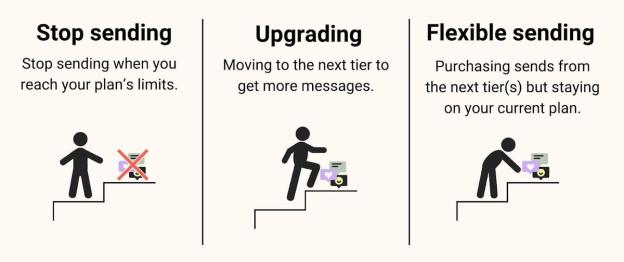
For Email and Mobile Messaging, you can choose what happens when you reach your usage limit:
- Use flexible overages to add the extra capacity between your current tier and the next tier for this billing cycle. The charge is based on your base plan’s unit rate.
- Upgrade (manually or via auto-upgrade) to a higher-tiered plan. Upgrading is generally more economical than flex sending if your upgrade needs are consistent.
- Stop sending on that plan until the next billing cycle.
For details, see the billing preferences section.
Helpdesk and Customer Agent
Helpdesk and Customer Agent plans are similar to Email and Mobile Messaging plans, but Helpdesk is based on tickets and Customer Agent is based on conversations.
For Service products, you can keep using the product when you reach your plan limit. When you purchase Customer Agent or Helpdesk, you commit to a minimum spend, with overages for additional usage.
There is a usage fee for exceeding your plan’s limits. When you purchase Helpdesk or Customer Agent, Flexible overages is the default billing preference for additional usage. You can change this preference to Automatically upgrade in Billing > Preferences.
You must be enrolled in either Flexible Overages or Auto-Upgrade in order to continue using Helpdesk and Customer Agent. If you wish to stop accruing overages for these products, you may turn Customer Agent or Helpdesk off within the product or cancel your plan(s).
Reviews
Review plans are similar to email and SMS plans, but are based on orders from your store rather than messages.
If your plan allows you 20 orders, you can send review requests for only those orders. When you reach your plan’s limit, you can either upgrade manually or pause sending review requests until your billing cycle renews.
Advanced Klaviyo Data Platform (KDP)
Advanced KDP plans are priced so that you pay based on the selected plan and for overages beyond that plan.
There is a usage fee for exceeding a plan’s limits. The fee is defined as: the number of profiles that exceed your current tier (in 1,000s) multiplied by the price per 1,000 profiles at the current tier.
Example of usage fee
Say that Funky T-shirts pays $4,765 per month for an Advanced KDP plan that allows 1 million profiles. The next month, their profile count grows to 1.52 million, exceeding their plan by 520,000.
Instead of forcing Funky T-shirts to upgrade to the next tier (2 million profiles at $9,100), they pay a usage fee that is:
- Number of 1,000 profiles that exceed the current tier: 520
X - Price per 1,000 profiles at the current tier: $4.77
= - Total usage fee: $2,480.40.
This means that between their plan ($4,765) and usage fee ($2,480.40), the total cost is $7,245.40. This is less than what Funky T-shirts would pay if they upgraded. Unlike with other products (where you pay before), this fee is billed after usage.
Generally, if you’re using less than 85% of the next tier up, it is more cost-efficient to incur the usage fee. Once you’re using 85% or more of the next tier, it’s better to upgrade.
The fee is applied to the next month’s invoice.
Marketing Analytics
Marketing Analytics plans are priced based on active profiles, so your plan automatically upgrades or downgrades based on the number of active profiles in your account at the end of your billing cycle. Your plan is automatically upgraded at the start of the next billing cycle.
Customer Hub
Customer Hub plans are priced based on active profiles, so your plan automatically upgrades or downgrades based on the number of active profiles in your account at the end of your billing cycle. Your plan is automatically upgraded at the start of the next billing cycle.
How to change plans
Note that if you're on the Advanced KDP plan and want to change to Marketing Analytics, you must cancel your Advanced KDP plan before you can add Marketing Analytics.
- Select your account name in the lower left.
- Click Billing.
- In Overview, select Change plan.
- Open the dropdown for the plan type you want to change.
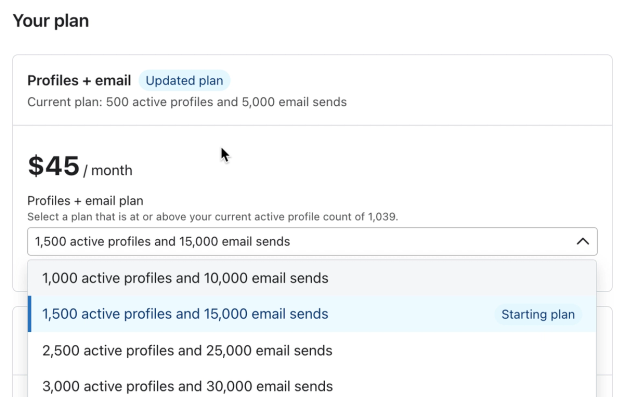
- Choose your plan.
- To downgrade your Profiles and Email plan, the lower plan must cover your active profile count.
- Click Continue to payment to review payment details.
- Review the amount due today, the monthly total, and your payment details. Click Confirm or Confirm and Pay to submit the plan change.
Klaviyo also provides several settings you can use to automatically switch plans:
Klaviyo setting | Available for |
* Automatically upgrade (also called auto-upgrade) | Mobile Messaging Email and profile Helpdesk Customer Agent |
Email and profile Mobile Messaging (paid plans of at least $490 on dollar-based pricing or $495 on credit-based pricing) Helpdesk Customer Agent | |
Email and profiles only when using flexible sending | |
Manually upgrade (the None option) | Email, Mobile Messaging, and Composer |
* Profiles and Email, Marketing Analytics, and Customer Hub plans are also automatically adjusted to cover active profiles. This profile enforcement is separate from the optional Automatically upgrade preference.
** Auto-downgrading based on profiles happens automatically for Marketing Analytics and Customer Hub, so it’s not a setting you can turn on or off.
You can switch between these options at any time.
How to choose a different upgrade/downgrade option
- Select your account name in the lower left.
- Go to Billing > Preferences.
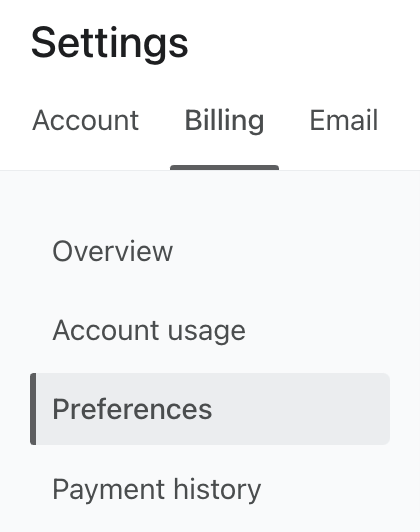
- Find the plan you want to change options for (e.g., email, Mobile Messaging, etc.).
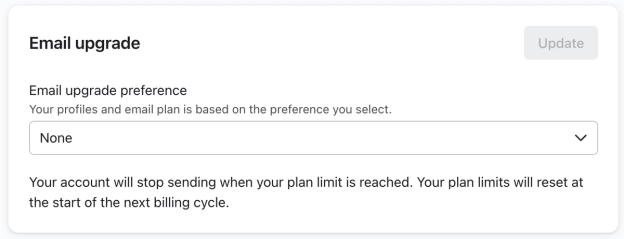
- Open the dropdown.
- Select one of the following options to change what happens when that plan type reaches its plan limits:
- None to stop sending or manually upgrade.
- Automatically upgrade to enable auto-upgrade.
- Flexible overages to flex plans.
- Note the cost associated with upgrading or flexible sending.
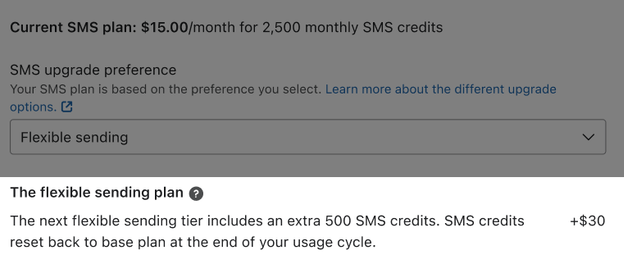
- Click Update to save.
Use flexible overages
Flexible sending is available for Email, eligible paid Mobile Messaging plans, Helpdesk, Customer Agent, and Composer. It is not available for Reviews, Advanced KDP, Marketing Analytics, or Customer Hub.
Flexible overages adds enough usage capacity to reach the next tier for the current billing cycle without permanently changing your base plan. For example, if the next email tier includes 10,000 more sends, a flex purchase adds those 10,000 sends. It does not increase your active profile allowance.
For plans billed in usage units, the flex charge is the additional capacity between tiers multiplied by your current unit rate. It is a 1-time purchase for the current billing cycle.
Flexing can cost more than upgrading because a higher plan can have a lower unit rate. For dollar-based Mobile Messaging plans, a flex purchase adds the difference in spend between your current plan and the next tier. Credit-based mobile plans add credits.
You can check how much it will cost to flex to the next tier before you send, either in the Billing Preferences tab or at checkout. After your purchase has taken place, you will receive an invoice with the charged amount.
Who is flexible overages best for?
Flexible overages is useful when you occasionally need extra sends or other usage capacity during the year and want to return to your original allowance in the next cycle. If you frequently exceed your usage limits, compare the cost with upgrading. Manage active profile limits separately.
Example of flexing up plans
Say that Funky T-shirts pays $7,000 for an emails and profiles plan that allows 7,000 profiles and 70,000 emails. However, next month is Black Friday/Cyber Monday, and they’ll need to send 80,000 emails.
Rather than permanently upgrade their account, Funky T-shirts can flex up:
- Plan cost ($7,000) / number of emails (70,000) = current unit rate (0.1)
X - Difference in the number of emails for next tier (80,000) and current tier (70,000) = 10,000
= - Flex cost: $1,000
When to upgrade vs. flex plans
Flexing is typically more expensive than upgrading. For plans billed in units, you buy the additional sends, credits, tickets, or conversations needed to reach the next tier at your current unit rate. Dollar-based Mobile Messaging adds spend instead. If you frequently flex, compare the cost with upgrading.
Flexing is better if you don’t consistently exceed your plan’s limits. It’s also good for anyone who doesn’t want to worry about remembering to downgrade.
Auto-downgrading based on profiles
Auto-downgrade is:
- Available for profiles plans only when using flexible sending
- Always on for Marketing Analytics & Customer Hub plans
You cannot auto-downgrade based on message sends.
You can enable auto-downgrade for your Profiles and Email plan in Billing > Preferences when using flexible sending. Near the end of your cycle, Klaviyo checks your active profile count and selects the lowest eligible paid tier that covers it. The downgrade takes effect for the next billing cycle.
Automatically upgrade based on usage (also called auto-upgrade)
Automatically upgrade is available for Profiles and Email, Mobile Messaging, Helpdesk, Customer Agent, and legacy credit-based Composer plans. It moves you to a higher tier when you exceed the plan’s usage capacity. The current Composer plan uses Flexible overages for additional capacity instead of auto-upgrade. Profile enforcement is separate and is based on active profile count.
Klaviyo automatically upgrades your plan based on profiles for the Profiles & Email plan as well as Marketing Analytics and Customer Hub plans. This is also known as Profile Enforcement.
Available to auto-upgrade | Not available to auto-upgrade |
Reviews | |
Mobile Messages (SMS & more) | Advanced KDP |
Helpdesk | |
Customer Agent |
This feature ensures you don’t hit monthly sending limits so that you can continue to send mobile messages, email, and automated flows unimpeded.
What happens when I’m automatically upgraded?
After you turn on auto-upgrade:
- When you either:
- Reach your plan's message limits (e.g., if your plan allows for 2,000 emails, but you try to send more).
- Schedule a campaign that will take you over your message limit for the current billing window.
- Auto-upgrade moves you to the next plan up.
Note: you can be auto-upgraded at any time in the billing cycle. - As soon as the account is upgraded, an email is sent to the owner informing them of this change.
- Once you're on this next level of plan, you will stay there until you choose to downgrade, upgrade, or are auto-upgraded. You will not be auto-downgraded.
When you upgrade, you pay the difference between your base plan (i.e., the plan you entered the billing cycle with) and the plan you’re upgrading to during that first month.
If you flex plans several times a year, compare the cost with upgrading. Upgrading can be more cost effective when you regularly exceed your limits.
Manually upgrade or stop usage: use the None option
To manually choose when to upgrade, or stop email or mobile sending when that plan reaches its usage limit, set its billing upgrade preference to None. Click your account name, then go to Billing > Preferences.
When that email or mobile plan reaches its usage limit, sending on that plan stops. You can resume by upgrading, purchasing eligible flexible capacity, or waiting for the next cycle. Review affected campaigns before rescheduling them.
For Composer, None stops additional usage when you reach your plan limit. You can add capacity through an available paid plan or flexible overages, or wait for the next cycle.
The None option is available for Email, Mobile Messaging, and Composer. It is not available for Helpdesk or Customer Agent.
Adjust credit card details
Klaviyo does not support multiple credit cards in a single account. If you purchase a plan with a different credit card than the one in your account, this changes the credit card on file. If your payment ever fails, the account Owner and billing contact will be alerted via email.
For details on changing the card on file, see how to update your credit card information. To view invoices and recent charges, open Billing > Payments & Invoices in the updated billing layout, or Billing > Payment history in the earlier layout.
Additional resources
- Understand Klaviyo's mobile messaging system
Learn about Klaviyo’s billing system for text messages, such as why countries and channels have different credit values and what’s included in these credits.
- How to find and update your tax ID in Klaviyo
Learn how to add and update tax ID in Klaviyo. After you add this information, you will be able to view your tax ID on all future billing invoices. Tax ID may be required in some cases.