Understanding manual billing
You will learn
Learn about manual billing (also called “Contract billing” or “Contracted accounts) with Klaviyo.
This article provides information on the most common contracts for manually billed customers; however, there may be exceptions. Contracts vary from company to company and not all information in this article may apply to your specific agreement.
Before you begin
Manual billing is not available to request from within Klaviyo. It is only available if:
- An Owner, Admin, or Manager contacts their success representative.
- Your Klaviyo plans total $2,000 or more per month.
Note that Klaviyo does not allow manual billing if you only need it for a temporary reason (e.g., waiting to receive a new credit card). There’s also no hybrid option with manual and automatic billing.
How manual billing works
When you are a manually billed customer, you have a contract that determines everything about your plans and billing information, including:
- Billing cycle (monthly, quarterly, semi-annual, annual)
- Usage cycle / period (monthly, quarterly, semi-annual, annual)
- Plan limits and usage
- Payment method & terms
- Overage rates and terms
This means manual billing may work differently for each customer.
Viewing plan limits
To view your plan's limits:
1. Select your account name in the bottom left.
2. Click Billing.
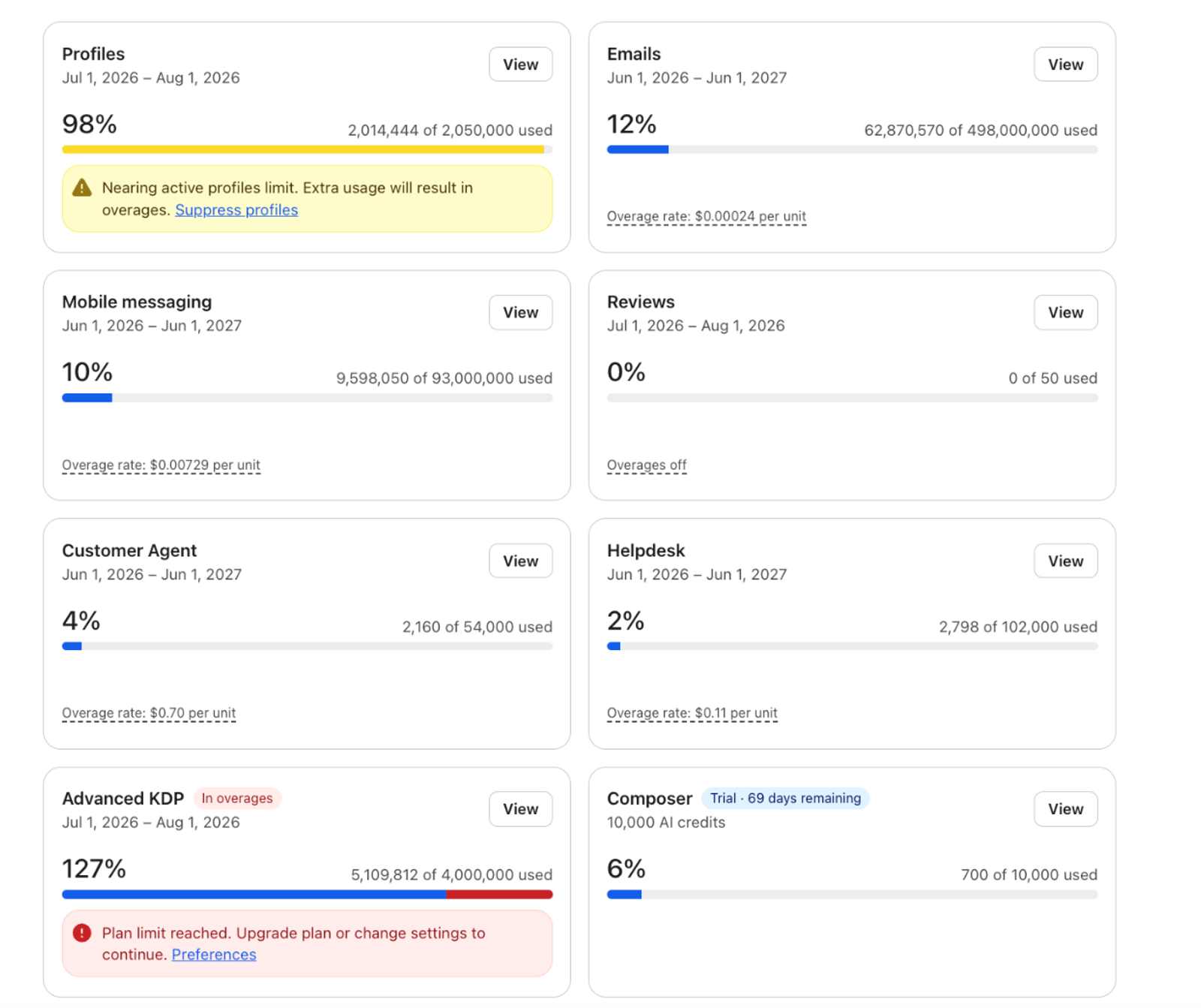
3. Review the Overview (Plans) tab to see your contract start and end dates, invoice schedule, contracted plan limits, and usage overages (if applicable), all shown per-product on individual usage cards.
Why can’t I change plans in Klaviyo?
If you want to change your contract to reflect a new plan and not incur overages, you will need to amend your contract. To do so, contact your success representative (e.g., CSM). Because your account is on a contract, you won't see a “Change plan” button on the Plans tab; instead, you'll see a notice that your account is on a contract, with a prompt to contact your Klaviyo representative.
Billing cycles
Note that billing cycles for manually billed customers are not necessarily the same as the plan usage cycle.
Plan limits and usage cycle
Plan limits for manually billed customers are determined by the contract:
- All invoices are based on the contract.
- Plan usage resets on the first of the month (for those who pay monthly), quarter (for those who pay quarterly), etc.
You can view your usage under Billing > Account usage. For more information, see our article on understanding your account usage.
If your contract does not include a certain product (e.g., Mobile Messaging, Reviews, Helpdesk), you are automatically on the free tier where available. To access other products, you’ll need to contact your Klaviyo success representative.
Your usage cycle runs on your contract's time zone
Unlike Stripe (credit-card) accounts, which reset usage on Eastern Time, manually billed accounts have a usage cycle that resets according to your contracted company's own time zone. If your usage seems to reset a few hours earlier or later than you'd expect, this is why.
Viewing historical usage
If you want to view your quarterly, yearly, etc. usage, click View on any plan card to open its historical usage view, where you can select a 3, 6, or 12 month range.
Payment options
Manually billed companies might pay in different ways, including:
• ACH
• Wire transfer
The payment method is defined in the contract.
Overages
Klaviyo allows you to keep using your plan and features when you need to exceed your plan limits so that you can use the product uninterrupted.
Your contract agreement pertains information for which products are subject to overages along with a CPM (Cost Per Mille) rate that you can expect to pay when you need additional usage. Most of our consumption-based products (Emails, Mobile Messages, etc.) are subject to overages when you exceed your limits.
For instance, say a customer is contracted to a $2,070 per month plan that allows for 1,700,000 emails. But monthly, that customer sent around 2,000,000 emails. In this case, the overage fee will apply to the 300,000 email difference. You'll see this reflected as a red overage badge on the product's usage card, and the red segment of its usage bar shows how far over the limit you are.
How to set overages
Overage preferences can be controlled via your Billing Dashboard.
What it is: A setting that lets manually billed accounts keep sending past their contracted limit, at a pre-agreed overage rate, instead of being cut off.
Why it's here: Similar to auto-upgrade for self-serve accounts, it means a busy month doesn't interrupt your marketing while you sort out a contract change with your Klaviyo representative.
What it lets you do:
- Turned on by default for most products.
- Applies to active profiles even without the setting enabled; email and SMS overages only accrue if the setting is on (see table below).
- Overages are billed at your contracted rate and limits, not a generic rate
Where to find it: Billing > Preferences (to turn on or off); Billing > Overview, on each product's usage card, to see whether it's currently active.
Note: Klaviyo’s Opt-in billing preferences (Auto-upgrade & Flexible Overages) are not available for manually billed customers.
Overages are turned on by default. See this section for details on turning off overages.
What products have overages?
The table below outlines where in your account you can accrue overages depending on whether you have overage setting enabled.
Without the overage setting | With the overage setting | |
Active profiles | ✔* | ✔ |
Email limits | ✖ | ✔ |
Mobile Messaging Limits | ✖ | ✔ |
Customer Agent Limits | ✖ | ✔ |
Helpdesk Limits | ✖ | ✔ |
Composer Limits | ✖ | ✔ |
*Even without the overage setting, your account can accrue active profile overages for a billing cycle.
Where to see your overages at a glance
In Settings > Billing > Overview , any product where you've exceeded your contracted limit shows an “In overages” badge directly on its usage card, along with your contracted overage rate (for example, “Overage rate: $X per unit”).
Products without overage flexibility, like active profiles, show “Profile compliance on” since profile overages always apply.
Click “Payment History” on the left menu to see additional views where you can see your per-unit overage rate and an estimated overage cost for the current cycle in one place.
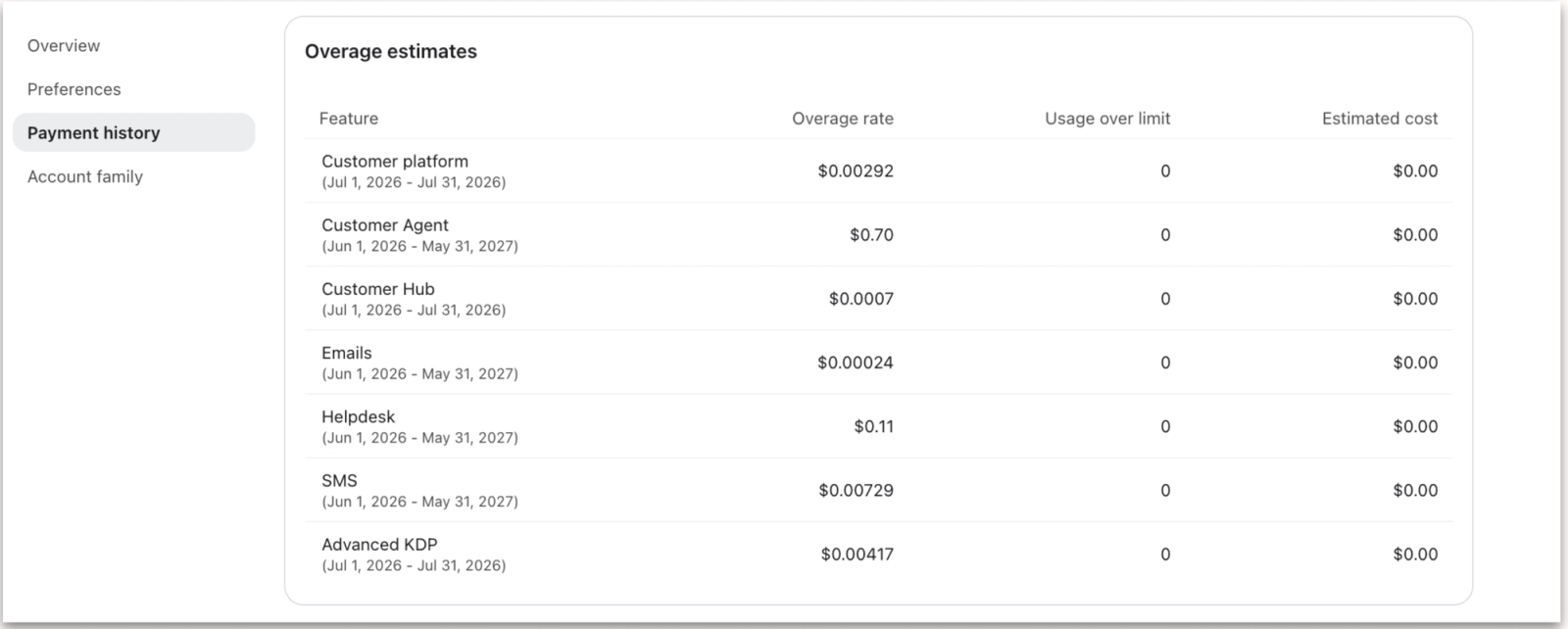
Overages are applied based on your contracted plan rates and limits. You must reach out to your Klaviyo representative if you would like to change your contracted plan.
Turning your overage settings on or off
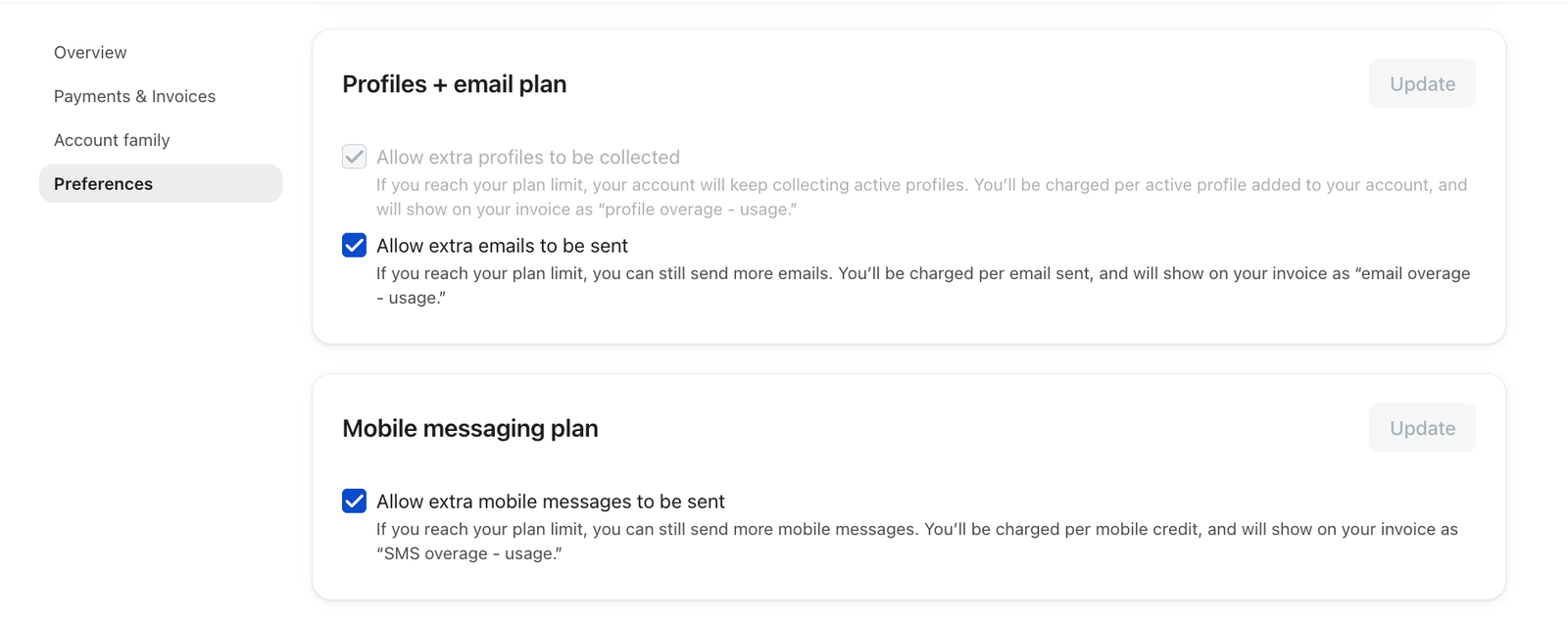
If you have disabled overages previously and now want the setting on, you can follow the same steps but instead check the boxes.
1. Click your account name in the bottom left corner.
2. Navigate to Billing > Preferences.
3. In the Plan overview section, uncheck the “Allow extra X to be sent” box for each product where you no longer want overages.
4. Click Update plan settings to save.
View invoices
View invoices Invoices for manually billed customers can be found under Billing > Payment & Invoices (this tab was previously called Payment history).
If you have an account hierarchy, then the invoice is on the primary or parent account. Because you're on a contract, you won't see the payment-method or cost-chart cards that Stripe customers see; instead, you'll see your contract terms, the overage rate and estimate panel, and your invoice history. You may view and download an invoice at any time.
Download the W9 form
All manually billed customers are provided with a W9. However, if you don’t have this form, you can download the W9 form here.
Additional resources
- Understanding your account usage
Learn how to review your account usage in Klaviyo. For all non-contracted accounts (including those using shared billing), the Account usage tab breaks down the usage of each plan for that account; e.g., how many emails and SMS you’ve sent.
- User management and privileges reference for Static User Roles
Learn about the different Klaviyo user roles, their account permissions and access, as well as their potential restrictions inside the platform. Depending on your role, the view of Klaviyo may look different. For instance, Owners see different account setting options than Admins do.
- How to set up single sign-on (SSO)
Learn how to set up single sign-on (SSO) for your Klaviyo account or portfolio. Currently, only identity provided (IdP) single sign-on is supported in Klaviyo.