Recommended SMS segments reference
Learn how to create SMS segments. Segmentation allows you to better understand your audience and send targeted messages in Klaviyo.
Why are these SMS segments recommended?
Just like any other channel, research shows that when you personalize and target your SMS messages to your recipient, it leads to higher engagement rates. And with higher engagement rates, there are more opportunities to generate revenue.
The following segments help you better understand your audience and message those most likely to engage with you. Depending on the segment, you may want to send only to this group or exclude it from a specific campaign.
All SMS subscribers
Creating an SMS subscribers segment gives you a high-level look at everyone currently opted in to text message marketing. Your subscribers may be spread across several lists or in multiple lists at once. A segment is the most accurate way to see everyone who is actively consented to SMS.
To build this segment, use If someone can or cannot receive marketing > can receive > text message marketing. Include this consent condition in every recommended segment you plan to send SMS marketing to, joined to the other conditions with AND. Past clicks, purchases, or replies do not replace current SMS consent. For setup instructions, see how to create a segment of SMS subscribers.

Highly engaged SMS segment
Similar to an engaged email segment, an engaged SMS segment allows you to target those who regularly interact with your content.
Require current SMS consent, then include anyone who has either subscribed in the last 30 days or clicked a text message in the last 90 days. Use Subscribed to Text Messaging Marketing for the subscription condition and Clicked Text Message for the click condition. Join these 2 activity conditions with OR, while keeping the consent condition required for both.
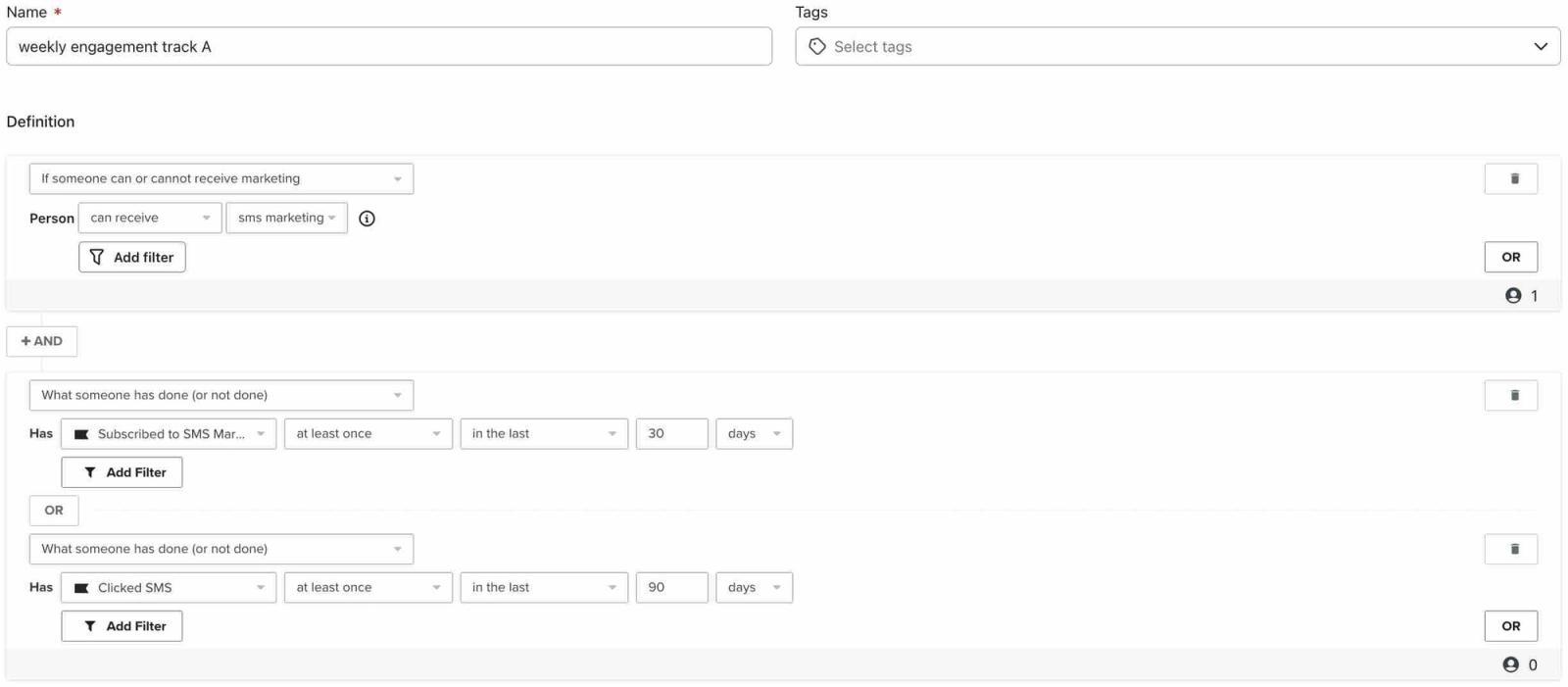
You can also use engagement tracks to create a sending schedule for your SMS content. For more information around measuring engagement and sending to different tiers, read our article on how to create a sending schedule based on SMS engagement.
Prefers SMS segment
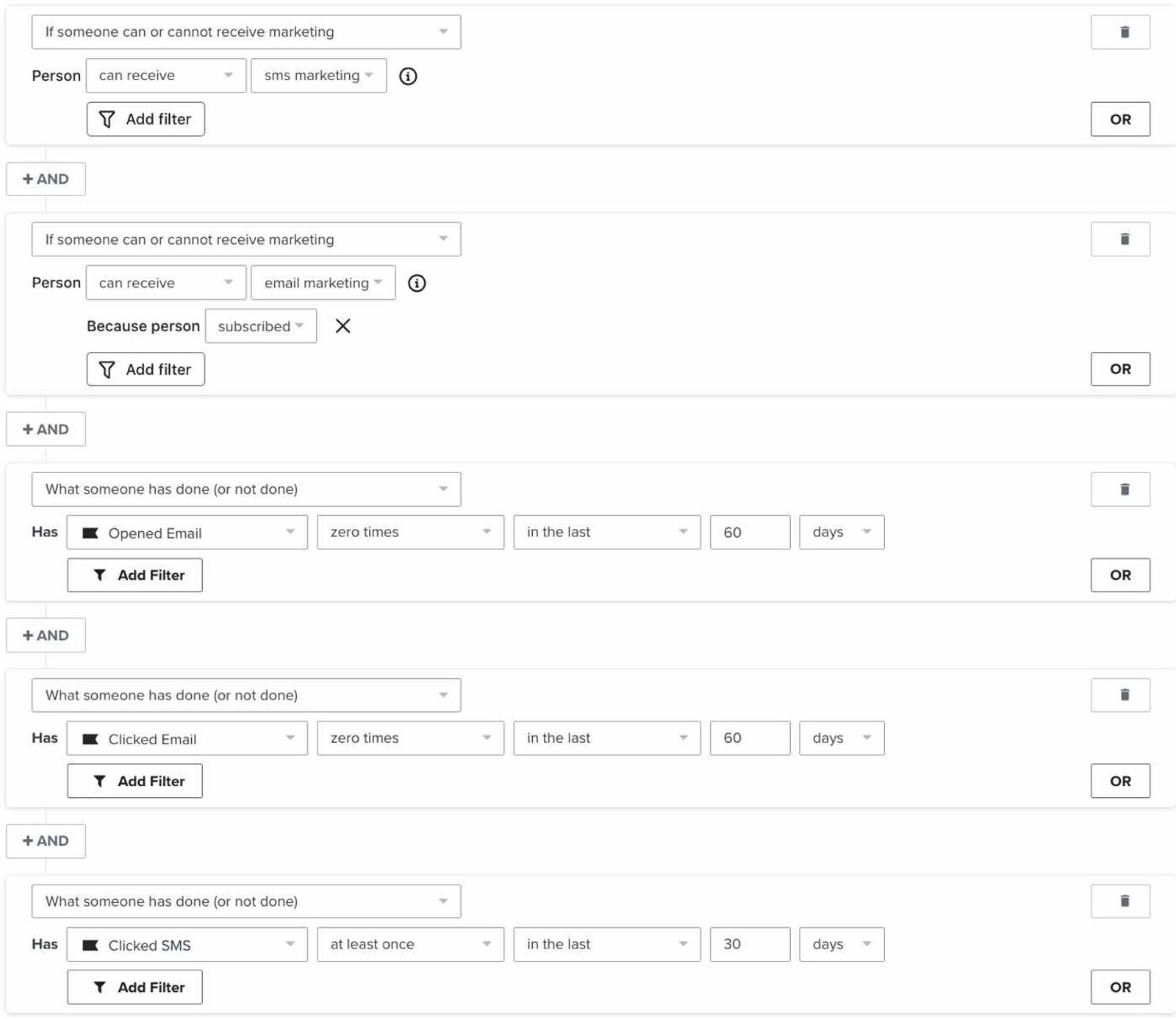
If you employ both SMS and email in Klaviyo, you may have subscribers who prefer one communication channel over the other. Create a segment using their direct behavior as conditions. In the example below, any profile who interacts with your SMS messaging often and has not recently interacted with your emails will be included. In your text messages, consider including copy that prompts these subscribers to re-engage with your email content with deals or special offers. Moreover, communicate any major updates via text (and potentially email as well) to ensure that these subscribers get that message.
SMS VIP segment
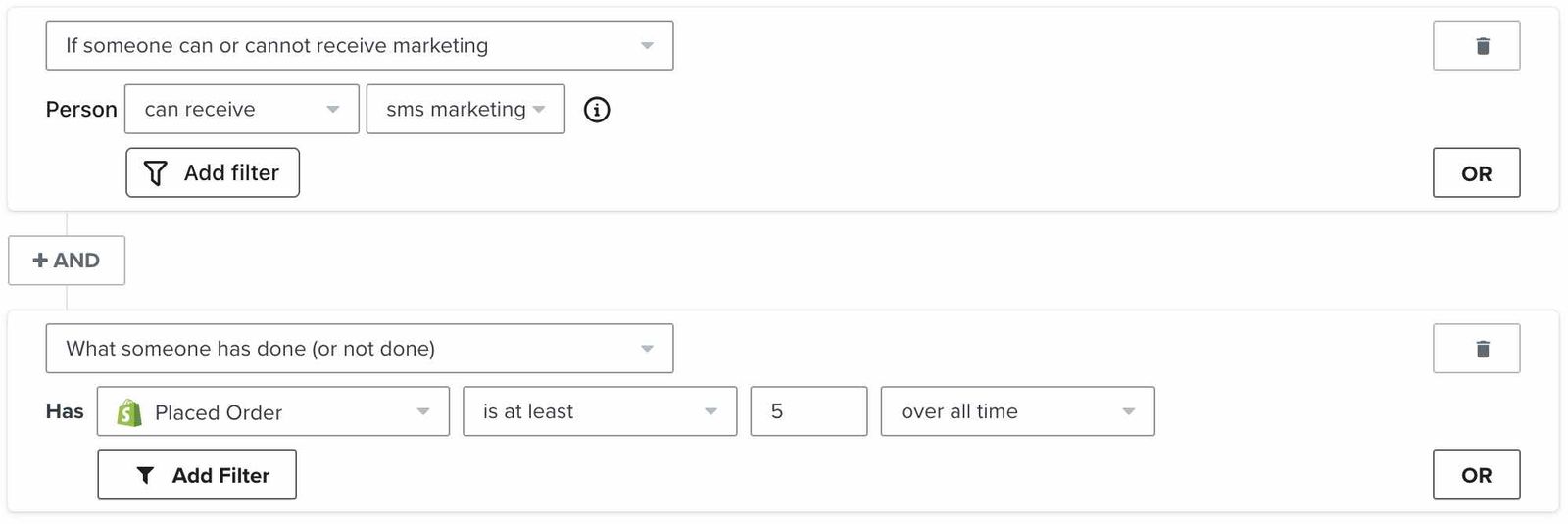
An SMS VIP segment allows you to hone in on your most valuable customers who have opted into SMS marketing. Send this group exclusive deals and promotions, and let them know that you appreciate their ongoing support. You can either build this from scratch or clone an existing email VIP segment and replace any email-consent condition with the SMS-consent condition above.
VIP criteria will look different in each account. Create a definition that best fits your business with regard to your product prices and customer buying cycle.
For more information on how to segment and target VIP customers, head to our Guide to running a VIP program.
High-intent SMS shoppers
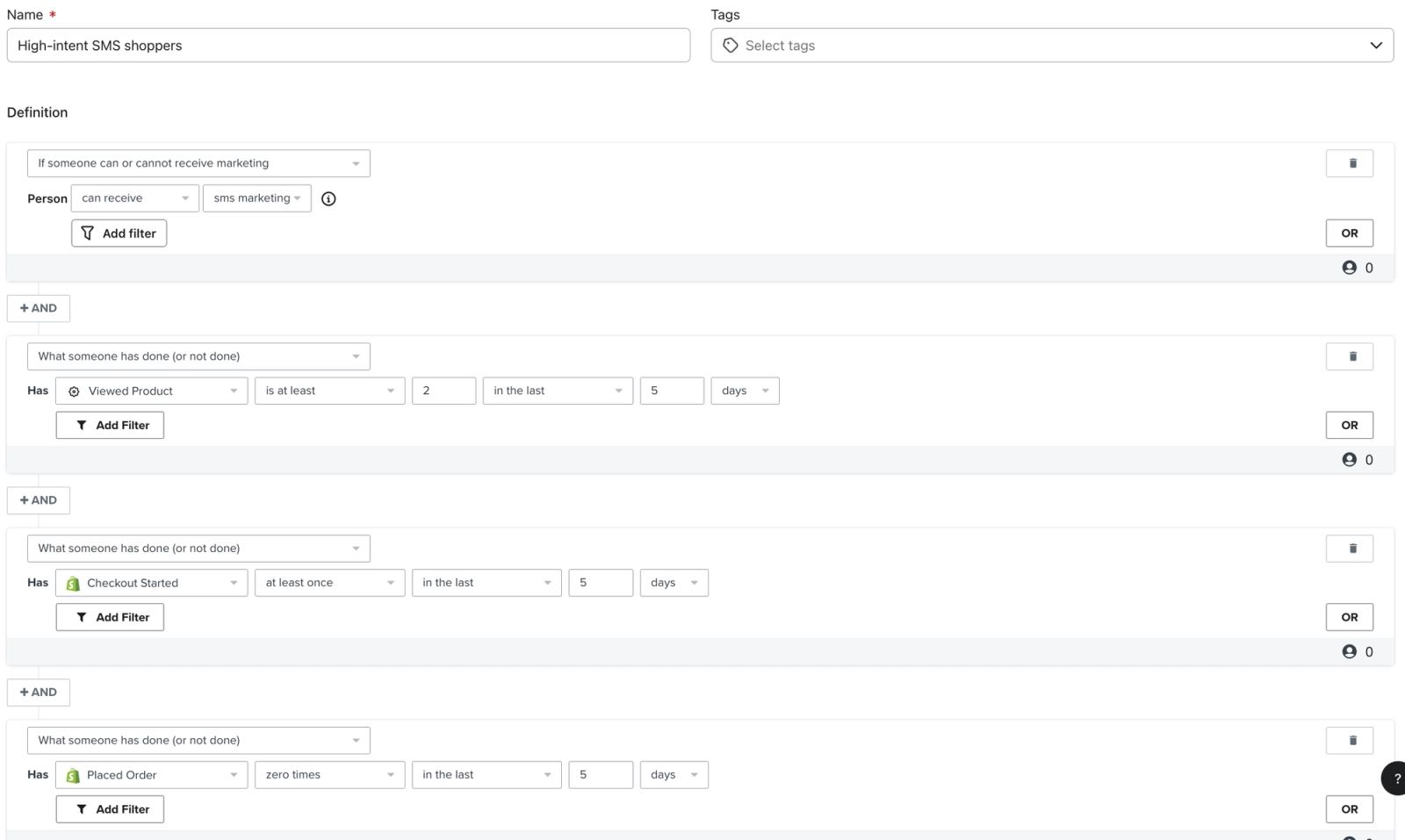
This groups anyone who has viewed products 2 times, has started to check out, but did not complete an order in the last 5 days.
Send this group an extra incentive to complete their purchase (remember that it should be different from the offer in your abandoned cart flow), show them customer reviews to build trust, or create a sense of urgency to encourage them to buy.
SMS location-based segment
A location-based segment allows you to focus your SMS marketing efforts on those within a designated geographic area. For example, if you are running an SMS campaign for an event at your brick-and-mortar location, you may only want to send a text to those who are within driving distance to that location.
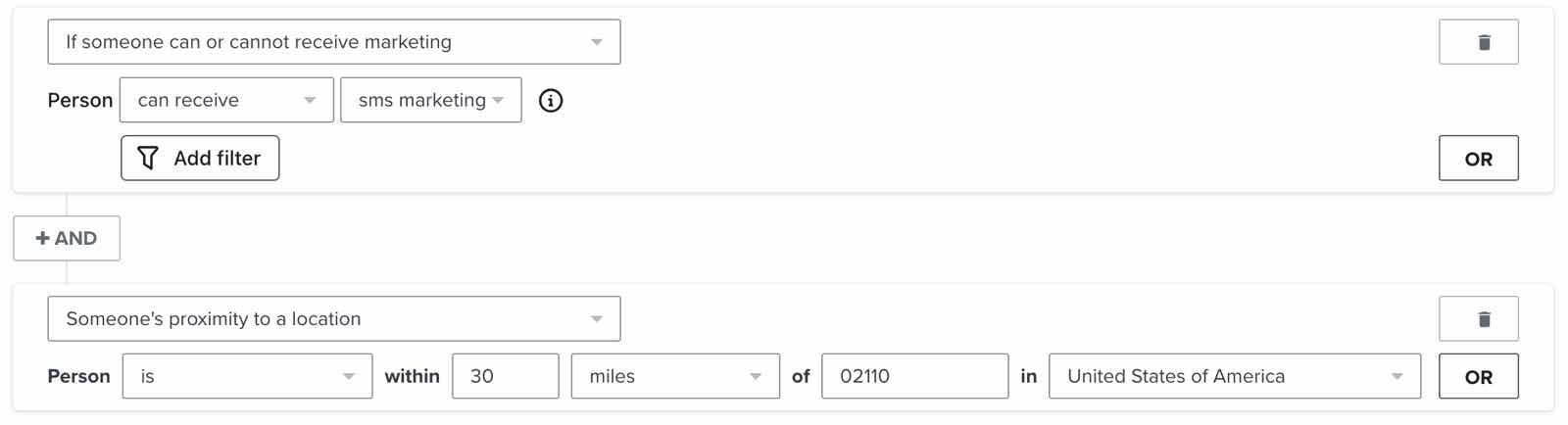
You can also segment your SMS subscribers based on their phone numbers’ country codes. For details, check out this article on segmenting SMS subscribers by country.
SMS budget shoppers
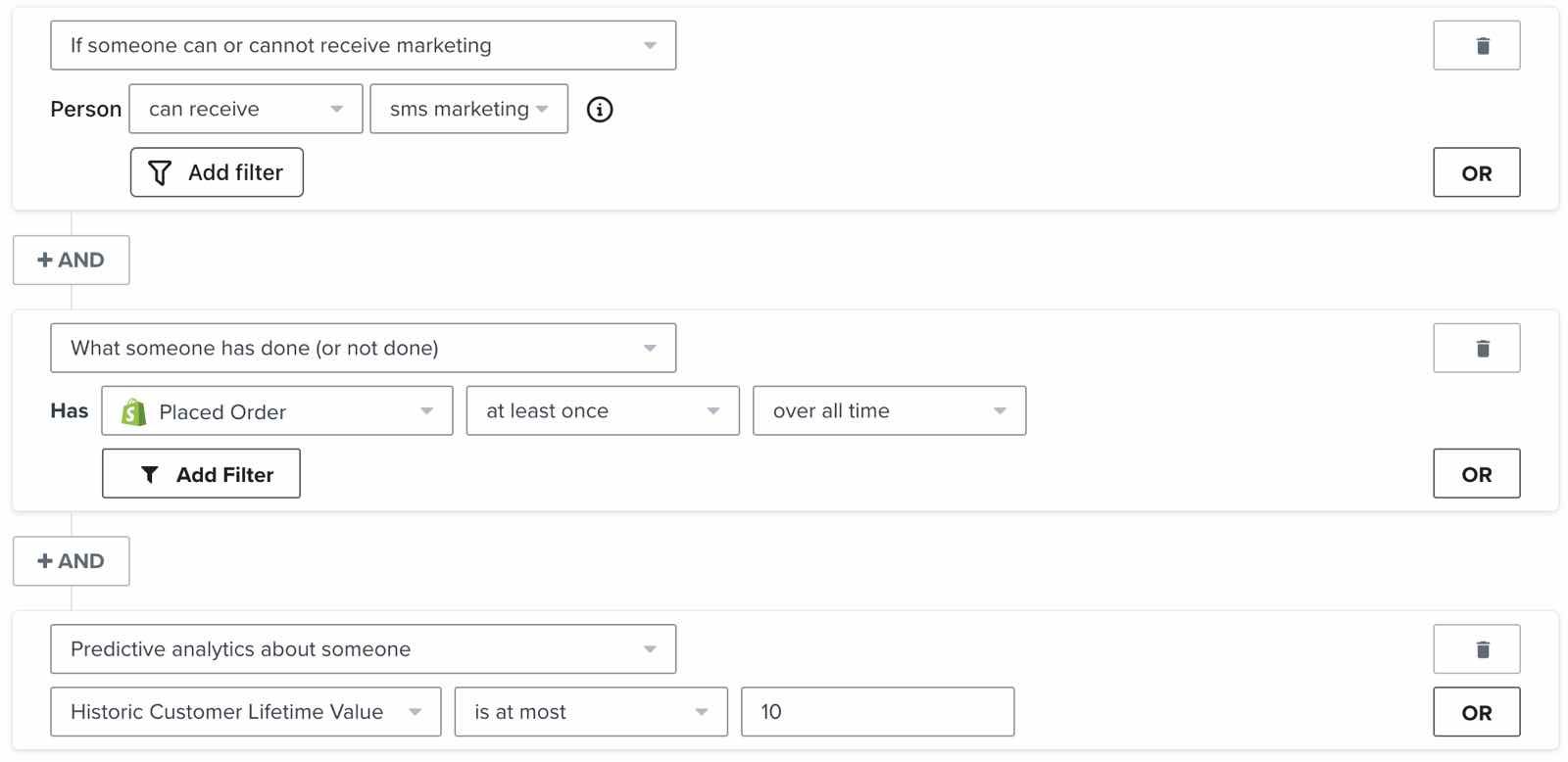
An SMS budget shoppers segment can help you target engaged SMS subscribers who have purchased from your store during sales. Use previous purchase history to identify this behavior. You can also test sale messages with subscribers who have low customer lifetime value (CLV). Predicted CLV estimates future spending. A low value alone does not show that someone is thrifty or frequently buys during sales. The example below targets SMS subscribers whose predicted CLV is at most $10. The amount you consider low will vary depending on your business and pricing. CLV conditions require enough order data in your account; check the requirements in the linked guide. If CLV is unavailable, use previous purchase history instead.
SMS marketing preference segment
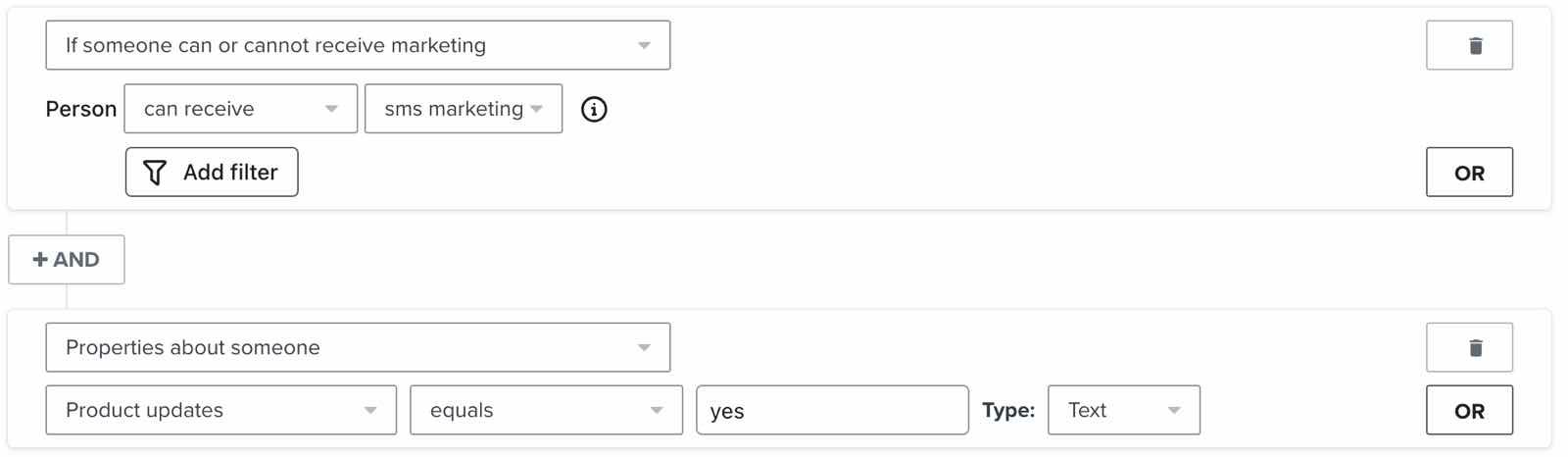
In some cases, you may ask SMS subscribers for the exact content that they want to receive from you. They may opt in to get messaging around events, flash sales, or new products. You can make each of these a profile property and then create segments for subscribers who only want to hear about specific announcements via SMS. In the example below, this segment will include those who want to hear about product launches via SMS.
Sent Text Message
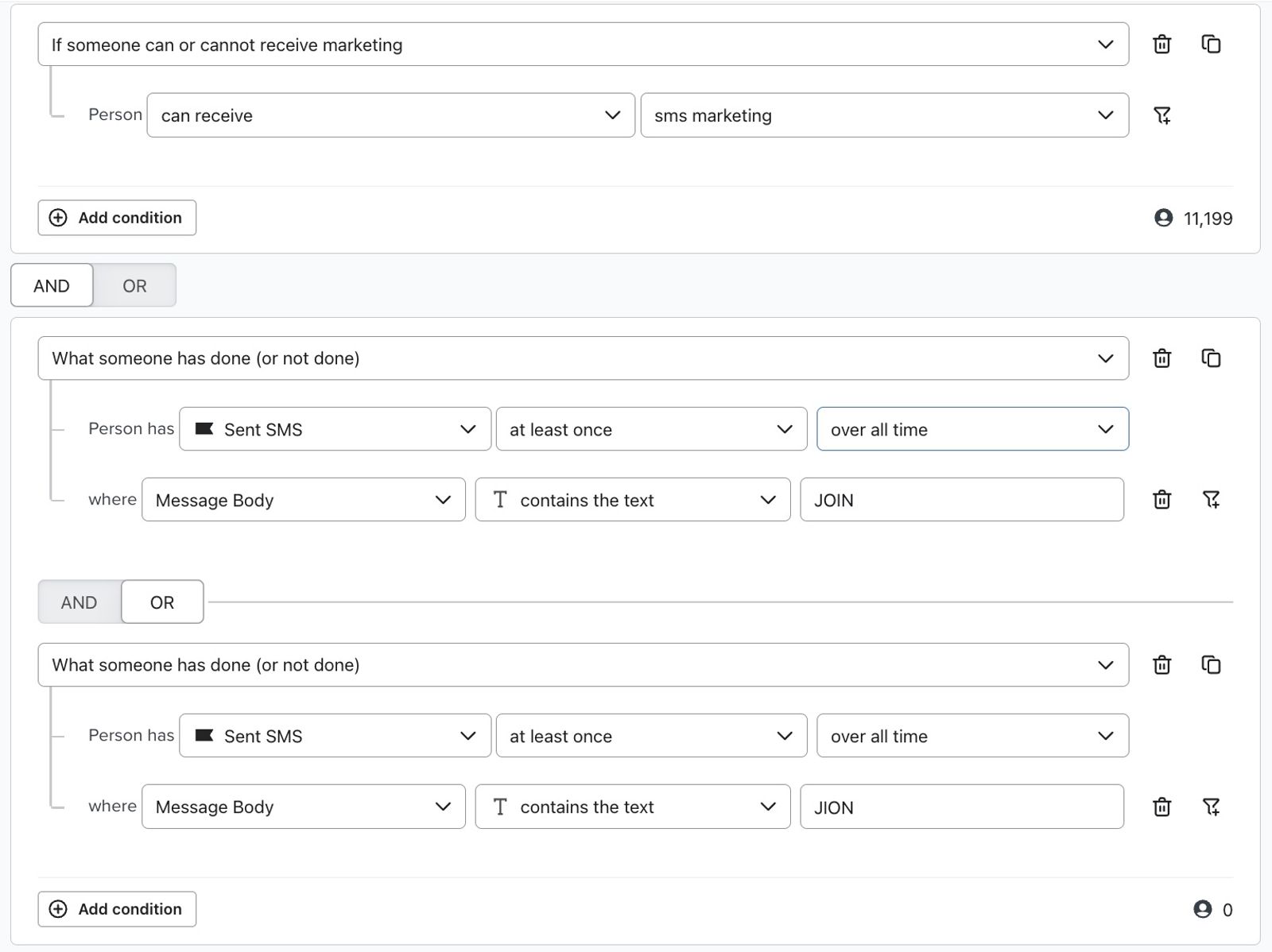
Use Sent Text Message with a Message Body filter to create segments based on words a subscriber texted your number. The word could be a custom subscribe keyword (e.g., JOIN) that tells you how subscribers found out about your SMS program. It can also be another word they texted, perhaps indicating their style preference or interest.
You can use flows to trigger when someone sends a certain word and add profile properties, or use a segment similar to the one shown below.
For an opt-in compliance keyword, use Subscribed to Text Messaging Marketing instead, and filter Message Body to the keyword. Use this distinction when creating keyword-based language segments as well.
When using this type of segment, please note the following:
- This segment is not available with branded sender IDs, as these numbers cannot receive SMS messages.
- You may want to include alternate spellings or misspellings of the word you want for the segment (as shown below).
SMS language-based segment
Knowing someone's preferred language means you can talk to them in the language they're most comfortable with. This means a better experience for the customer, which usually leads to more engagement for your SMS program.
There are a few ways you may know someone's language, including by:
- Collecting it as a profile property (via a form or from a flow)
- Basing it on the opt-in keyword someone used
- This includes both custom subscribe keywords and the opt-in compliance keyword
Using a profile property |  |
Using the opt-in keyword |  |
Received virtual contact card
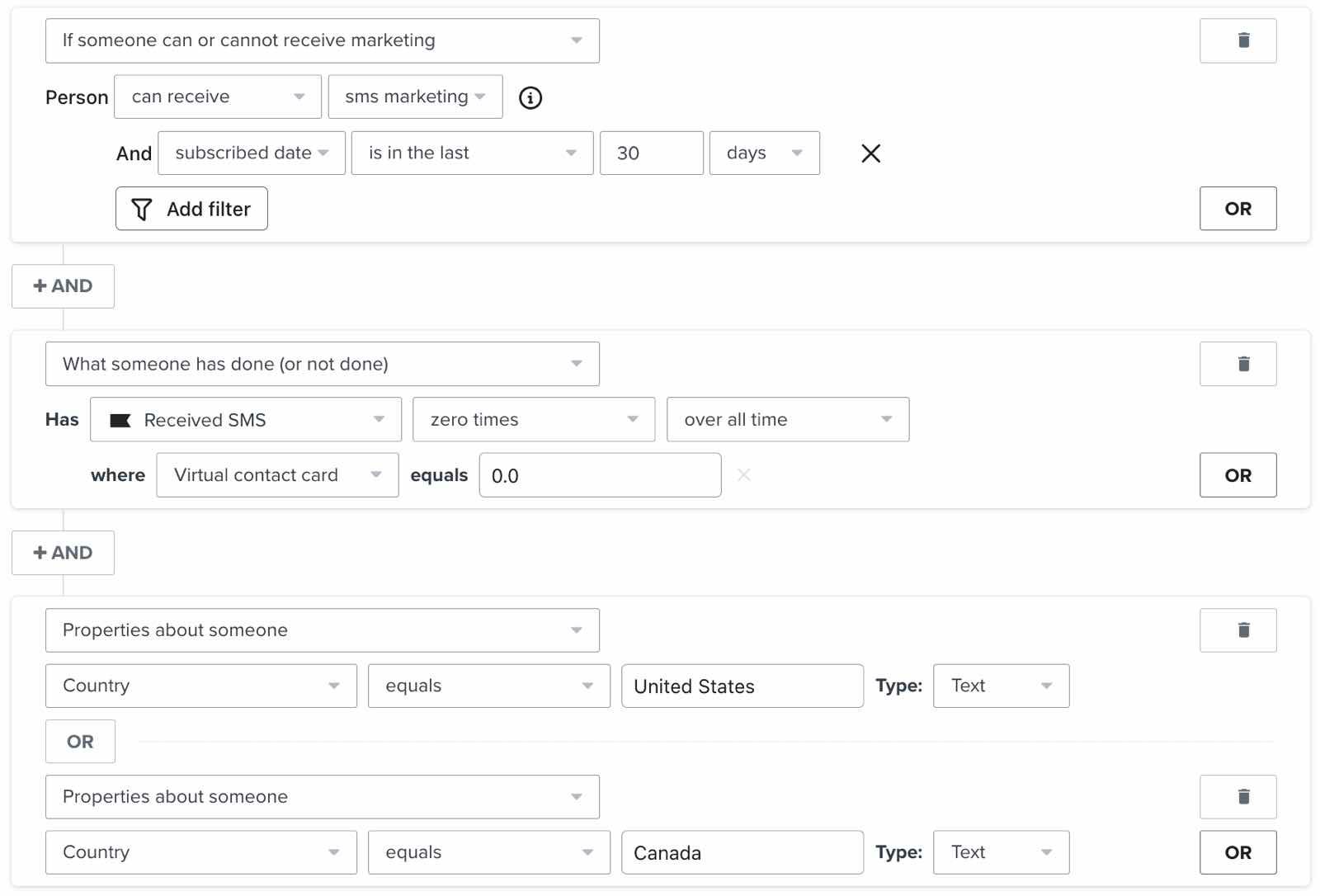
Use What someone has done (or not done) > Received Text Message and filter to messages where Virtual Contact Card is true. This identifies messages that included a contact card. To distinguish profiles who have and have not received one:
- Choose at least once and over all time to include profiles who have received a message with a contact card.
- Choose zero times and over all time with the same contact-card filter to include profiles who have never received a message with a contact card.
Virtual contact cards are MMS messages and can be sent to recipients in the US, Canada, and Australia using an MMS-capable sending number. Use an Australian long code for Australia. Branded sender IDs and Canadian short codes cannot send contact cards. Recipients in the UK or New Zealand cannot receive them.
We also recommend adding a condition that someone opted into SMS more than 30 days ago to reduce overlap with your welcome flow. Adjust this window to match the length of your welcome flow.
The example below shows how to set up a segment for those who didn't receive a virtual contact card.
Additional resources
- How to create a sending schedule based on SMS engagement
Learn how to create engagement tracks based on your sending schedule for your SMS subscribers.
- Getting started with SMS and MMS for the first time
- SMS marketing strategies for all levels [+12 Pro tips]