How to build a segment using RFM properties
You will learn
Learn how to use RFM values and customer groupings as properties in your segments. Using RFM properties in a segment is useful for creating segment-based recommendations in your marketing content. For example, you may want to provide discounts to some of your current At risk or Inactive customers, or use cross-selling content with customers in your Recent group.
For information on how to use RFM segments in campaigns or flows, head to our strategy guide.
Before you begin
Advanced KDP and Personalization are not included in Klaviyo’s standard marketing application, and a subscription or active trial is required to access the associated functionality. Head to our billing guide to learn about how to purchase these plans.
Your account also needs enough purchase data for RFM analysis. Check the RFM report requirements and setup before building your segment.
RFM profile properties
RFM analysis uses 3 profile properties. You can use all 3 in segments: the group properties identify customers by RFM group, and RFM group last changed lets you filter by when they changed groups.
Legacy property | Current property | What does it measure? | Additional considerations |
|---|---|---|---|
$current_month_rfm_group | Current RFM group | The RFM group the profile currently belongs to. | |
$previous_month_rfm_group | Previous RFM group | The most recent different RFM group the profile belonged to prior to their current RFM group. | Until a profile’s RFM group changes, their Previous RFM group will show as Unknown. |
N/A | RFM group last changed | Timestamp of when the profile transitioned from Previous RFM group to Current RFM group. This will only appear when a profile changes its RFM group. |
When RFM properties are first assigned, or when you change your RFM model settings, Previous RFM group is set to Unknown and RFM group last changed is cleared. These values update when the profile next changes RFM groups.
When profile properties refresh
RFM profile properties refresh every night. Saving changes to your RFM model settings also starts a profile-property refresh.
The RFM dashboard recalculates for the dates and settings you select separately from profile-property updates. You may see different numbers per RFM group in the dashboard and your segments while profile properties are updating.
Setting up a segment with RFM properties
To build a segment based on a current or previous RFM group:
- Navigate to Personalization > Customer insights, then select RFM analysis.
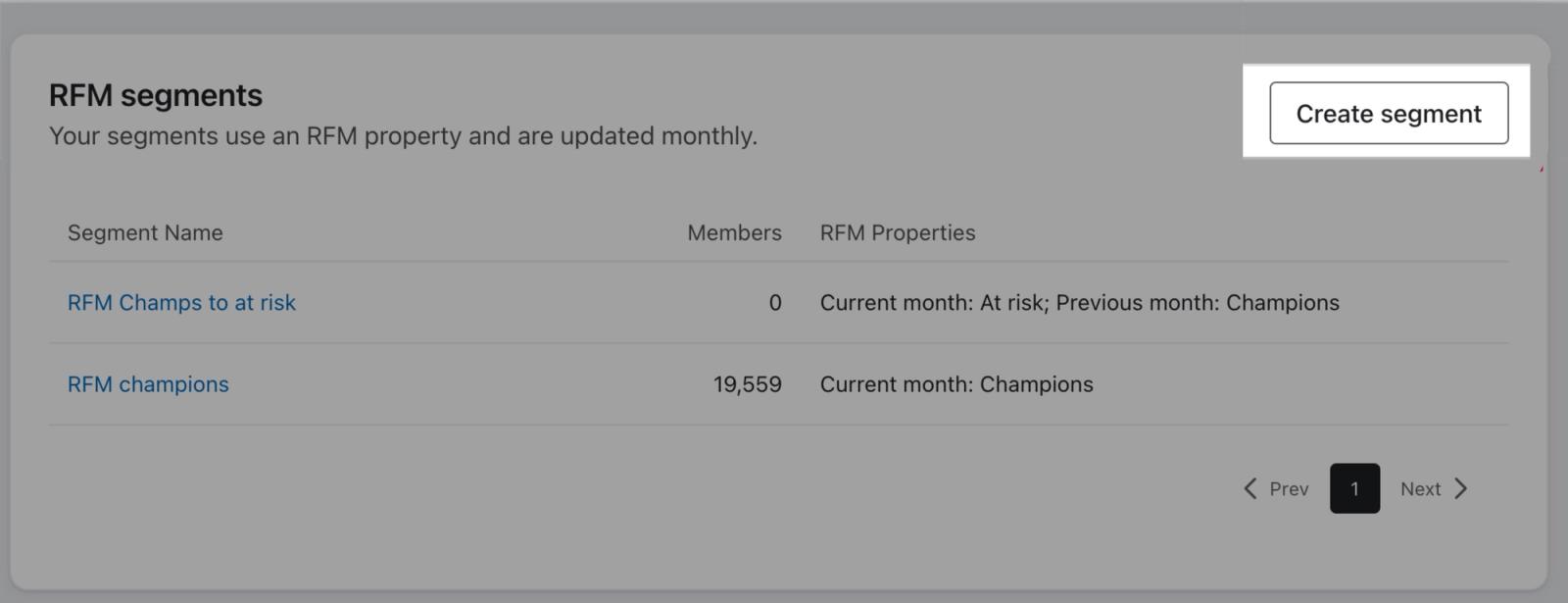
- Scroll to find the RFM segments card and click on Create segment.
If the card shows Generate segments instead, you can start your own segment from Audience > Lists & segments. Select Create > Segment. If a naming dialog opens, enter a name, add any optional Tags, and click Create segment to open the builder. Then continue below.
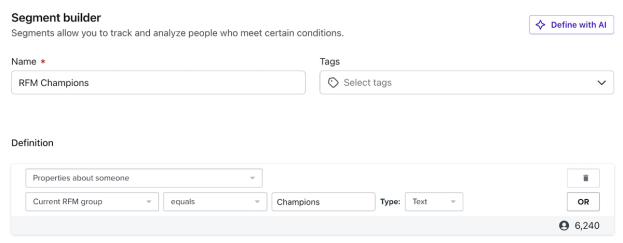
- In the segment builder, enter or review the segment name at the top.
- Choose Properties about someone as the segment condition.
- In the Property dropdown, choose one of the 2 RFM group properties:
Current RFM group
The RFM group the profile currently belongs to.
Previous RFM group
The most recent different RFM group the profile belonged to prior to their current RFM group. If the property names include an RFM model name, choose the properties for the model you want to use. - Choose equals to include a group or does not equal to exclude it. For example, select Current RFM group does not equal Champions to exclude the Champions group.
Learn more about segment conditions and how to use them. - In Value, select the RFM group you want to include or exclude. Leave Type set to Text for Current RFM group and Previous RFM group so the condition works correctly.
- To tailor the segment further, use AND or OR connectors. For example, to target both Inactive and At risk customers, join Current RFM group equals Inactive and Current RFM group equals At risk with OR. A profile only needs to match 1 of these conditions. Use AND when a profile must meet both conditions.
- Optional: To include only profiles whose group changed recently, add an AND condition using Properties about someone > RFM group last changed. Set Type to Date, select is in the last, and enter a time period, such as 30 days.
- Once your segment is complete, click Create segment.
Additional resources
- Getting started with the recency, frequency, and monetary (RFM) analysis report
Learn how to use the recency, frequency, and monetary values (RFM) report to gather deeper insights into your customers’ purchasing behaviors. The RFM report provides data on how recently a customer made a purchase, how frequently they purchase overall, and how much they generally spend on individual transactions. Klaviyo then brings this data together to determine what customer group (e.g., Loyal customers) a profile most aligns with. These insights are helpful as they can optimize your marketing strategies, including how you personalize messages, how you encourage repeat purchases, how frequently you message and when, etc. Additionally, for those customers or segments who may be at risk, you can use these insights to drive winback campaigns and reduce churn.
- Understanding scoring and customer groups in the recency, frequency, and monetary analysis (RFM) report
Learn how to understand the recency, frequency, and monetary scores and customer groups are derived in the RFM report.
- How to strategically use RFM properties in campaigns and flows
Learn how to use RFM (recency, frequency, and monetary) properties to target specific types of campaigns and content to your customer groups. Either by using the profile properties themselves or by using a segment with the RFM properties, you can tailor your marketing even further.