Understanding your push notification settings
You will learn
Learn about the push notification settings page, where you can set up push notifications for your mobile app, adjust Smart Sending, and configure universal links and App Links. You’ll also learn about the message settings available when creating a push notification campaign or flow.
Before you begin
If you haven’t already turned on push notifications in your account, read our guide on how to set up iOS push notifications or how to set up Android push notifications.
Want to request a feature for Klaviyo push notifications? Fill out this Google form to tell us about it!
View push notifications settings
- Click your account name in the bottom left corner.
- From the account menu dropdown, click Settings.
- Click Push notifications.
Enable iOS or Android push
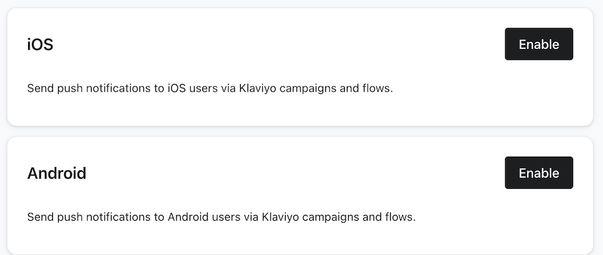
On the Mobile app settings page, you can view settings for your iOS and Android apps. To set up a platform, click Enable next to it and follow the corresponding setup guide above to add your credentials and click Save.
Smart Sending settings for push
Select Sender preferences under Push notifications to find your Smart Sending settings. If you see Smart Sending has moved, follow the Personalization settings link.
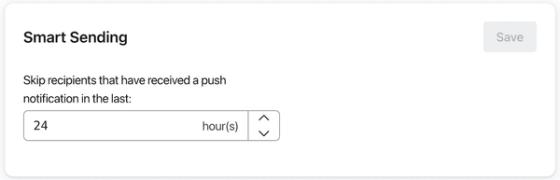
Smart Sending allows you to limit how often someone receives push notifications. The default window is 24 hours. You can set separate windows for previously received push campaigns and push flow messages.
- In Sender preferences, enter the number of hours in the Campaigns and Flows fields. If you followed the link to Personalization, find Push under When > Frequency limits and enter the number of hours under Minimum time between messages.
- In Personalization, to use different windows, click Define unique settings for campaigns and flows, then enter the Campaigns and Flows values. Otherwise, the single value applies to both.
- Click Save.
It is best practice to enable Smart Sending to ensure that customers are not overwhelmed with messages from your business, especially if you're sending emails, SMS, and push notifications.
Smart Sending is channel specific, meaning that push notifications have a separate Smart Sending window from SMS and email.
Universal links and App Links
On the Universal & app links page, you can set up special links in your email and text messages. Universal links and App Links direct your customers to content within your mobile app or - if the app isn't installed - to the same content on your website.
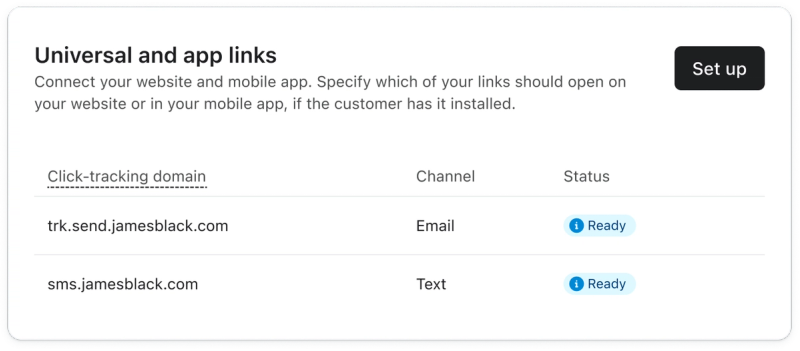
Before you start, configure the click-tracking domain for the channel you want to use and set up your app to handle universal links or App Links. You’ll need an apple-app-site-association (AASA) file even for an Android-only app, plus an assetlinks.json file if you support Android. These files associate your website domain with your app.
- Click Set up on the Universal & app links page.
- Enter your target domain, the website domain you plan to link to in your messages, then click Next.
- Upload your AASA file and, for Android, your assetlinks.json file. Click Save.
- Back on the settings page, check that each tracking domain you want to use is Active. If a domain is Ready, click Enable for that domain.
Read How to set up iOS universal links and Android App Links for full instructions.
Message settings for push notifications
The Behaviors tab includes these 5 settings for standard push notifications in campaigns and flows:
- Open action
- Show badge count (iOS only)
- Play sound (iOS only)
- Enable background processing (iOS)
- Custom data
For silent push notifications, only Custom data is available in this tab.
You can access these settings by going into the message editor and then clicking the Behaviors tab.
After adjusting your settings, click Next in a campaign wizard, Save and return in a campaign canvas, or Save & continue for a flow message.
Open action
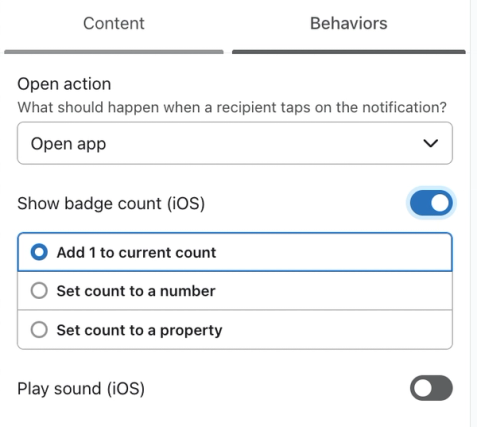
This setting determines what happens when someone taps on a push notification. There are 3 options:
- Open app
The app will open to the home screen (default). - Deep link
Tapping the notification will redirect the user to a specific page within your app. Learn more about deep linking. - Open external URL
A tap on the notification will redirect the user to a link outside of your mobile app. For example, the tap may open a web browser or create an email or text message. Supported schemes include https://, http://, mailto:, tel:, and sms:.
Show badge count (iOS)
Badge count, also called the notification badge or unread count, shows a number on the app icon. Typically, it’s the number of notifications an app has received since the last time it was opened.
Show badge count is a push notification setting that displays when creating a campaign and flow message. This setting only applies to iOS apps, as Android automatically increases badge count for new notifications. Note you must be on Klaviyo's Swift SDK version 4.1.0 or higher to access this feature.
When sending a push notification to an iOS device through Klaviyo, there are 3 options you can use to set the badge count. Open the dropdowns to learn about each.
Add 1 to current count
This option increases the current badge count by 1. So, if the app’s current count is 2, it becomes 3.
Set count to a number
For this option, choose a whole number from 0 to 999,998. For instance, if the current badge count is 1, you can set it to 10. Avoid 999,999: although the editor accepts it, the notification uses 1 instead.
Set count to a property
Choose a profile property, or an event property for a flow, that contains a whole number from 0 to 999,998. For instance, you can show the number of products in someone’s cart in an abandoned cart flow. If the property is missing, is not a valid whole number, or is outside this range, the notification uses a badge count of 1.
Play sound (iOS)
When turned on, this setting means a sound plays when the push notification is delivered to the subscriber’s phone.
Klaviyo requests the default iOS notification sound.
Enable background processing (iOS)
When enabled, Klaviyo will set the content-available flag to 1 for iOS notifications. Your app must be configured to handle background notifications so it can refresh data or perform other tasks when iOS gives it time to run.
Enabling this setting does not make a standard push notification silent or hide it from the recipient. To send a silent push notification, open the Content tab and set Type to Silent, and Klaviyo will automatically add the content-available flag to the notification.
Apple treats silent background notifications as low priority and does not guarantee their delivery. A standard notification with background processing enabled still includes a visible alert. See Apple’s guide to Pushing background updates to your app. Test background processing on a real device before using it in a live campaign or flow.
Custom data
Turn on Custom data to include up to 10 key-value pairs with a standard or silent push notification. Your app must be configured to recognize the keys and act on their values. Learn more about key-value pairs.
Additional resources
- How to set up Android push notifications
Learn how to set up push notifications for Android in your Klaviyo account. After you've completed the steps in this article you'll be able to send push notifications in your flows and campaigns.
- How to set up iOS push notifications
Learn how to set up push notifications in your Klaviyo account. After you've completed the steps in this article you'll be able to send push notifications in your flows and campaigns.
- How to send a push notification campaign
Learn how to use Klaviyo to send push notification campaigns via your iOS or Android app.
- How to set up iOS universal links and Android App Links
Universal links (for iOS) and App Links (for Android) direct your customers to content within your mobile app or, if the app isn't installed, to the same content on your website. Using these links in email and text messages allows you to use consistent URLs across all your marketing channels while creating a seamless experience for your customer, no matter their device. It's similar to traditional deep linking, but with additional functionality.