How to verify that new contacts are being added to a list
You will learn
Learn how to verify that contacts are being added to your list.
Growing your list is one of the most important steps in getting set up for success with Klaviyo. With onsite tracking set up and visitors identified, you can collect data about their browsing activity, like what items they’ve looked at on your site, even if they’ve never made a purchase. This helps you send more targeted messages.
Determine how you collect new subscribers
Common ways to add contacts to a list include:
- Sign-up form
- Subscribe page
- List (CSV) upload
- Quick add
- Copy / paste from Excel
Uploading a CSV is a common way to get existing contacts into your Klaviyo account when switching from another service provider. After this initial setup, you can collect new subscribers using a subscribe page or sign-up form.
Klaviyo has 5 types of built-in web sign-up forms:
- Popups
- Flyouts
- Full page forms
- Embeds (usually in the header or footer of your site)
- Banner forms
Contacts who sign up only for transactional SMS are not added to a list by that signup.
Klaviyo’s built-in subscribe pages can be embedded as a page on your site or hyperlinked to in an email, ad, QR code, etc.
Klaviyo also integrates with a number of third-party list growth tools that you may choose to use instead.
A profile can exist in your Klaviyo account without belonging to the list you are checking. List membership alone also does not confirm that someone has consented to email or SMS marketing.
Verify that new subscribers are being added to a list
To view list members:
- Click Audience in the Klaviyo sidebar.
- Choose Lists & segments.
- Click your list (e.g., Newsletter) to open it.
Make sure to choose a list, not a segment.
The Members tab shows the newest list members first. You can change the order using the Date added column. Please note that if you upload a CSV or copy/paste from an Excel spreadsheet, the upload dates will be the same for all contacts.
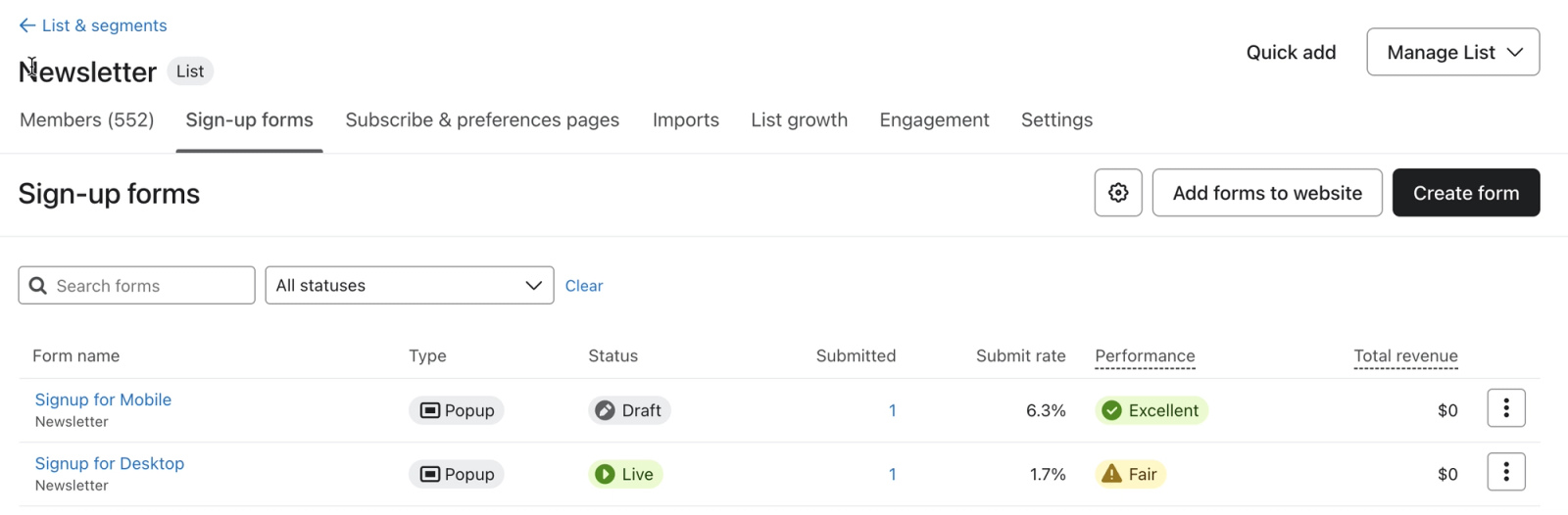
Check your list’s opt-in setting under Settings > Consent. If the list uses double opt-in, new email subscribers must confirm their subscription before being added. To learn about the opt-in process and how to change the setting, see our guide to the double opt-in process.
For SMS, follow the confirmation instructions shown during signup. Smart Opt-in uses a one-time code. For signups using branded sender IDs, reply-based double opt-in is skipped because these numbers cannot receive replies.
You can test that new subscribers are being added to your list from a sign-up form or subscribe page by signing up yourself. Before testing, check that the form or subscribe page is connected to the list you are checking.
- Submit the sign-up form or subscribe page using an email address or phone number you can access that is not already subscribed or on the list.
- Complete any confirmation requested, such as clicking the confirmation email link, replying to the confirmation text, or entering the one-time code.
- Reopen your list’s Members tab and look for your test profile. If it appears, the sign-up method you tested is adding contacts to that list.
Additional resources
- Understanding the double opt-in process
Learn the difference between single and double opt-in, why double opt-in is important for both SMS and email, and how to update the opt-in settings for a list or keyword in Klaviyo.
- How to create a never engaged segment
Learn how to identify your least engaged email subscribers, so you can avoid contacting them to improve and maintain your deliverability. Once you’ve identified them, consider excluding them from your marketing initiatives, sending them one final re-engagement attempt, or suppressing them during list cleaning. In this article, you will learn how to create this segment.
- Understanding the benefits of having a main list for each marketing channel
Learn about the benefits of using one main list per marketing channel (e.g., SMS and email) and how to organize your lists in Klaviyo. Additionally, see the tools you can use to identify and target subscribers based on their behavior or how they subscribed.