Understanding scoring and customer groups in the recency, frequency, and monetary analysis (RFM) report
You will learn
Learn how recency, frequency, and monetary scores and customer groups are derived in the RFM report.
Advanced KDP and Personalization are not included in Klaviyo’s standard marketing application, and a subscription is required to access the associated functionality. Head to our billing guide to learn about how to purchase these plans.
For more information about building and customizing your report, head to our guide on getting started with the RFM report.
Before you begin
To qualify for this report, your account must:
- Have at least 500 customers who have placed an order.
This does not refer to total profiles, but rather the number of people who have actually made an order with your business. A profile without a purchase for the selected conversion metric and time frame is not assigned an RFM group.
- Have an ecommerce integration (e.g., Shopify, BigCommerce, Magento, etc.) or use the Klaviyo API to send placed orders.
- Have at least 180 days of order history and have orders within the last 30 days.
- Have at least some customers who have placed 3 or more orders.
The customer counts and order-history requirements apply to the conversion metric and time frame selected for your RFM model.
Only Owners, Admins, Managers, and Analysts can access this report. Additionally, if you have created a new custom metric to use in your RFM report, it may take up to 48 hours for this change to be reflected in your data.
RFM definitions
RFM metrics are common terms used in marketing and data strategies. Within Klaviyo, they are defined and calculated as the following:
- Recency
How long ago a customer purchased from your company. Recency is expressed as the elapsed time (measured in the number of days) since a last purchase within your report’s time frame. - Frequency
How often a customer purchases from your company within your report’s time frame. - Monetary value
How much a customer has spent with your company within your report’s time frame.
To review the definitions and scoring thresholds for your RFM model:
- Go to Personalization > Customer insights > RFM analysis.
- Select a model under RFM scoring model and click Edit (or View if you have read-only access).
- Open Recency definitions, Frequency definitions, or Monetary value definitions.
Understanding percentiles, scoring, and customer groups
Percentiles and scoring
Klaviyo assigns each customer a score of 1–3 for recency, frequency, and monetary value, using the selected model’s conversion metric, time frame, and scoring thresholds. Higher scores mean a customer purchased more recently, purchased more frequently, or spent more.
Klaviyo only looks at orders with a positive value. If an order is free (e.g., has a 100% discount), it is not considered in the RFM analysis.
By default, recency uses thresholds of 180 and 365 days. Frequency and monetary value use thresholds based on the 33rd and 66th percentiles of your customer data. You can customize these thresholds for each model, so check your model’s settings when interpreting its scores.
- Recency scoring
- Customer’s most recent purchase was within the last 180 days: score of 3
- Customer’s most recent purchase was more than 180 days ago, but within the last 365 days: score of 2
- Customer’s most recent purchase was more than 365 days ago: score of 1. This indicates a long gap since their last purchase.
- Frequency scoring
- At or above the higher purchase-count threshold, based on the 66th percentile: score of 3
- At or above the lower purchase-count threshold, based on the 33rd percentile, but below the higher threshold: score of 2
- Below the lower purchase-count threshold: score of 1
For example, if the purchase-count thresholds are 2 and 3, a customer with 1 purchase receives a score of 1, 2 purchases receives a score of 2, and 3 or more purchases receives a score of 3. These counts are an example, not fixed requirements for every model.
- Monetary scoring
- At or above the higher spending threshold, based on the 66th percentile: score of 3
- At or above the lower spending threshold, based on the 33rd percentile, but below the higher threshold: score of 2
- Below the lower spending threshold: score of 1
Percentile thresholds are converted into purchase counts or spending amounts. Customers with the same value receive the same score, so the scores do not necessarily divide customers into equal thirds.
Customer groups
Once a score is determined for each RFM metric, these scores are brought together to determine the customer group.
The model below visualizes how these 3 scores are blended together to determine your potential customer buying group. All RFM metrics and their scores (1-3) can be visualized on this cube and where they fall within each of its sides or quadrants. For example, the top green corner of the model illustrates a customer who has earned the top score of 3 for all RFM metrics.
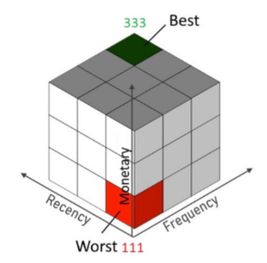
Once Klaviyo brings these 3 scores together, they are then categorized and lined up to a customer group. This customer group describes their present buying habits and is a helpful way to understand which customers are repeat buyers, who may need a nudge for future purchases, who is potentially a churn-risk, etc. The chart below illustrates this logic including:
- Customer group name
- Groups split (i.e., what individual RFM scores contribute to this group)
- General description of the customers in this group
- Suggested actions for this customer group
To check the scoring thresholds behind your customer groups, select the model under RFM scoring model in the RFM report and click Edit (or View if you have read-only access). Use the table below as a reference for the group definitions and score combinations.
Group name | Possible score breakouts (listed from left to right in RFM order) | Description | Examples of potential actions/strategies for this group |
Champions | 333, 332, 323 | Your best customers |
|
Loyal | 321, 322, 331, 232, 233 | Valuable customers that are engaged They purchase repeatedly and have a recency score of 2 or 3. Their monetary score can range from 1 to 3. |
|
Recent | 312, 313, 311, 222, 223 | Recent customers |
|
Needs attention | 213, 221, 123, 132, 133 | A valuable customer that has not purchased recently They may have spent a lot or bought frequently in the past, but have not purchased recently. |
|
At risk | 231, 212, 122, 131, 211 | A customer who has not purchased recently and has a low or medium spending score |
|
Inactive | 111, 112, 113, 121 | A lapsed customer | Try a winback campaign to re-engage them. Offer them an exclusive promotion or coupon (especially time-limited promotions). If they are unengaged (especially if they do not interact with your winback or promotional emails), consider list-cleaning and removing them before they harm your deliverability. |
Additional resources
- Getting started with the recency, frequency, and monetary (RFM) analysis report
Learn how to use the recency, frequency, and monetary values (RFM) report to gather deeper insights into your customers’ purchasing behaviors. The RFM report provides data on how recently a customer made a purchase, how frequently they purchase overall, and how much they generally spend on individual transactions. Klaviyo then brings this data together to determine what customer group (e.g., Loyal customers) a profile most aligns with. These insights are helpful as they can optimize your marketing strategies, including how you personalize messages, how you encourage repeat purchases, how frequently you message and when, etc. Additionally, for those customers or segments who may be at risk, you can use these insights to drive winback campaigns and reduce churn.
- How to build a segment using RFM properties
Learn how to use RFM values and customer groupings as properties in your segments. Using RFM properties in a segment is useful for creating segment-based recommendations in your marketing content. For example, you may want to provide discounts to some of your current At Risk or Inactive customers, or use cross-selling content with customers in your Recent group.
- How to strategically use RFM properties in campaigns and flows
Learn how to use RFM (recency, frequency, and monetary) properties to target specific types of campaigns and content to your customer groups. Either by using the profile properties themselves or by using a segment with the RFM properties, you can tailor your marketing even further.