How to clean SMS lists
You will learn
Learn about list cleaning for SMS, including why list cleaning is important, how to list clean, and when to clean your lists.
List cleaning for SMS revolves around making sure that you are sending to profiles that are actually able to receive your texts. SMS message delivery can fail for a number of reasons, and it is important to exclude profiles consistently experiencing errors from your usual sends. Once a profile is unable to receive a message for an extended period of time, you can consider removing SMS consent from their profile.
Why clean SMS lists?
Wireless carriers don’t evaluate your SMS performance like email providers do, meaning list cleaning doesn’t hold the same weight for SMS as it does for email.
As long as you have consent from a profile, you can continue to send them SMS messages. However, make sure to include a way to opt out regularly (i.e., at least once a month) so anyone who wants to unsubscribe can do so.
These requirements may vary according to local legislation in different countries.
However, there are times when you might want to unsubscribe profiles from SMS. Specifically, it’s a good idea to unsubscribe profiles who simply aren’t receiving SMS messages over a period of several months.
It’s a best practice to keep your list clean from profiles experiencing delivery errors for 2 main reasons:
- Better SMS deliverability
Sending to profiles already experiencing errors can be viewed negatively by carriers and cause them to block your sends. - More efficient use of your SMS spend
Sending to profiles that are experiencing errors still uses your available spend, but they may not be able to receive your messages.
How to clean an SMS list
The best way to list clean for SMS is:
- Create an SMS error segment to capture profiles that are unable to receive messages and exclude them from sends.
Excluding this segment from a campaign does not exclude its members from flows or SMS conversations. Those exclusions do not remove SMS consent. - Send an SMS campaign to this group at least once every month to keep them “warm.”
If possible, choose only your most high-value campaigns, such as sales or other major promotions. Exclude this segment from every other campaign. - Create another segment to capture profiles that are unable to receive a message for an extended period of time (i.e., 3 to 6 months).
- Remove SMS marketing consent from profiles in the long-term SMS error segment, or keep their consent and exclude them from regular campaigns while checking periodically whether delivery has recovered.
Double opt-in
To help keep your SMS list clean from profiles that are unable to receive SMS messages because of errors, it is highly recommended to take advantage of double opt-in. Double opt-in is a process through which a new subscriber must confirm their subscription before being subscribed to a given list. Profiles that are not able to receive the confirmation SMS (e.g., invalid phone numbers, a device such as a landline that is incapable of receiving SMS, etc.) won’t be added to your list, helping with the process of maintaining a clean list.
Double opt-in also helps prevent subscriptions made with a mistyped number or someone else’s number. Someone can submit a number, but the person receiving the confirmation SMS must confirm the subscription before that number is subscribed.
For countries where you use only a branded sender ID, Klaviyo skips the SMS double opt-in confirmation because the sender ID cannot receive replies. The confirmation step does not protect list quality in those countries.
Learn more about double opt-in.
Create an SMS error segment
To identify SMS subscribers with delivery errors, create an SMS error segment:
- Navigate to Audience > Lists & segments and select Create > Segment.
- Enter a name, such as SMS errors. If a naming dialog opens, click Create segment to continue to the builder.
- Add the conditions below. Use AND between the consent condition and the error conditions, and OR between the error conditions.
- If someone can or cannot receive marketing > Person can receive text message marketing
AND - What someone has done (or not done) > Failed to Deliver SMS at least once in the last 30 days
Where Failure Type equals Device unreachable
OR - What someone has done (or not done) > Failed to Deliver SMS at least once in the last 30 days
Where Failure Type equals Device disconnected
OR - What someone has done (or not done) > Failed to Deliver SMS is at least 2 over all time
Where Failure Type equals Device unreachable
OR - What someone has done (or not done) > Failed to Deliver SMS is at least 2 over all time
Where Failure Type equals Device disconnected
OR - What someone has done (or not done) > Failed to Deliver SMS at least once over all time
Where Failure Type equals Invalid Mobile Number
OR - What someone has done (or not done) > Failed to Deliver SMS is at least 5 over all time
Where Failure Type equals Unknown error
Click Create segment.
In many cases, SMS errors are temporary, so you don’t want to unsubscribe someone right away.
When Klaviyo automatically removes consent
Note that there are cases where Klaviyo automatically removes SMS consent from a number to help maintain the cleanliness of your SMS lists. Klaviyo automatically removes consent in the following cases:
- The subscriber has opted out
- The carrier reports that a subscriber’s number has been deactivated, for example after a change of number or carrier.
- The subscriber is a known litigator
- Klaviyo detects a landline number
- Klaviyo receives an Invalid Mobile Number or Device incapable of receiving SMS delivery error.
- Klaviyo receives a Message blocked delivery error. Carrier violation is a different error and does not automatically remove consent.
Learn more about when Klaviyo automatically removes SMS consent.
Exclude error segment from sends
Once you create your SMS error segment, exclude it from most SMS campaigns on an ongoing basis.
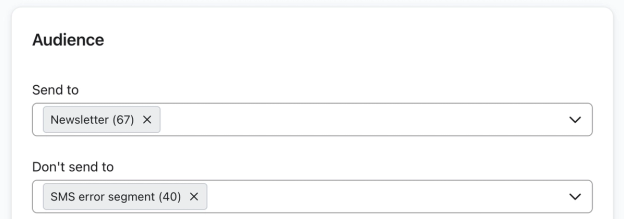
Profiles that match only a 30-day error condition can leave the segment once that error falls outside the window, as long as they meet none of the other error conditions. Profiles that meet a condition set to over all time do not leave simply because time passes or a later message is delivered. Profiles that leave the segment can be included in future campaigns if they are still subscribed and in the campaign’s selected audience.
Keep contacts “warm”
While you should exclude SMS subscribers in your error segment from most of your regular sends, it is important to occasionally text them to keep the contacts warm.
In regards to SMS contacts, “warm” refers to maintaining a consistent sending schedule with your audience (i.e., so that they receive messages from you periodically).
While the engagement doesn’t have to be frequent, sending at least once a month can help prevent contacts from becoming inactive and forgetting about your brand. Contacts that receive a text after a long period without sends are more likely to unsubscribe or report your texts, which leads to deliverability issues and a higher likelihood of being filtered by carriers.
For example, say you have a group of SMS subscribers that you haven't messaged in 3 months. If you message them for Black Friday, some may react negatively and opt out of your texts, or flag your messages as spam.
To prevent subscribers in your error segment from becoming “cold” over time:
- Include the SMS subscribers in your error segment in 1 or 2 sends per month, depending on how frequently you send.
- These campaigns should be the most important messages of the month, like product launches and major sales
- Rely on your flows to re-engage contacts.
Identify profiles with long-term errors
When a profile has delivery errors for several months with no successful deliveries, consider removing their SMS marketing consent. Create another segment using the steps above, with the conditions below. Use AND between the consent condition, the Received SMS condition, and the group of error conditions. Use OR within the error group.
- If someone can or cannot receive marketing > Person can receive text message marketing
AND - What someone has done (or not done) > Received SMS > 0 times in the last 26 weeks
AND - What someone has done (or not done) > Failed to Deliver SMS at least 5 in the last 26 weeks
Where Failure Type equals Device unreachable
OR - What someone has done (or not done) > Failed to Deliver SMS at least 5 in the last 26 weeks
Where Failure Type equals Device disconnected
OR - What someone has done (or not done) > Failed to Deliver SMS is at least 2 over all time
Where Failure Type equals Device unreachable
OR - What someone has done (or not done) > Failed to Deliver SMS is at least 2 over all time
Where Failure Type equals Device disconnected
OR - What someone has done (or not done) > Failed to Deliver SMS at least once over all time
Where Failure Type equals Invalid Mobile Number
OR - What someone has done (or not done) > Failed to Deliver SMS is at least 5 over all time
Where Failure Type equals Unknown error
Before unsubscribing these profiles, review their message history. Newer subscribers can also match this segment, and conditions set to over all time can match errors older than 26 weeks. Check that the profiles you remove have had repeated delivery problems over the period you intend to review.
Remove SMS consent
Once a profile has been unable to receive messages for an extended period of time, you have 2 options:
- Keep their SMS consent, exclude them from regular campaigns, and send occasional messages to check whether delivery has recovered.
- Remove SMS marketing consent
If you’d prefer, you can keep SMS consent on your SMS profiles and exclude them from regular campaigns. This gives you the opportunity to send texts if they engage again in the future. However, you should continue to text them monthly to maintain your relationship with them, and decrease the risk of them unsubscribing or marking a message as spam. Continuing to send messages to them can also help identify if an error was temporary or permanent.
If you instead choose to remove SMS consent, you will no longer be able to send SMS marketing to a contact unless they resubscribe.
Once you have created your long-term error segment, remove SMS consent from the profiles included with the following steps:
Your account must have SMS configured and enabled. You also need permission to export profiles and edit account settings.
Removing SMS marketing consent prevents these profiles from receiving SMS marketing unless they resubscribe. Review the segment members and CSV before confirming the unsubscribe.
- On your segment, select Manage segment.
- Select Export to CSV.
- In the export wizard, select the Phone Number and Country fields.
- Click Start Export. Wait for the CSV to download before continuing.
- Check that the CSV has 1 phone number column named Phone Number or Phone Numbers. Keep Country for numbers without an international country code, or include the code in each number, such as +17823746561. The file must be 50 MB or smaller.
- In the bottom left corner of Klaviyo, click your brand name.
- Select Settings > Other > Profile maintenance.
- Scroll to the Import text message unsubscribes section.
- Upload your CSV file of SMS contacts to unsubscribe in the Text message unsubscribes field.
- Click Save.
- Confirm your selection in the modal by clicking Unsubscribe Phone Numbers.
It may take a few minutes for the process to complete. Check the import history for the status and number of records imported. If records were skipped, open the row’s details and select Download Skipped Records. Correct the data issues and import the corrected file.
Outcome
After you finish, the contacts successfully processed by the import will no longer receive SMS marketing unless they resubscribe. Continue to review delivery errors and clean your SMS lists regularly, since unsubscribing these contacts does not guarantee delivery to everyone who remains.
Additional resources
- How to create a sunset flow
Learn how to set up a sunset flow that is designed to phase out customers who are no longer engaging with your brand. You can use this flow as a last-ditch effort to win back their business, and then delete or suppress anyone who is not responsive. You will also see how this recommended sunset segment definition connects to the prebuilt Sunset (Email) segment in the Segment Library. This will help you maintain a clean list and avoid having inactive customers contribute towards your Klaviyo billing plan.
- How to increase SMS click rates
Learn how to improve your SMS click rates as well as about performance benchmarks for campaigns and flows.
- Understanding active profile management in Klaviyo
Learn how to manage active profiles in your Klaviyo account and reduce the number of billable profiles by suppressing those that have not engaged with your business for a sustained period of time.