How to add UTM tracking to campaigns and flows
You will learn
Learn how to use UTM tracking in your Klaviyo email, text, WhatsApp, and mobile push messages to develop insights and improve your Google Analytics conversion tracking.
UTM tracking sends data to Google Analytics (or other tracking software) about where visitors came from. Use UTM tracking in your campaigns and flows if you’d like to track conversions from your Klaviyo messages in Google Analytics.
Before you begin
This article explains how to append UTM parameters to links you send through Klaviyo email, text, WhatsApp, and mobile push messages. In order to use these parameters for data analysis in Google Analytics, you’ll need a fully configured Google Analytics account. Successfully using custom parameters (i.e., parameters other than the 5 defaults provided) requires a comfortable working knowledge of Google Analytics.
Note that message ID and message variation are different properties used in UTM tracking. Message ID refers to the overarching ID number of the message, while message variation refers to the ID associated with a specific A/B test version. Currently, only message ID will appear in report downloads. The values available in Google Analytics depend on the UTM parameters you include. Variation letters, such as A or B, are separate from these IDs.
Reference Google’s support documentation for questions related to your Google Analytics account or setup.
Configure global UTM settings
Before configuring UTM settings for individual messages, consider turning on global UTM tracking in your account settings. You can always adjust the UTM settings for a specific message using the instructions in the following sections.
For multiple channels, use Message type as the value for utm_medium so each link identifies its channel, such as email or SMS. This is the default for accounts without saved custom UTM settings; check the value if you have previously customized your settings.
- Navigate to Settings > Other > UTM tracking.
- Select the optional parameters you want to include.
utm_sourceandutm_mediumare required and cannot be turned off. - Adjust the Campaign value and Flow value fields.
- Campaigns and flows have different dynamic value options. Within each category, the same options are available for each parameter.
- Recommended: set the UTM medium to be Message type if you use multiple marketing channels (e.g., email and text messages).
- Toggle Automatically add UTM parameters to links on to enable UTM tracking by default for new messages.
- Click Save to save your changes.
Changes to your account’s parameter values apply to future sends of messages that use the account defaults. Messages with custom tracking parameters keep their own settings. To turn on tracking for an existing message, follow the steps below.
Add UTM tracking to a flow message
To turn on UTM tracking for a flow message for email, text messages, WhatsApp, and mobile push notifications:
- Navigate to the Flows tab.
- Open the flow you’d like to edit.
- Select a message in the flow builder.
- Under Settings, check the box next to Enable UTM Tracking to automatically append UTM parameters to your links.
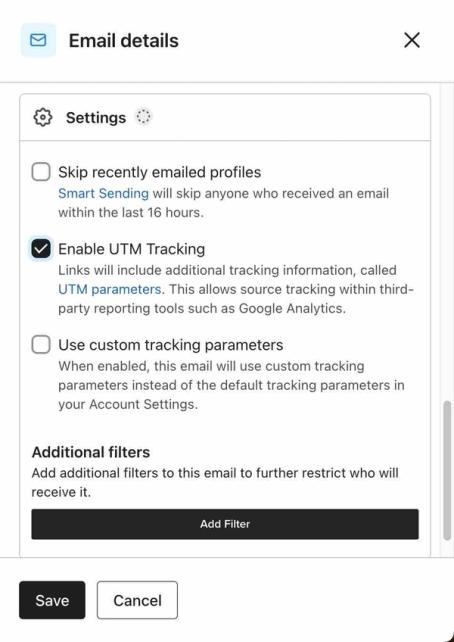
- Click Save.
- Repeat for all other messages in the flow, if desired.
When this setting is on, links are tagged in accordance with your account's default UTM tracking settings. To use different tracking parameters for a particular message:
- Beneath the UTM Tracking setting, check the box for Use custom tracking parameters.
- Adjust the message’s UTM parameters as desired.
- Click Save.
Note that all links for email, text, and WhatsApp must have http:// or https:// in order to be tracked. Mobile push deep links may use custom schemes (e.g., myapp://).
Additionally, in text messages, the Automatically shorten links setting must remain enabled in order to use UTM parameters. Links added to URL buttons in WhatsApp messages and deep links in mobile push notifications will automatically use the UTM parameters configured at the message or account level.
Add UTM tracking to a campaign message
You must pause the campaign first if you’d like to adjust the UTM parameters for a message that has already been scheduled. UTM parameters cannot be edited for sent messages.
To turn on UTM tracking for an email, text, WhatsApp, or mobile push campaign in the step-by-step builder:
- Navigate to the Campaigns tab.
- Click to open an unsent campaign from the list.
- In the Tracking section of the Recipients step, turn on Include tracking parameters.
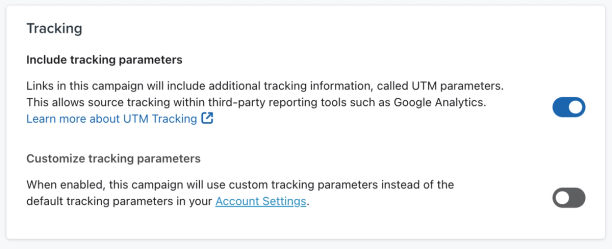
Note that all links for email, text, and WhatsApp must have http:// or https:// in order to be tracked. Mobile push deep links may use custom schemes (e.g., myapp://).
Additionally, in text messages, the Automatically shorten links setting must remain enabled in order to use UTM parameters. Links added to URL buttons in WhatsApp messages and deep links in mobile push notifications will automatically use the UTM parameters configured at the message or account level.
When this setting is on, links are tagged in accordance with your account's default UTM tracking settings. To use these defaults, click Next to save and continue to the Message step. To use different tracking parameters for your campaign before continuing:
- Enable the Customize tracking parameters toggle.
- Adjust the message’s UTM parameters as desired.
- Click Next and continue editing your campaign as desired.
Campaigns in the canvas
If your campaign opens in the canvas, configure UTM tracking for each message:
- Select the draft message you want to edit.
- Select the Settings tab and turn on Include tracking parameters.
- To use values other than your account defaults, turn on Customize tracking parameters and adjust the parameters.
- Click Save. Repeat for other messages as needed.
How list or segment values are selected
If you use List or segment name(s) as the value for a parameter such as utm_source and send a campaign message to multiple lists or segments, the value is the first list or segment selected for that message’s audience.
The value for utm_source refers to 1 list or segment and is the same for all recipients of that message, even if a recipient is not in that list or segment. It does not identify each recipient’s list or segment membership.
For example, let's say Jane is a subscriber in your account. She is in both the VIP Customers segment and the High-Engagement segment. When creating an email campaign, you send to both of these segments, but you select VIP Customers first. This means that when the campaign is sent, the value for utm_source will be VIP Customers for Jane's email and for the message’s other recipients. This value labels the campaign’s traffic; it does not show which segment each recipient belongs to.
Note that this logic applies for any tracking parameter campaign value for which one of the following 3 parameter values are selected:
- List or segment id(s)
- List or segment name(s)
- List or segment name(s) (list or segment id)
Add UTM variation letters to email A/B tests
The steps below cover email A/B tests. The Track links separately in each variation option is not available for text messages.
UTM variation letters measure the performance and link activity between A/B tested campaigns and flow emails.
For example, if you have 3 variations of a campaign and want to find out which directs the most traffic to your site, use this feature to label them with letters. After sending the campaign, you’ll be able to tell whether version A, B, or C was most effective and adjust your content accordingly.
Turning on Track links separately in each variation adds a variation parameter to your email links. Turning on general UTM tracking alone does not add this parameter. To report on it in Google Analytics, configure your website or app to send its value as a custom event parameter, then create an event-scoped custom dimension for that parameter before running the test.
Email campaigns
To add a UTM variation letter to a campaign:
- After adding UTM tracking, open the campaign’s email content. In the step-by-step builder, click Next from Recipients. In the canvas, select the email message and click Edit on the Message tab.
- For a new test, add or edit your email content, then click Create A/B test. If the email already has an A/B test, continue to the next step.
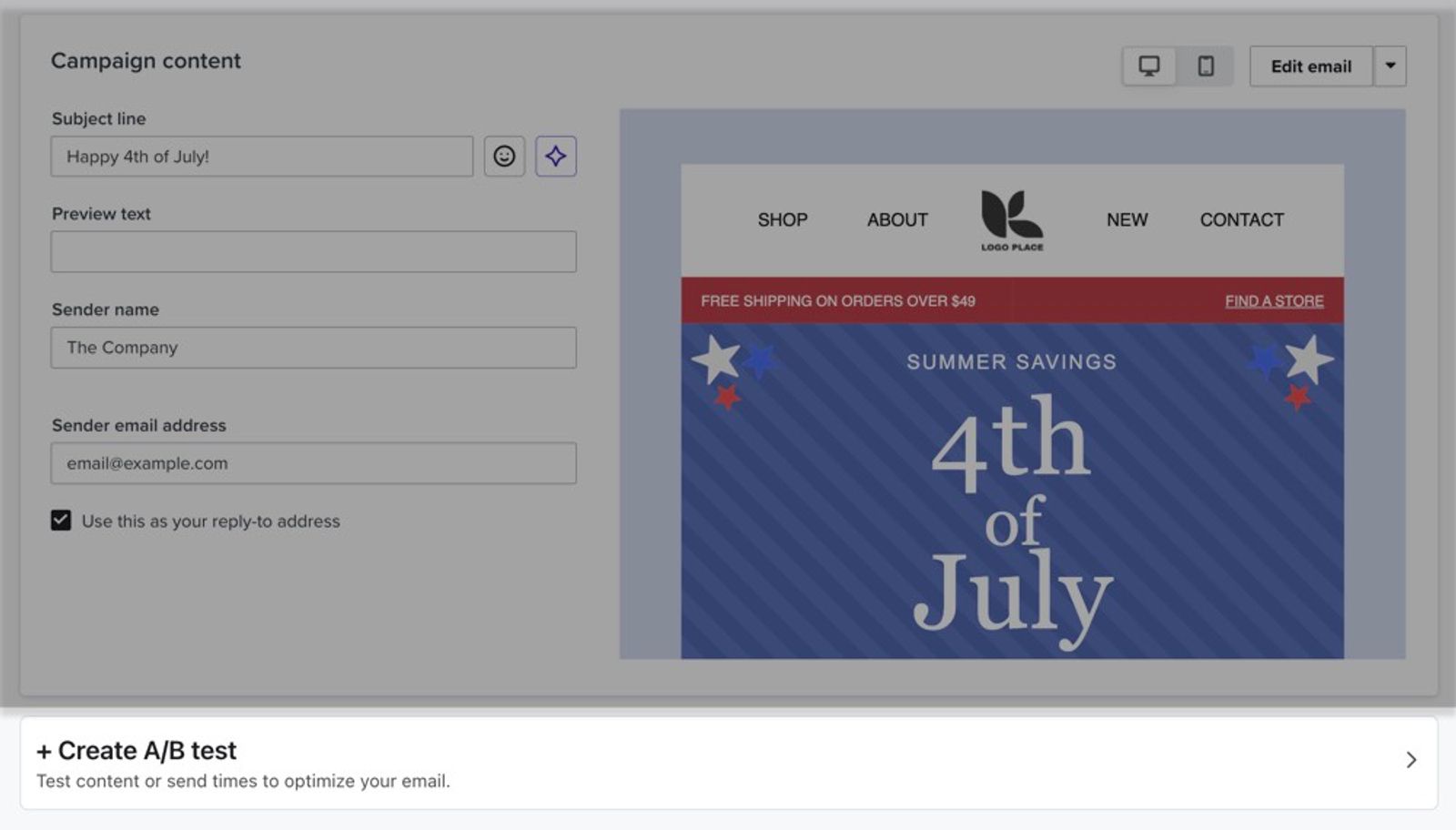
- Under Content test settings or Send time test settings, turn on Track links separately in each variation.
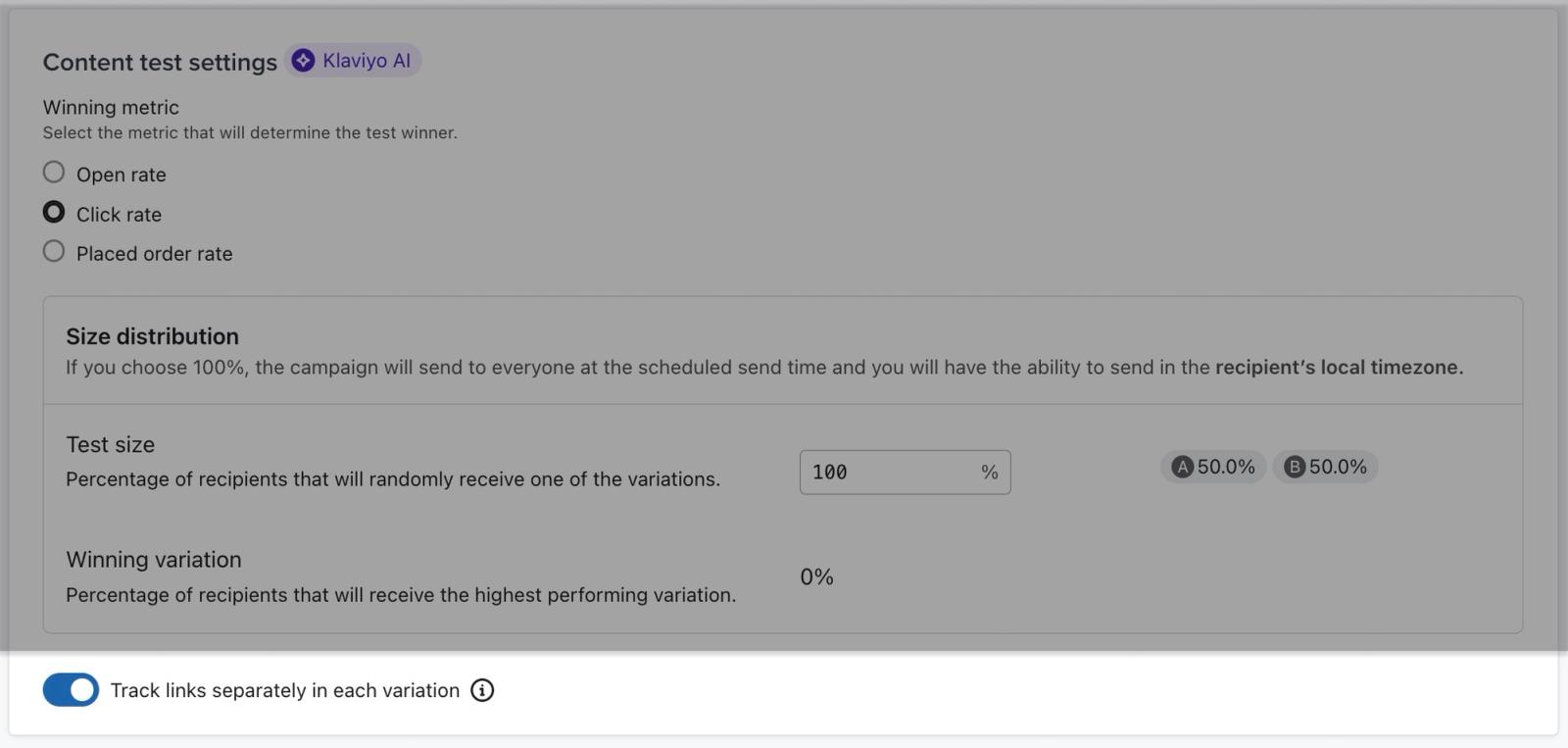
- Click Next to save and continue to review. If you opened the message from the canvas, click Save and return instead.
Flow emails
Before creating a new flow email A/B test, add content to the email. You cannot create a new A/B test for a transactional email or an email awaiting transactional approval. To add UTM variation letters to a flow email:
- From the flow editor, click into a flow message.
- In the sidebar, click Create A/B test. For an existing draft test, click Configure test. For a live test, click View test, then select the Message content tab.
- Under Test settings, select Track links separately in each variation. For a live test, click Modify settings first to show the option.
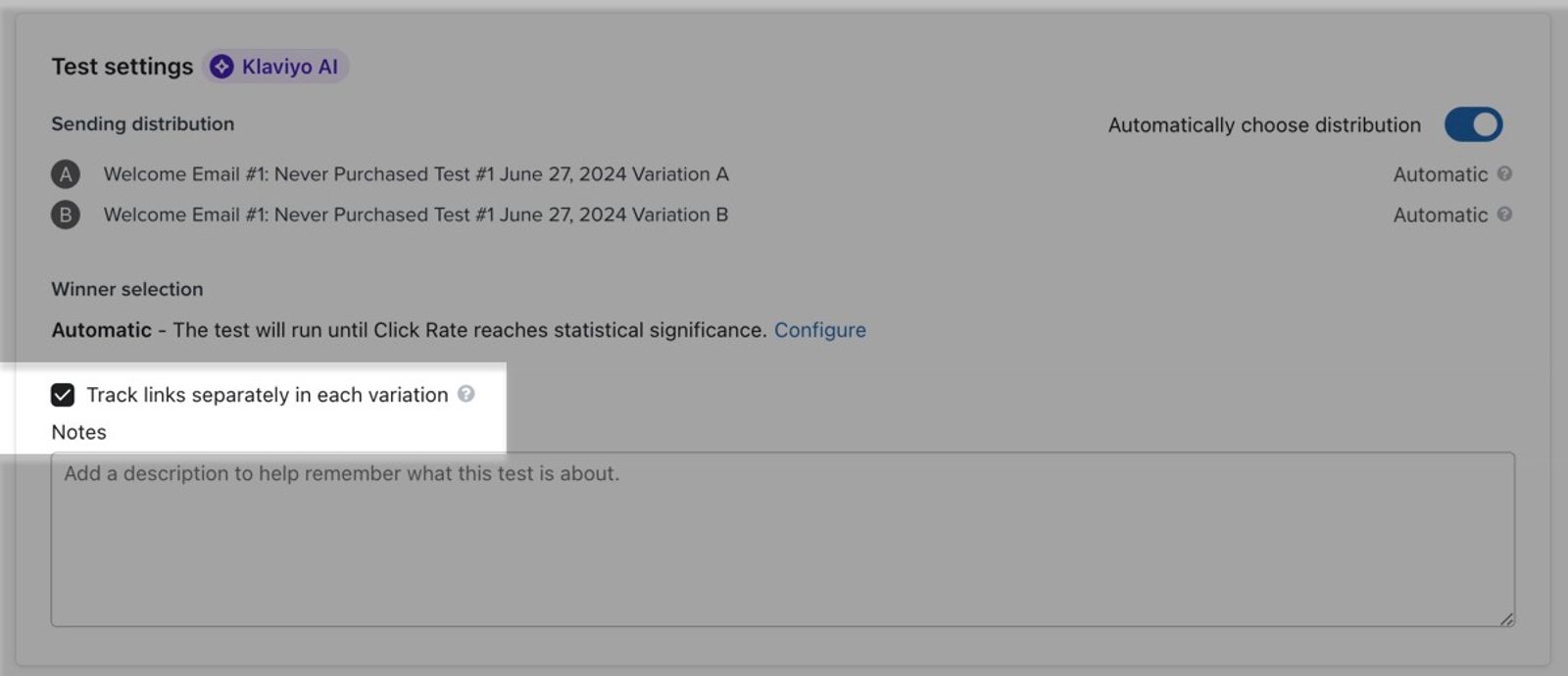
- Click Done to save the tracking setting and return to the flow.
Additional resources
- Understanding UTM tracking in Klaviyo
Learn what UTM tracking is, how it works, and how you can use it in your Klaviyo messages to gain a deeper understanding of your marketing performance.
- Understanding message conversion tracking
Learn how conversion tracking works for email, SMS, and mobile push messaging and how to edit these settings. For each campaign and flow sent, Klaviyo automatically tracks conversions. This allows you to analyze the performance of your marketing channels and their individual success.