Understanding how back in stock flows work
You will learn
Learn about how back in stock flows work, how contacts move through them, and how they appear different from most other metric-triggered flows. For instance, they have the back in stock delay component, which is unique to this type of flow.
Klaviyo back in stock is supported for customers using the following:
If you haven't set up back in stock in your Klaviyo account or store yet, learn How to build a back in stock flow.
Triggering the flow
When a customer subscribes to an out of stock product on your site, you'll see an event tracked on their profile: Subscribed to Back in Stock. Those that subscribe to a back in stock alert will automatically enter your flow triggered off this Subscribed to Back in Stock event.
Back in stock delay component
After triggering the flow, you will see the contact added to the Waiting list of recipients at the back in stock delay component.
To explore who is waiting at this step, click View details in the Performance section of the details sidebar for this delay.
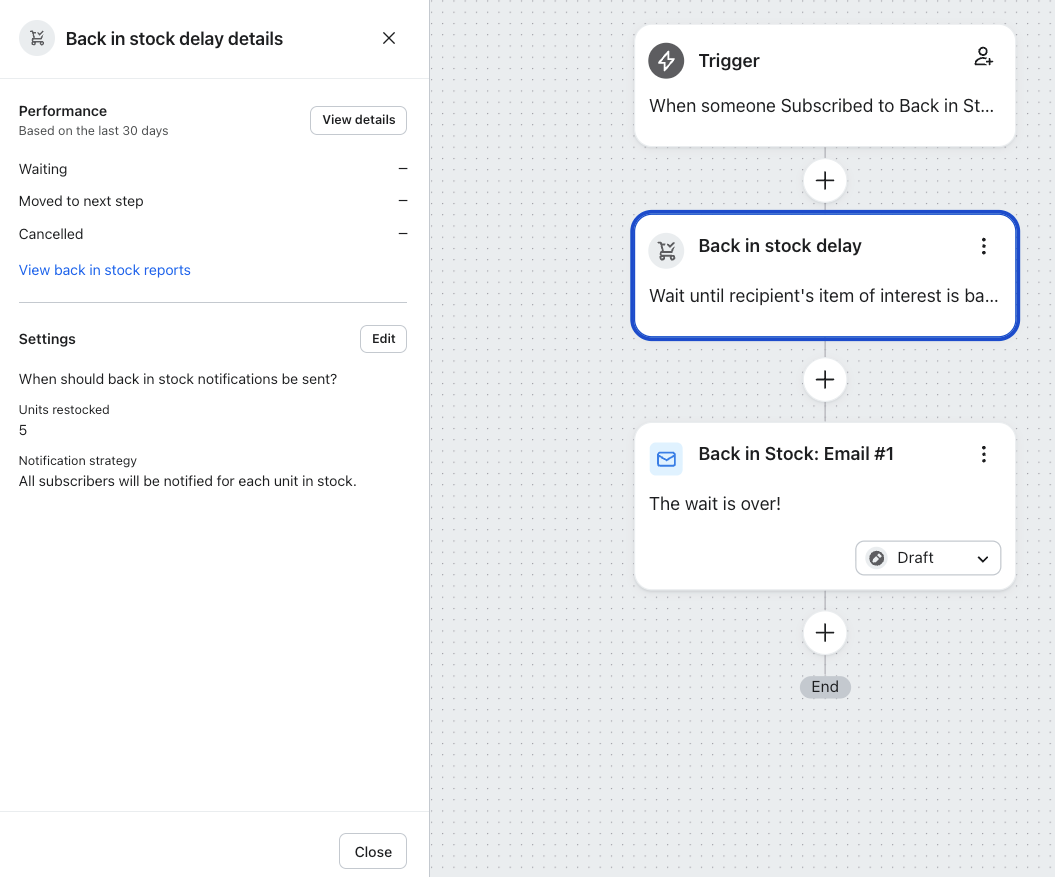
Sending to back in stock subscribers
When a product is restocked, your back in stock settings determine which subscribers move from Waiting to Moved to next step. If notifications are sent in batches, other subscribers remain in Waiting until a later batch. Moving to the next step does not necessarily mean a message was sent; the message's status determines whether it sends automatically or is held for review.
Your flow's message status must be set to Live or Manual for subscribers to be added to the waiting list for the back in stock delay. If the message after the delay is set to Draft, no one will be put in the waiting list.
To view recipient activity around your stock alert email or SMS, click on the message itself. Here, in the Performance section of the sidebar, you will see a summary of activity over the last 30 days. Click View details to explore activity over a longer, or custom, timeframe.
Note that it's not possible to check if the item is still in stock before sending a second message. After the initial message is sent, Klaviyo cannot check the inventory for the item to see if the item has gone out of stock again.
Adding past profiles to back in stock flows
Adding past profiles to back in stock flows typically won't bring in new people. Back in stock flows are triggered by the Subscribed to Back in Stock metric, and metric-triggered flows add past profiles based on time delays. Since back in stock flows are best without time delays (and the back in stock delay functions differently), adding past profiles won't have any effect. If you wish to reach out to those in a back in stock report, we recommend sending a campaign.
That said, if your back in stock flow contains a time delay, adding past profiles works similarly to how it does in other metric-triggered flows. If an added profile reaches the back in stock waiting queue, they move on when selected for a restock notification according to your back in stock settings—not necessarily as soon as the product is restocked.
Additional resources
Learn more about back in stock flows:
- How to build a back in stock flow
Learn how to build a Klaviyo back in stock flow to alert customers about inventory if you are using the Shopify, BigCommerce, Magento 2, PrestaShop, SFCC, or Shopware platforms, or if you have an inventory-aware catalog synced via custom catalog feed or API.
- How to configure back in stock alert emails
Learn how to use pre-built templates or configure a custom template for a back in stock flow email. When creating a back in stock flow email, it's important to set up the message so that it shows the right product data. Klaviyo supports back in stock flows for accounts with Shopify, BigCommerce, Magento 2, PrestaShop, Shopware, and SFCC integrations, as well as accounts with inventory-aware catalogs sync via custom catalog feed or API. The instructions below cover Shopify, BigCommerce, and Magento 2 integrations.
- How to use SMS in your back in stock flows
Learn how to use SMS in your back in stock flows with Klaviyo.
- Understanding how contacts move through a flow
Learn how contacts move through a flow. Flows are automated Klaviyo workflows that are set in motion by an initial trigger and then include one or more steps. Flows can be built to send timely communications to recipients, or they can simply apply certain actions, like updating a specific field on a profile.