How to resolve AT&T spam traps
You will learn
Learn about AT&T spam traps, how Klaviyo notifies you if it detects that you may have been caught in the spam trap, and the steps you can take to rebuild your reputation with AT&T.
AT&T spam traps
Carriers such as AT&T in the US may place SMS senders into a 30-day probationary period when they identify the sender is not following SMS messaging best practices. During this time, senders may see less than 5% deliverability on this particular network with all errors being returned as Device Unreachable - Vendor code 30003.
If a sender continues to send to devices on the network during the probationary period, this results in the accumulation of errors that can lead to indefinite delivery issues on the network.
AT&T spam trap alerts in Klaviyo
If Klaviyo detects that your account may be caught in AT&T’s 30-day spam trap, alerts appear in:
- Email inboxes for the account owner, admins, and managers
- An in-app notification on the home page
- An in-app notification on the campaigns list-view page
Exclude delivery failures from sends
To prevent the accumulation of errors during the probationary period, Klaviyo recommends excluding profiles that experienced a send failure from your future sends during this time.
- Navigate to Audience > Lists & segments.
- Click Create > Segment.
- Enter a name for the segment (e.g., SMS errors). If you’re in a Create segment panel, click Create segment to open the condition builder.
Add the following conditions. Require SMS marketing consent AND at least 1 of the failure conditions, joined by OR:
- If someone can or cannot receive marketing > Person can receive SMS marketing
AND
- What someone has done (or not done) >
- Failed to Deliver SMS at least once in the last 30 days
- WHERE Failure Type equals Device disconnected
OR
- What someone has done (or not done) > Failed to Deliver SMS at least once in the last 30 days
- WHERE Failure Type equals Device unreachable
OR
- What someone has done (or not done) > Failed to Deliver SMS at least once over all time
- WHERE Failure Type equals Message blocked
OR
- What someone has done (or not done) > Failed to Deliver SMS is at least once over all time
- WHERE Failure Type equals Device incapable of receiving SMS
OR
- What someone has done (or not done) > Failed to Deliver SMS is at least once over all time
- WHERE Failure Type equals Invalid Mobile Number
OR
- What someone has done (or not done) > Failed to Deliver SMS at least 2 over all time
- WHERE Failure Type equals Device disconnected
OR
- What someone has done (or not done) > Failed to Deliver SMS at least 6 over all time
- WHERE Failure Type equals Device unreachable
OR
- What someone has done (or not done) > Failed to Deliver SMS is at least 5 over all time
- WHERE Failure Type equals Unknown error
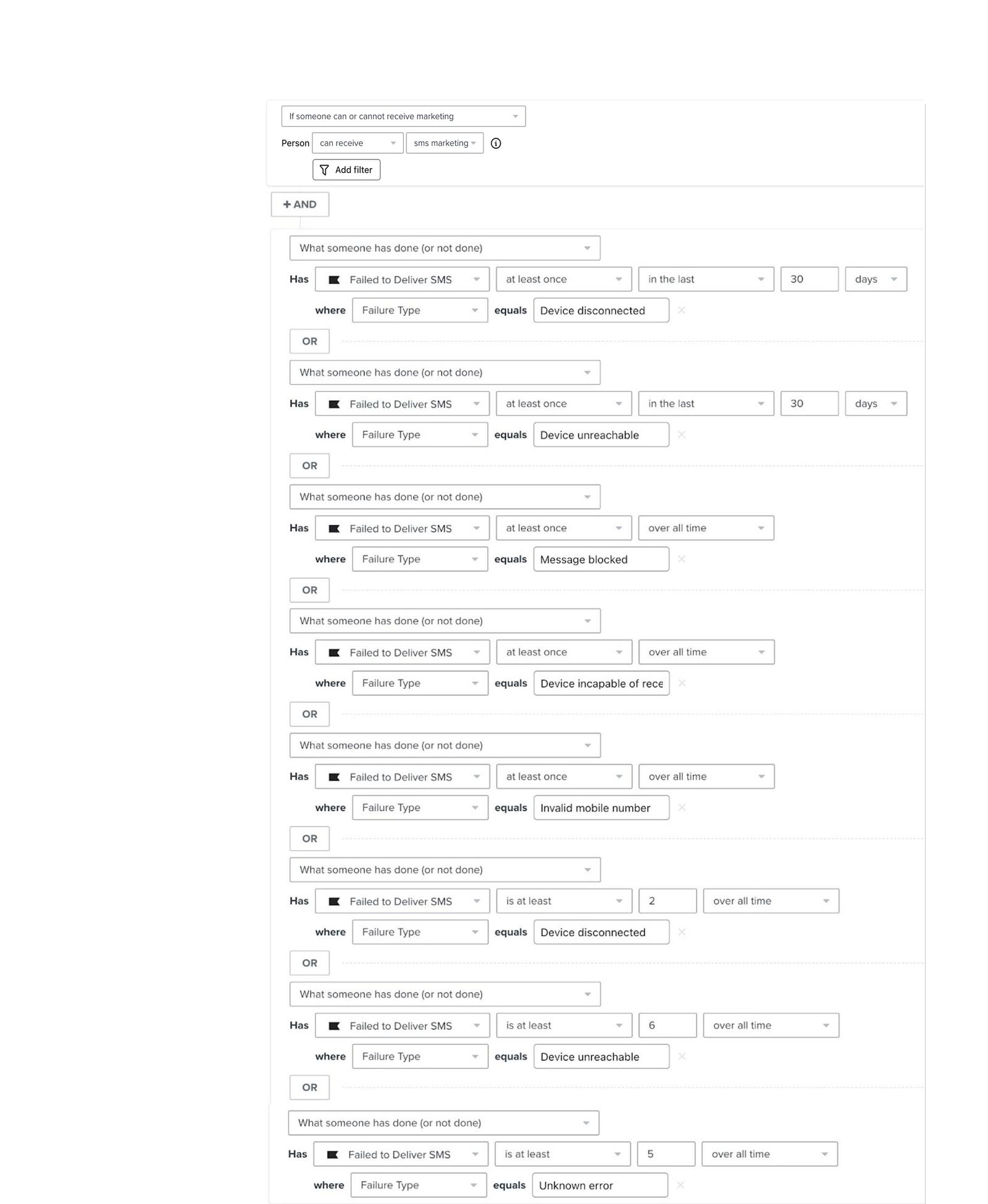
Click Create segment to save the segment after adding the conditions.
When choosing recipients for each SMS campaign, select this segment under Don't send to, then click Next to save your audience settings. Creating the segment alone does not exclude its members from campaigns.
What if my sending list is too small following the implementation of the recommended SMS error segment?
The SMS error segment is designed to exclude profiles with recurring delivery errors from your SMS campaigns. If too many subscribers are excluded, consider increasing only the lifetime failure thresholds below: use a value higher than 2 for Device disconnected or higher than 6 for Device unreachable. Keep both 30-day failure conditions in place during the probationary period, and monitor deliverability after changing a threshold.
- What someone has done (or not done) >
- Failed to Deliver SMS is at least X over all time
- WHERE Failure Type equals Device disconnected
OR
- What someone has done (or not done) >
- Failed to Deliver SMS is at least X over all time
- WHERE Failure Type equals Device unreachable
Outside the recalibration period, an effective SMS error segment should help you reach the expected delivery rate of 95% or more.
Follow SMS best practices
In addition to capturing failed sends in an error segment, you should follow SMS best practices to maintain strong SMS deliverability.
- Check that the call to action disclosures are clear and accurately describe the SMS program users are signing up to. This helps keep opt-out rates down and ensures people are aware of the program they are subscribing to.
- Consider implementing double opt-in. This helps minimize failures like erroneous number sign-ups, landlines, and devices incapable of receiving SMS.
- Segment your subscribers to ensure content is personalized to their interests. This increases deliverability and reduces opt-out rates.
- Aim for opt-out rates of less than 1% per campaign.
- Ensure that opt-out information is available on campaigns.
See more SMS best practices.
Outcome
Profiles that match only the 30-day failure conditions leave the exclusion segment once those failures fall outside the last 30 days. Profiles that still meet any of the over all time conditions remain excluded. Leaving the segment does not guarantee successful delivery; continue monitoring your SMS delivery results.
During the recalibration period, the expected SMS delivery rate is 85%–90%. Outside of the recalibration period, the expected delivery rate is 95% and above.
Additional resources
- Basics: SMS best practices
Learn 9 SMS best practices to implement when you’re first getting started.
- Understanding and reviewing your SMS deliverability
Learn the important aspects of SMS deliverability, including how to evaluate it and best practices.
- How to create and send an SMS campaign
Learn how to create and send an SMS campaign in Klaviyo. Note that the process is almost exactly the same for MMS campaigns. The only difference is that you add an image or GIF during the content creation stage.