How to use the conversion overview dashboard
Learn how to analyze your total conversions and revenue, including Klaviyo attributed values, via the Conversion overview dashboard. You can also review how many profiles are completing different numbers of conversions and the total revenue they represent. This dashboard enables you to optimize marketing efforts and increase conversion rates by targeting specific segments based on conversion behaviors.
Advanced KDP and Personalization are not included in Klaviyo’s standard marketing application. You need access through a paid plan or an active trial to use the Conversion overview dashboard. Head to our billing guide to learn about how to purchase these plans.
Before you begin
This dashboard is calculated using event data. Thus, you may see a difference in how other Klaviyo reports or dashboards calculate attributed revenue (e.g., the Home dashboard uses data based on when the message was sent).
Accessing and customizing the dashboard
It is not possible to remove or replace the cards on the Conversion overview dashboard.
- Navigate to Personalization > Customer insights > Conversion overview. This path also applies if you access these features through Advanced KDP.
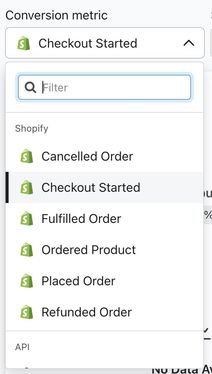
- Optional: Once inside the dashboard, select the Conversion metric dropdown to adjust the metric used to calculate the dashboard. For example, if you choose Ordered Product, you will see revenue and conversions related to completed purchases. Learn more about message conversion tracking.
Revenue and Average order value are available only when the selected conversion metric includes a monetary value.
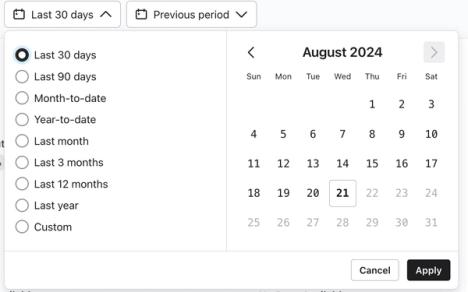
- Click the Timeframe dropdown. Choose one of the following options, then click Apply:
- Last 30 days (default option)
- Last 90 days
- Month-to-date
- Year-to-date
- Last month
- Last 3 months
- Last 12 months
- Last year
- Custom: select a start and end date, up to 1 year apart.
- Optional: to show data for a specific segment, click the Audience dropdown and select the segment. Select All profiles to view conversions across your account without a segment filter.
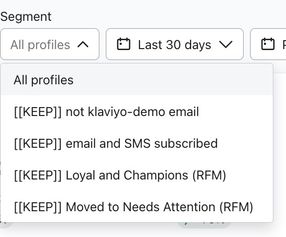
Conversions are based on segment membership at the time the conversion event occurred.
For example, say you have a segment of profiles that have never placed an order. When a profile places their first order, they will exit the segment. However, since the profile was in the non-purchasers segment at the time they placed their order, the revenue is attributed to the original segment at the time of the purchase (i.e., profiles that have never placed an order).
- Optional: to change the comparison period, select the Previous period dropdown. Choose one of the following options, then click Apply:
- Previous year
- Previous period
This option compares your data to the same prior date range. For example, if you select the Previous year option and set your time period to the Last 30 days, the dashboard will compare your data to the corresponding 30 days from the previous year. If you choose the Previous period, your data will compare to the same prior date range or, in this case, the 30 days immediately before your chosen date range.
- Custom set of date ranges.
If you choose a custom range, your data will compare to that particular range only.
Reviewing the dashboard
Overview card
The top Overview card displays information on total revenue and conversions, highlighting the specific amounts that can be attributed to Klaviyo.
- Attributed revenue is revenue that can be directly tied to Klaviyo.
- Total revenue includes revenue attributed to Klaviyo and revenue from other sources (e.g., ads, other channels, or in-store purchases), as long as those purchases are recorded in Klaviyo under the selected conversion metric.
You can see the representation of the total conversion and revenue values in both numbers and bar charts, as shown below.
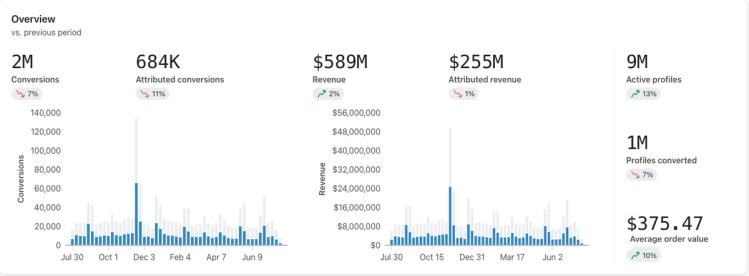
You will also be able to see the percentage change compared to your selected comparison period for all revenue or conversions. A positive change will reflect as green, while a negative change will reflect as red.
On the right-hand side of the card, you can review profile information associated with your conversions and revenue. These include the following values:
- Active profiles
The latest recorded count of profiles that can be emailed through Klaviyo within your chosen time period. This appears when Audience is set to All profiles. - Audience membership
When you select a segment, this replaces Active profiles and shows the number of profiles in the segment at the end of the chosen time period. Membership data is available from June 21, 2023. If the selected period ends before that date, the value shows N/A; if the comparison period ends before that date, the percentage change shows N/A. - Profiles converted
The number of profiles that converted within your chosen time period. - Average order value
The average revenue spent per conversion.
Conversion group characteristics card
The Conversion group characteristics card represents the total number of conversions and the revenue per grouping.
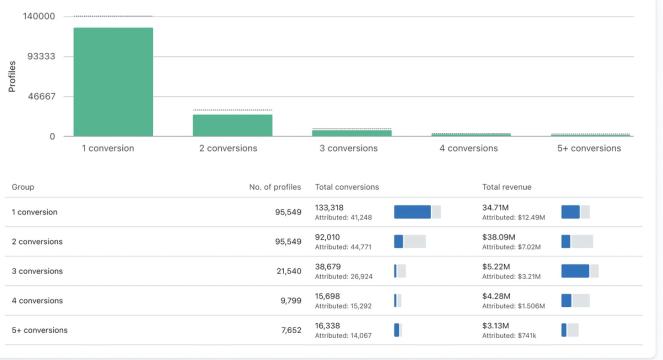
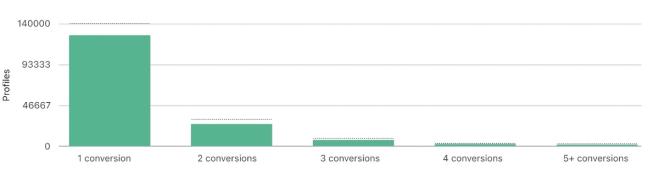
The chart at the top of the card groups profiles by how many times they completed the selected conversion event during your chosen time period. For example, the 3 conversions group contains profiles with exactly 3 conversions. The groups are 1, 2, 3, 4, and 5+ conversions. The comparison line shows the number of profiles in each group during your selected comparison period.
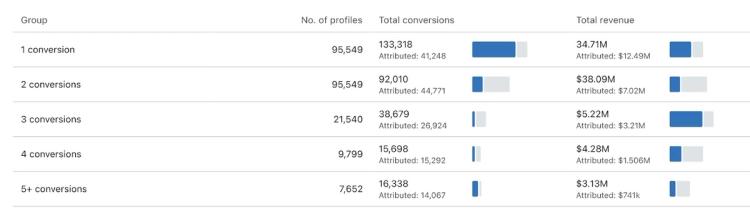
The table on the bottom shows the conversion group and specific related values. For example, if you have a group of profiles who made 2 conversions, you can see what this represents in terms of the total:
- Number of profiles
- Number of individual conversions
- Revenue
The Total conversions and Total revenue columns also break out these values in terms of total vs. Klaviyo attributed numbers.
Additional resources
- Understanding Klaviyo message attribution
Learn about Klaviyo's event and message attribution or the ability to review which of your messages or channels led to customer actions.