How to add SMS to a thank you flow
You will learn
Learn how to add SMS to a thank you or order confirmation flow to diversify the type of communication sent to your customers. Both a thank you and order confirmation flow are a type of post-purchase flow.
What is a post-purchase flow?
A post-purchase flow is any flow that sends after someone makes a purchase. This is a broad category that includes the following flows:
- Thank you
- Order confirmation
- Cross-sell
- Up-sell
- Product review
- Replenishment
Before you begin
Before you can start adding SMS to any flow, turn on SMS in your account settings.
The steps below send SMS to customers who have opted in to text message marketing. Placing an order alone does not provide that consent.
The next steps depend on whether or not you have a post-purchase flow set up in Klaviyo:
- If you don’t have a post-purchase flow: create a pre-built flow with SMS.
- If you have a post-purchase flow: add SMS into the existing flow.
Use a pre-built flow with SMS
If you don’t already have a thank you or order confirmation flow, the easiest option for creating a flow is by using a template.
Depending on the integration you are using, the flow library may have a pre-built thank you or order confirmation flow with SMS. For example, there are many flows that contain SMS when using the Shopify integration with SMS enabled.
To check for this:
- Navigate to the Flows tab.
- Click Create flow.
- In the search bar, enter a term for a flow type you want to create such as “thank you.”
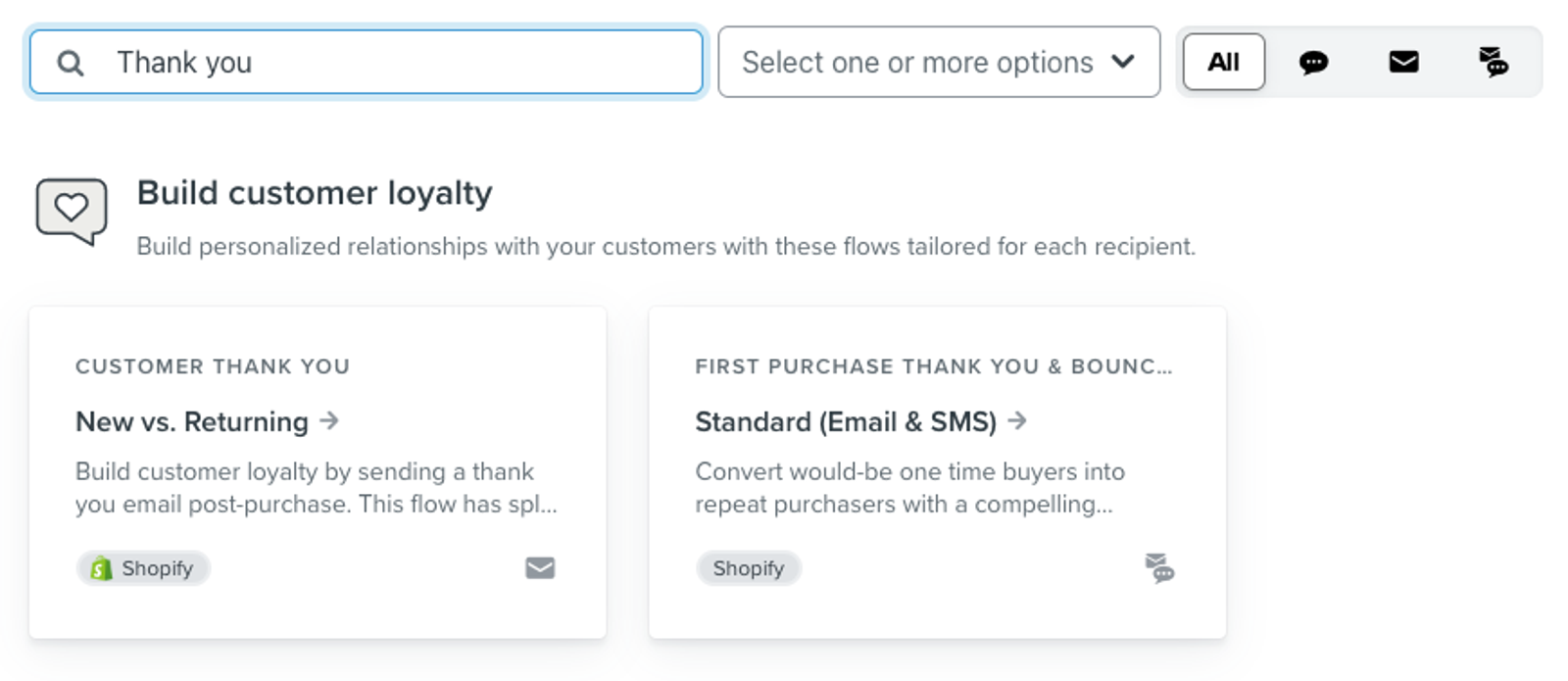
- Open a template that includes SMS. In the template details, look for the Text Messaging or Email and Text Messaging label.
- If you don’t see an SMS option available, make sure you have SMS enabled in your account settings. A pre-built template including SMS may not be available for your integration. In that case, choose an email template. After creating it, follow the steps below to add SMS to the flow.
- Enter a name for the flow, complete any required setup shown in the template details, and click Use template.
After creating a flow from a template, edit the email and SMS content to suit your needs.
When the content and settings are ready, click Review and turn on in the flow builder. If you see Update status instead, click that. Select Live and click Save to start sending configured messages.
Add an SMS action to an existing flow
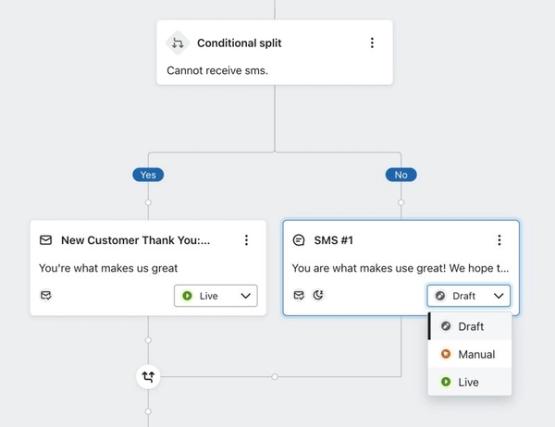
The steps below use Split, with Path #1 and Everyone else. If your sidebar shows Conditional split instead, use that for the SMS consent check. Select the split to set and save its condition; YES corresponds to Path #1, and NO corresponds to Everyone else.
- Navigate to the Flows tab.
- Click the name of the thank you or order confirmation flow where you want to include SMS.
- In the flow builder, drag Split from the Logic section of the sidebar to after the first time delay (if there is one) or the trigger, before the first email.
- On the canvas, click Add path criteria on Path #1. Set If someone can or cannot receive marketing > Person cannot receive > text message marketing, then click Save. Customers who cannot receive text message marketing follow Path #1, where your existing email path stays; those who can receive it follow Everyone else. This configuration allows you to add the split to an existing post-purchase flow without having to rearrange your email path.
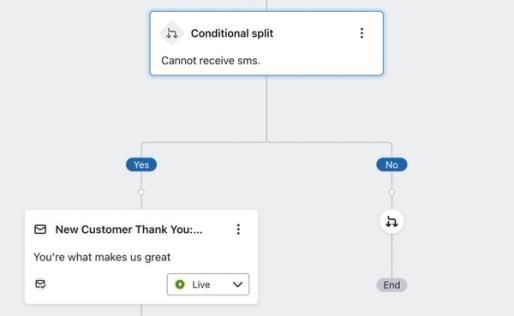
- Drag Text message onto the Everyone else path (NO if you used a Conditional split).
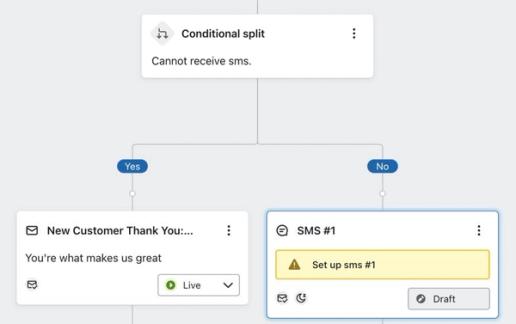
- Select the text message card, then click Edit in the Content section.
- Add in your message. For example:
“Hey {{ first_name|title|default:'there' }}, thank you for your purchase! We hope you're getting excited for your order to arrive.” - Click Preview to check the message and personalization. Close the preview, then click Next to save and return to the flow builder.
- Drag the rejoin icon below the SMS message onto the email path after the first email. This allows you to continue sending customers emails after sending them an SMS.
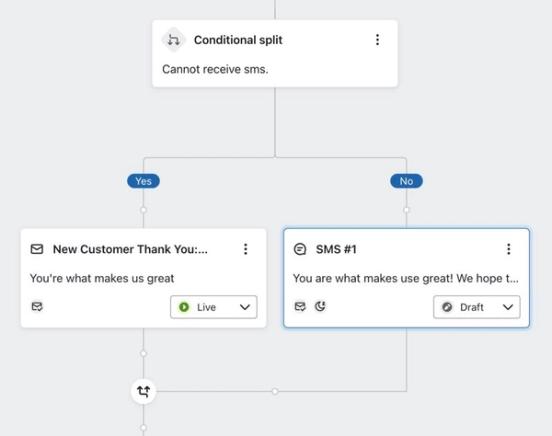
- Select the text message card, choose Live under Status, then click Save.
Best practices for thank you and order confirmation flows
Message content
Keep your SMS messages short and concise, and ensure they include relevant information. In this case, you want to thank the customer directly and provide information about their order.
Avoid overusing emojis. Having 1 or 2 emojis in a thank you or order confirmation message might be fine, but multiple repeating emojis are often associated with spam.
Number of SMS messages
For both thank you and order confirmation flows, we recommend only using 1 SMS. Typically, all you need is a single message per recipient; however, if you want to send multiple messages, we recommend using SMS once and then following up with email.
Message timing
Use the following timing for the first message and an optional follow-up email:
- Message 1: No delay
- Message 2: 3 days
No flow delay does not guarantee that the SMS sends immediately. If quiet hours are enabled, Klaviyo postpones messages scheduled during those hours until the next allowed sending time.
Don’t send email and SMS messages at the same time. Too many messages can overwhelm your customers and cause them to unsubscribe or mark your messages as spam. It is better to alternate between message types.
Enhance your SMS post-purchase flow
See the example flows below for ways to customize your flow:
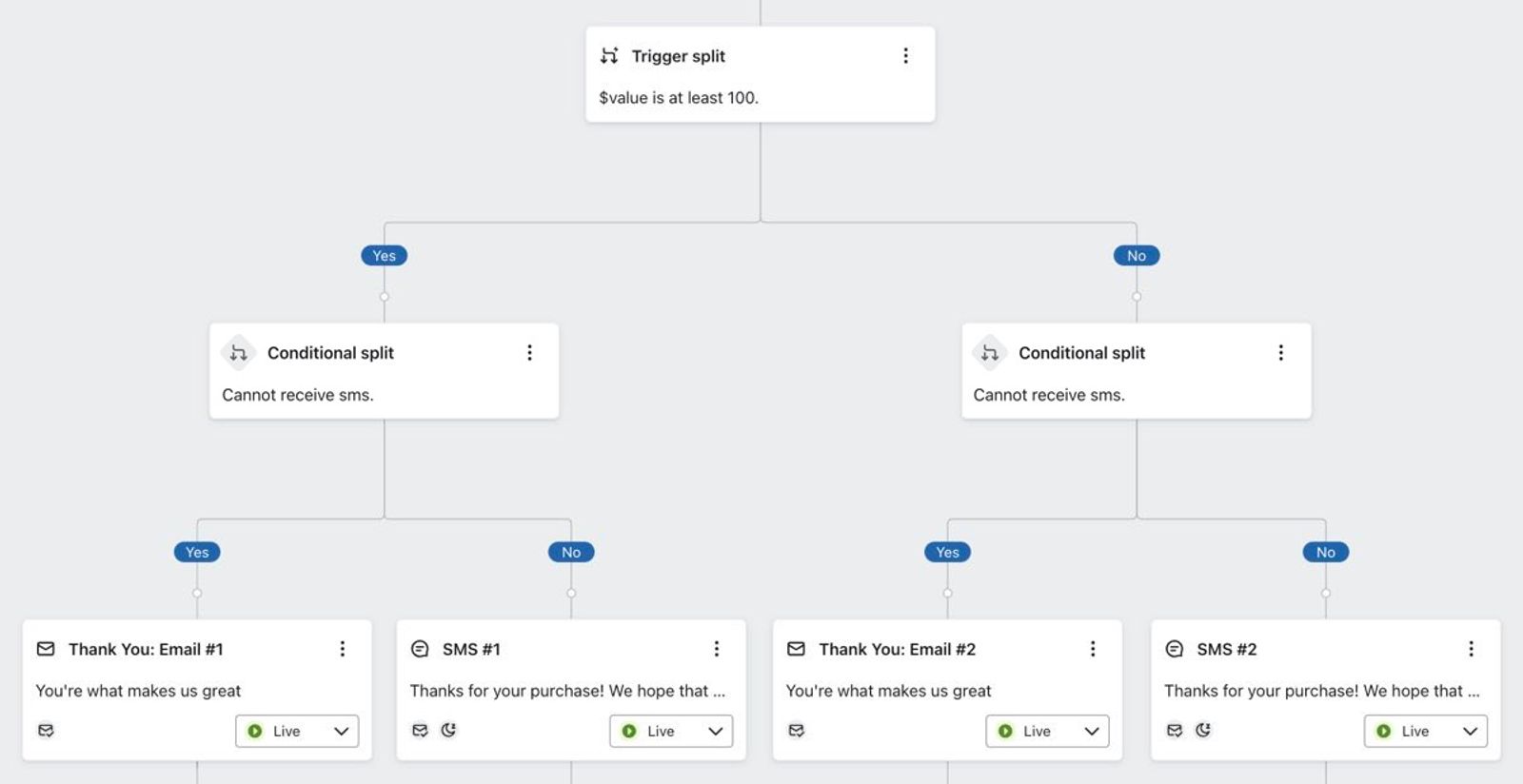
Order value split
To tailor messages by order value in a Placed Order flow:
- Drag Split from Logic to where you want to separate customers by order value. On the canvas, click Add path criteria on Path #1.
- Set Properties of Placed Order > $value > is at least > 100, then click Save. Replace 100 with the order value you want to use. If your sidebar shows Trigger split instead, add it, set $value > is at least > 100, and click Save.
- On both Path #1 and Everyone else (YES and NO for a Trigger split), add a split that checks SMS consent and add your email and SMS messages using the steps above.
Order collection split
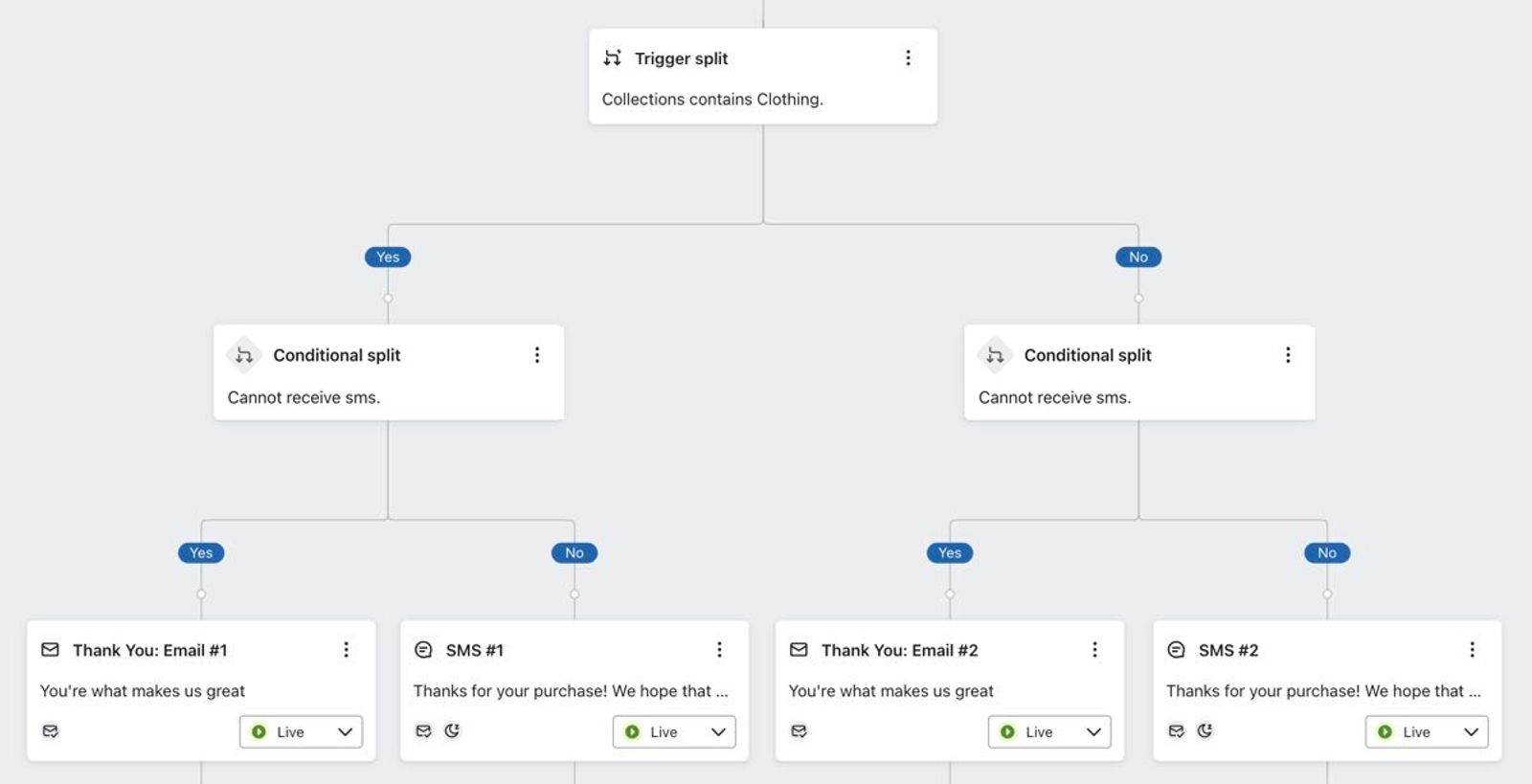
To tailor messages by item collection, use an order event that includes Collections, such as Shopify’s Placed Order event. If the property is not available for your flow’s trigger, you cannot use this collection condition.
- Drag Split from Logic onto the flow. On the canvas, click Add path criteria on Path #1.
- Choose Properties of Placed Order (or the corresponding option named for your order event), then set Collections > contains > CollectionName and click Save. Replace “CollectionName” with the name of the collection you want to use. If your sidebar shows Trigger split instead, add it, set Collections > contains > CollectionName, and click Save.
- You can add multiple splits for different collections. On both Path #1 and Everyone else (YES and NO for a Trigger split), add splits that check SMS consent and add your email and SMS messages using the steps above.
New vs. returning customers
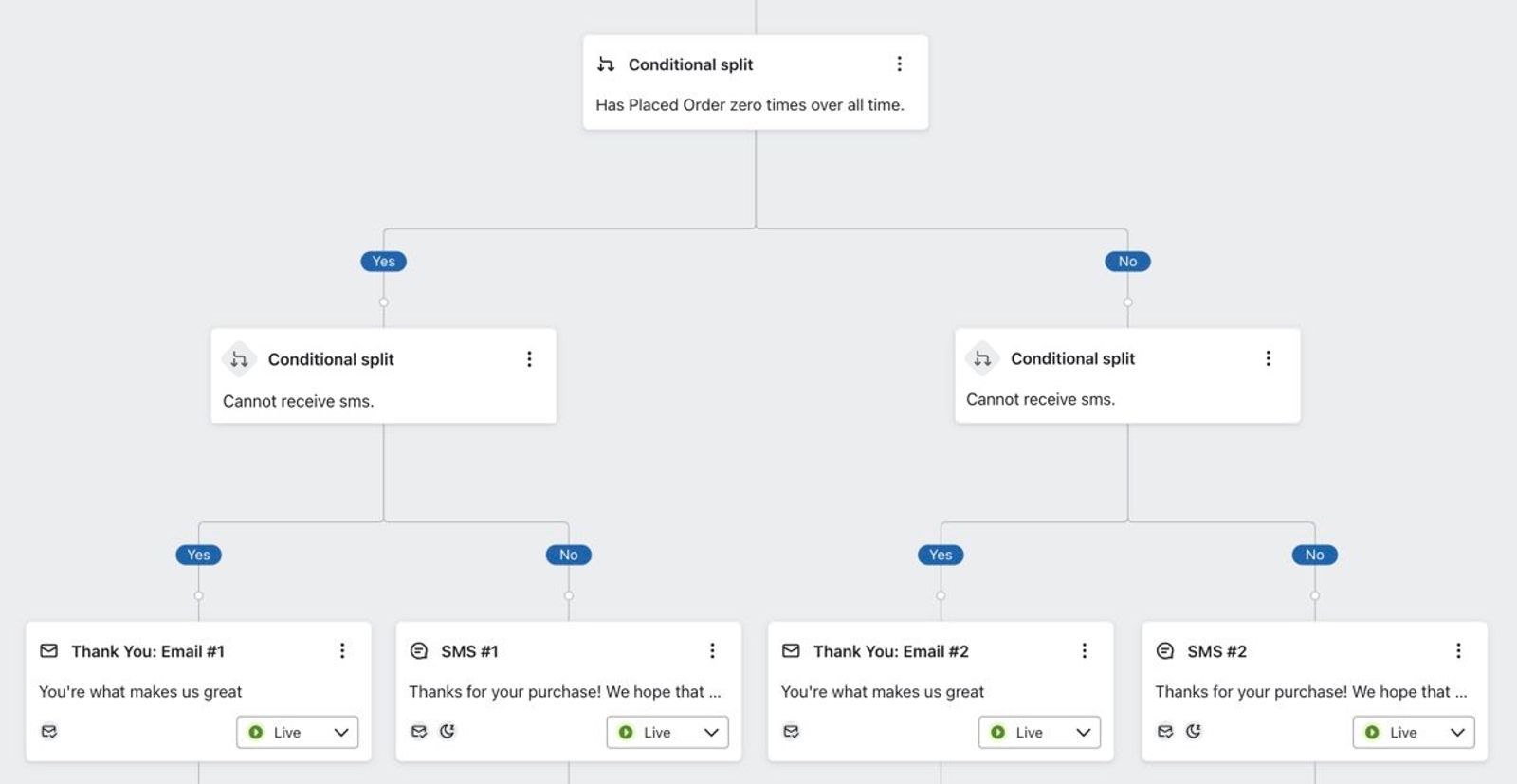
In a Placed Order flow, a first-time customer has placed 1 order, including the purchase that triggered the flow. Use that count to separate new and returning customers:
- Drag Split from Logic directly after the Placed Order trigger. On the canvas, click Add path criteria on Path #1.
- Set What someone has done (or not done) > Placed Order > equals > 1 > over all time, using the Placed Order metric from the same integration as the flow trigger, then click Save. If your sidebar shows Conditional split instead, add it, set the same condition, and click Save.
- First-time customers follow Path #1, and returning customers follow Everyone else (YES and NO for a Conditional split). On both paths, add splits that check SMS consent and add your email and SMS messages using the steps above.
Additional resources
Learn how to use SMS in other flows:
- How to create an SMS welcome flow
Learn how to create a welcome flow for your SMS subscribers.
- How to add SMS to your abandoned cart flow
Learn how to add SMS to your abandoned cart flow as well as compliance requirements and best practices.
- How to add SMS to your browse abandonment flow
Learn how to add SMS to your browse abandonment flow to diversify the type of communication sent to your customers.