Olo data reference
You will learn
Learn what data is synced when you integrate Olo with your Klaviyo account. This includes server-side order data synced directly from Olo, and onsite behavioral events captured as guests browse and order on your Olo Serve site. To sync onsite behavioral events, you must set up onsite tracking via Google Tag Manager.
How to view your data
To view your Olo data:
- Click the Analytics dropdown in the left-hand navigation sidebar.
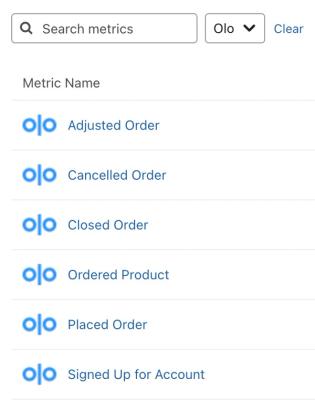
- Select Metrics. Here, you can view all of the metrics in your account. The metrics with a Olo icon represent all of the metrics synced from your Olo integration.
- Filter this view to see only Olo metrics by using the filter selector next to the search bar.
- The Olo integration also captures onsite metrics (Viewed Product, Added to Cart, Started Checkout) if you have set up onsite tracking for Olo via Google Tag Manager. See Track onsite events from Olo with Google Tag Manager to enable them.
Third party deliveries (Uber Eats, DoorDash, etc.) sync from Olo to Klaviyo if they include a valid email address and/or phone number.
Placed Order
This event is tracked when an order was placed (submitted) to Olo and includes all of the product information about the items purchased, store information and order details that can be used in follow up emails, SMS, and other messages.
You can filter and target Placed Order events based on the following criteria:
- Value
The total value of the order, inclusive of fees and any applied discounts. - Brand Name
Configured name for the restaurant. - Client Platform
The associated platform used to place the order; e.g., Web or MobileWeb. - Fulfillment Method
The handoff mode for the order; e.g., pickup or delivery. - Item Count
The total quantity of line items in the order. - Item Names
The names of the products in the order. - Items
The details of each item including name, quantity, description, price, image URL. - Order ID
The unique ID for each placed order. - Ordering Provider
The interface used to place the order; e.g., Olo or DoorDash. - Store Number
Reference to the restaurant’s store.
Closed Order
This event is tracked when an order has reached its estimated ready time and is considered complete in Olo.
You can filter and target Closed Order events based on the following criteria:
- Value
The total value of the order, inclusive of fees and any applied discounts. - Brand Name
Configured name for the restaurant. - Client Platform
The associated platform used to place the order; e.g., web or mobile. - Fulfillment Method
The handoff mode for the order; e.g., pickup or delivery. - Item Count
The total quantity of line items in the order. - Item Names
The names of the products in the order. - Items
The details of each item including name, quantity, description, price, image URL. - Order ID
The unique ID for each placed order. - Ordering Provider
The interface used to place the order; e.g., Olo or DoorDash. - Store Number
Reference to the restaurant’s store.
Ordered Product
This event is also tracked when an order is considered complete in Olo, but a separate event is tracked for each item purchased. The events Klaviyo tracks includes detailed information about each product someone purchases. This is useful when creating behavioral segments based on specific products.
You can filter and target Ordered Product events based on the following criteria:
- Value
The total value of the item purchased. - Name
The name of the ordered product in Olo. - Product ID
The ID associated with the product. - Quantity
The total quantity ordered of the product - Store Number
Reference to the restaurant’s store.
Adjusted Order
This event is tracked when an order has been fully or partially adjusted or refunded.
You can filter and target Adjusted Order events based on the following criteria:
- Value
The total value of the order, inclusive of fees and any applied discounts. - Adjustment Reason
The reason for the adjustment. - Adjustment Type
The type of adjustment; e.g., a full or partial refund. - Brand Name
Configured name for the restaurant. - Client Platform
The associated platform used to place the order; e.g., web or mobile. - Fulfillment Method
The handoff mode for the order, e.g., pickup or delivery. - Item Count
The total quantity of line items in the order. - Item Names
The names of the products in the order. - Items
The details of each item including name, quantity, description, price, image URL. - Order ID
The unique ID for each placed order. - Ordering Provider
The interface used to place the order; e.g., Olo or DoorDash. - Store Number
Reference to the restaurant’s store.
Canceled Order
This event is tracked when an order was canceled by a user or the system.
You can filter and target Canceled Order events based on the following criteria:
- Value
The total value of the order, inclusive of fees and any applied discounts. - Brand Name
Configured name for the restaurant. - Canceled Reason
The reason for the cancellation. - Client Platform
The associated platform used to place the order; e.g., web or mobile. - Fulfillment Method
The handoff mode for the order; e.g., pickup or delivery. - Item Count
The total quantity of line items in the order. - Item Names
The names of the products in the order. - Items
The details of each item including name, quantity, description, price, image URL. - Order ID
The unique ID for each placed order. - Ordering Provider
The interface used to place the order e.g., Olo or DoorDash. - Store Number
Reference to the restaurant’s store.
Track sign-ups
This event is tracked when a user has created an account in Olo (not applicable to guests).
If the user chooses to allow email, the user will also be subscribed to the configured email list with a Subscribed to List event in Klaviyo.
Onsite events (via Google Tag Manager)
The following events are tracked onsite on your Olo Serve ordering site and require setting up onsite tracking via Google Tag Manager. They power browse abandonment, cart abandonment, and full-funnel segmentation. If you haven't set this up, these events won't appear in your account.
Active on Site
Triggered when a guest starts browsing your Olo Serve site.
You can filter and target Active on Site events based on the following criteria:
- os
The operating system the customer is using to browse your site. - browser
The browser the customer is using to browse your site. - page
The page the customer is viewing when browning your site. - initial_page_path
The initial page the guest visited when visiting your site.
Viewed Product
Triggered when a guest views or clicks into a menu item on your Olo Serve site.
You can filter and target Viewed Product events based on the following criteria:
- ProductName
Name of the menu item viewed. - ProductID
Olo product identifier. - Brand
Brand name. - Price
Item price. - Categories
Menu categories the item belongs to. - ImageURL
URL of the item's menu image. - URL
URL of the product/menu page. - Modifiers
Item modifiers, when present.
Added to Cart
Triggered when a guest adds an item to their cart. Fires once per item type added (adding multiples of the same item is captured in AddedItemQuantity).
You can filter and target Added to Cart events based on the following criteria:
- $value
Total value of the current cart. - AddedItemProductName
Name of the item just added. - AddedItemProductID
Olo product identifier of the item just added. - AddedItemCategories
Menu categories of the item just added. - AddedItemImageURL
Menu image URL of the item just added. - AddedItemURL
Product page URL of the item just added. - AddedItemPrice
Unit price of the item just added. - AddedItemQuantity
Quantity of the item just added. - AddedItemModifiers
Modifiers selected for the item just added. - ItemNames
Names of all items currently in the cart. - CheckoutURL
URL to the cart/checkout.
Started Checkout
Triggered when a guest begins the checkout process.
You can filter and target Started Checkout events based on the following criteria:
- $value
Total pre-tax value of the cart. - ItemNames
Names of all items in the cart. - Quantity
Total quantity of all line items in the cart. - CheckoutURL
URL to the checkout. - Categories
All menu categories represented in the cart. - Modifiers
All modifiers selected across the cart. - FulfillmentType
Fulfillment method — Pickup or Delivery. - Brand
Brand name.
Synced guest data
In addition to the metrics Klaviyo syncs from Olo, Klaviyo also creates a unique profile for every customer that syncs with a valid email address and/or phone number. When Klaviyo syncs contact information, there are also certain custom properties that may get added to each Klaviyo profile. You can use these properties in segments and in flows.
You can also use the Olo User ID property to identify profiles who represent the same user in Olo if you would like to merge those profiles. For more information on merging profiles, see our article on How to delete, merge, and export a profile.
When you have onsite tracking enabled, anonymous guests are identified once they enter their first name, last name, and a valid email or phone number on the Olo checkout sign-in form. This attaches their onsite activity (Active on Site, Viewed Product, Added to Cart, Started Checkout) to a Klaviyo profile.
Here are the properties that are automatically synced from Olo:
- Email, first and last Name, phone number
These built-in Klaviyo fields are automatically populated with all available data from Olo. - Olo Customer
Indicates that a profile is present within Olo. - Olo User ID
User ID in Olo. - Email consent
Consent for email marketing. - SMS consent
Consent for SMS marketing.
Additional resources
- Getting started with Olo
Learn how to integrate with Olo, a tool that assists restaurants with online ordering.
- How to create a post-purchase flow
Learn how to set up a post-purchase flow in Klaviyo as well as best practices for doing so. A post-purchase flow triggers after a customer has placed an order while your ecommerce platform is integrated with Klaviyo. Sending post-purchase emails builds relationships and brand loyalty with your customers and makes them more likely to purchase again.