Getting started with Dutchie POS
This reference is about the Dutchie v1 integration, which was built by Klaviyo and is no longer allowing new installations. New customers should use the Dutchie integration in Klaviyo’s app marketplace, built by KAV Labs. Learn more on KAV Labs’ help center.
You will learn
Learn how to use customer profiles and order data synced to Klaviyo by an existing Dutchie Point of Sale (POS) v1 integration. With this data, you’ll be able to reach customers with targeted messaging through segmentation, campaigns, and flows.
An existing Dutchie v1 integration syncs customer profiles and order data to your Klaviyo account going forward.
Note that Klaviyo’s integration does not currently sync any web data from Dutchie Ecommerce to Klaviyo (such as Started Checkout, Order Submitted, etc.). Only Dutchie POS events (that is, Placed Order and Ordered Product) can be synced. Without web events like Started Checkout, you will not be able to use Klaviyo flows like Abandoned Cart.
Before you begin
- You are responsible for ensuring compliance with any cannabis-related laws in the territories you are operating in and the territories where the customers you are marketing to are located.
- In Dutchie, product images can flow from POS to Ecommerce, but they do not flow from Ecommerce to POS. To ensure that Klaviyo can sync product images, make sure you are updating images via Dutchie POS.
- In a typical Dutchie setup, each state-level retailer (parent) has multiple individual locations (children). Child locations are separate instances in Dutchie, each with their own API keys. An existing Dutchie v1 connection can include the child locations specified during setup (from a single parent) in one Klaviyo account.
- Profile and transactional data is unified at the parent level, but we specify locationName within synced order data.
New Dutchie integrations
For a new connection, use the Dutchie integration in Klaviyo’s app marketplace, built by KAV Labs. The Klaviyo-built Dutchie v1 integration no longer accepts new installations. The remaining sections apply to existing Dutchie v1 connections.
Data synced from Dutchie POS to Klaviyo
To check on the data sync from Dutchie POS to Klaviyo:
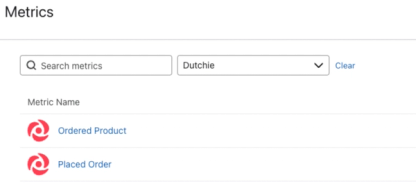
- In your Klaviyo account, select Analytics > Metrics.
- Open the Integration filter and select Dutchie.
Here, you’ll see a list of order events synced from Dutchie POS to Klaviyo:
The data synced from Dutchie to Klaviyo includes:
- Profile information associated with order events.
- The following order events:
- Placed Order
- Ordered Product
Klaviyo will only sync profiles that have an email address. We recommend turning on the setting Require email address for guest checkout in Dutchie Ecommerce, which can be found under Settings > Options > Checkout. The email address will sync to Dutchie POS.
For more information on the properties associated with events synced from Dutchie, check out our article Dutchie POS data reference.
Add onsite tracking (optional)
You can choose to manually add Klaviyo’s onsite JavaScript, known as Klaviyo.js, to your Dutchie site via Google Tag Manager. Klaviyo.js enables Active on Site tracking and the use of Klaviyo sign-up forms. Google Tag Manager is supported by both Dutchie and Klaviyo.
Read about how to add Klaviyo onsite tracking using Google Tag Manager.
Dutchie and email sending
Email marketing consent collected during a Dutchie Ecommerce checkout is not synced to Dutchie POS. The Dutchie v1 integration only syncs data from Dutchie POS, so this consent is not passed to Klaviyo.
For instance, the following scenario could occur:
- Your customer places a delivery order online and provides their email at checkout. They choose to subscribe to email via a checkbox.
- The email provided in the online checkout is attached to the order.
- The order is delivered, and the customer checks out using the POS.
- The placed order information, along with the attached email address, syncs to Klaviyo, but email subscription information from the online checkout does not sync to Klaviyo.
When a synced profile has no email subscription history in Klaviyo, its email consent status is Never Subscribed. Profiles marked as Never Subscribed can technically receive emails, though they have not provided explicit consent. To learn more about marketing consent and its best practices, read our guide about explicit versus implicit consent.
Note that for catalog items, Klaviyo cannot capture the Product URL from Dutchie. It is recommended to style the product as unlinked in your emails. You can choose to manually add product links, or links to anywhere on your site, to your emails.
Dutchie and SMS sending
Klaviyo does not allow SMS sending for Dutchie merchants. This is because mobile carriers prohibit SMS and MMS sending about certain substances, which include marijuana/cannabis.
Dutchie use cases
Here are some example use cases for email sending using Dutchie data:
- Product recommendations
Use a Klaviyo product feed to send customers recommendations based on their previous orders. - VIP customer messaging
Create a VIP segment in order to target your most valuable customers. - Product education
Educate your customers about the products you offer through a newsletter or targeted sends. - Sales and promotion notifications
Let your customers know when a sale is happening, and target customers’ preferred product categories using segmentation. - Loyalty program communications and offers
Further engage your VIP customers by building a VIP loyalty program with Klaviyo.
Outcome
You’ve learned how to check data synced by an existing Dutchie v1 integration. Now, you can create automated flow messages, personalize campaigns, segment your lists, and more based on data synced from Dutchie POS.
Why am I seeing the notification “Your account is calling a retired revision”?
Are you seeing a notification in Klaviyo that reads “[ACTION Required] Your account is calling a retired revision”, like the one below?
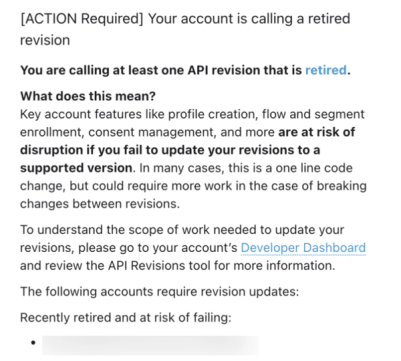
For the Klaviyo-managed Dutchie v1 integration, no action is currently needed in response to this notification, and the integration will continue to work as expected. If the notification concerns another integration or a custom API connection, follow the notification’s guidance.
Additional resources
- Dutchie POS data reference
Learn what data is synced from Dutchie POS to Klaviyo, how to view it, and what properties Dutchie events contain. Additionally, learn how to view your Dutchie data in Klaviyo.
- Getting started with Klaviyo