Understanding Klaviyo's account hierarchy
Why this matters
Klaviyo uses three different structures to organize businesses and users. While every customer works in an account, portfolios and organizations serve different purposes for account management. Understanding how they differ helps you choose the right setup as your business grows
The Klaviyo hierarchy
Organizations and portfolios both connect multiple accounts, but they serve different purposes. Organizations provide centralized ownership and governance, while portfolios provide a convenient way to access and monitor multiple accounts.
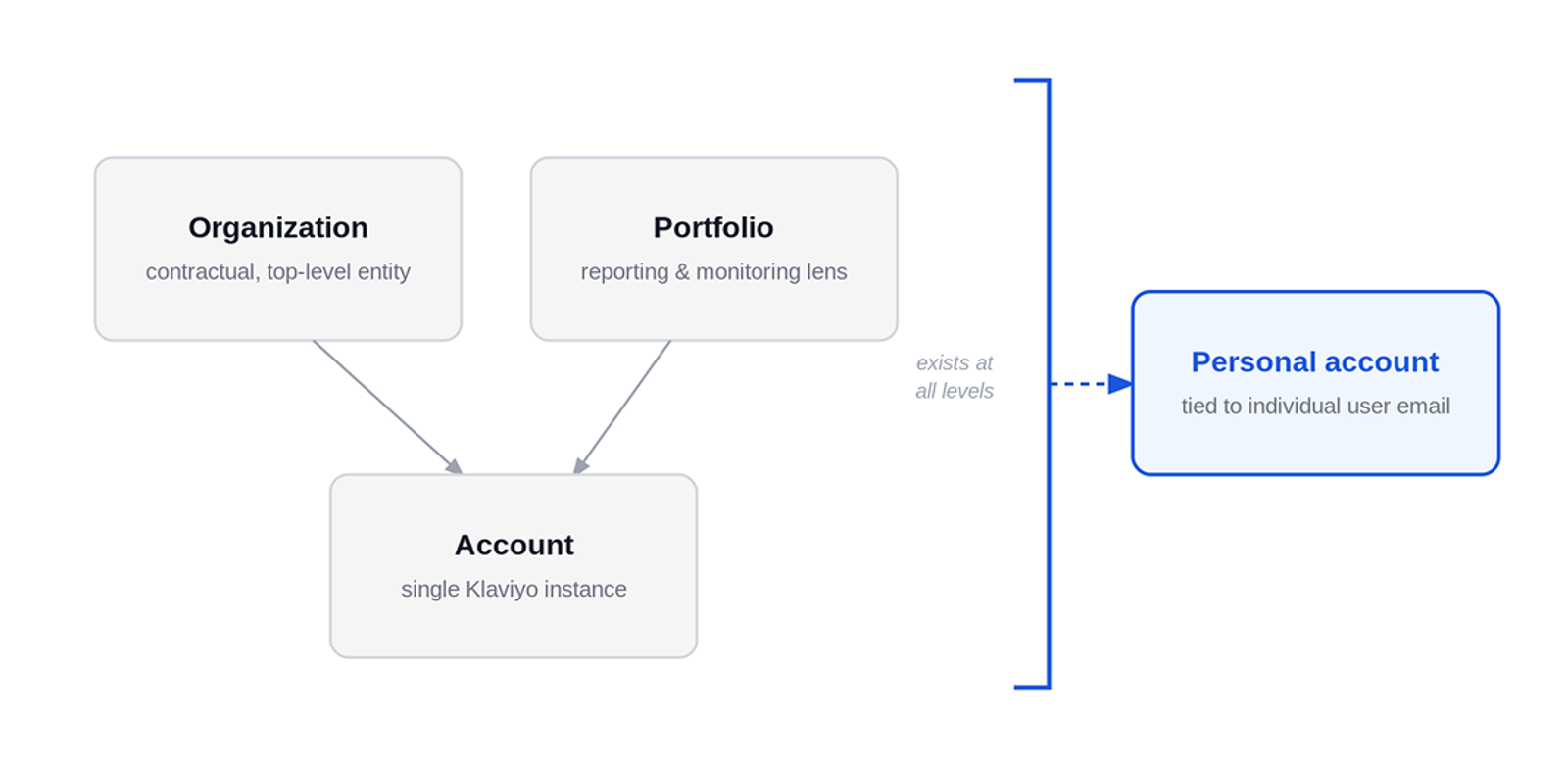
Core concepts
Account
An account is the core workspace in Klaviyo. Each account is a self-contained environment with its own profiles, lists, segments, campaigns, flows, integrations, sending domains and billing.
Portfolio
A portfolio is a grouping of accounts for aggregated reporting. No legal agreement or ownership required, it acts as a monitoring lens, not a governance structure.
Organization
An organization formally connects multiple accounts under one legal entity, allowing centralized administration, shared security policies, permissions, and optional cross-account data capabilities.
Personal account
Your personal account contains your login information and preferences. It follows you across every account, portfolio, and organization you can access.
Which structure is right for your business?
Area | Organizations | Portfolios |
|---|---|---|
Focus | Governance and data actionability | Reporting and external management |
Audience | Enterprise C-Suite, Legal counsel, Global admins | Agency partners and SMB's |
Primary use | Centralized command, unified identity, cross-sell activation | Agency client management, aggregated reporting |
Access model | Zero trust — nothing until explicitly assigned | All-or-nothing |
Data sharing | Advanced — contractual, cross-account profile merging | Limited — read-only view |
Legal basis | Formal contractual relationship | Informal, self-service |
Additional resources
- Getting started with portfolios
Learn about portfolios in Klaviyo, including what they are, who should use them, and how to set them up.