How to calculate retention rate
You will learn
Retention rate calculations provide useful insights into how loyal your customer base is and where you may need to improve upon to increase purchase behavior. Retention rate goes beyond finding out who your recent customers are; rather, it takes into account purchases over a set window of time to gauge long-term customer behavior.
Calculate retention rate
There are three steps you must take to calculate retention rate.
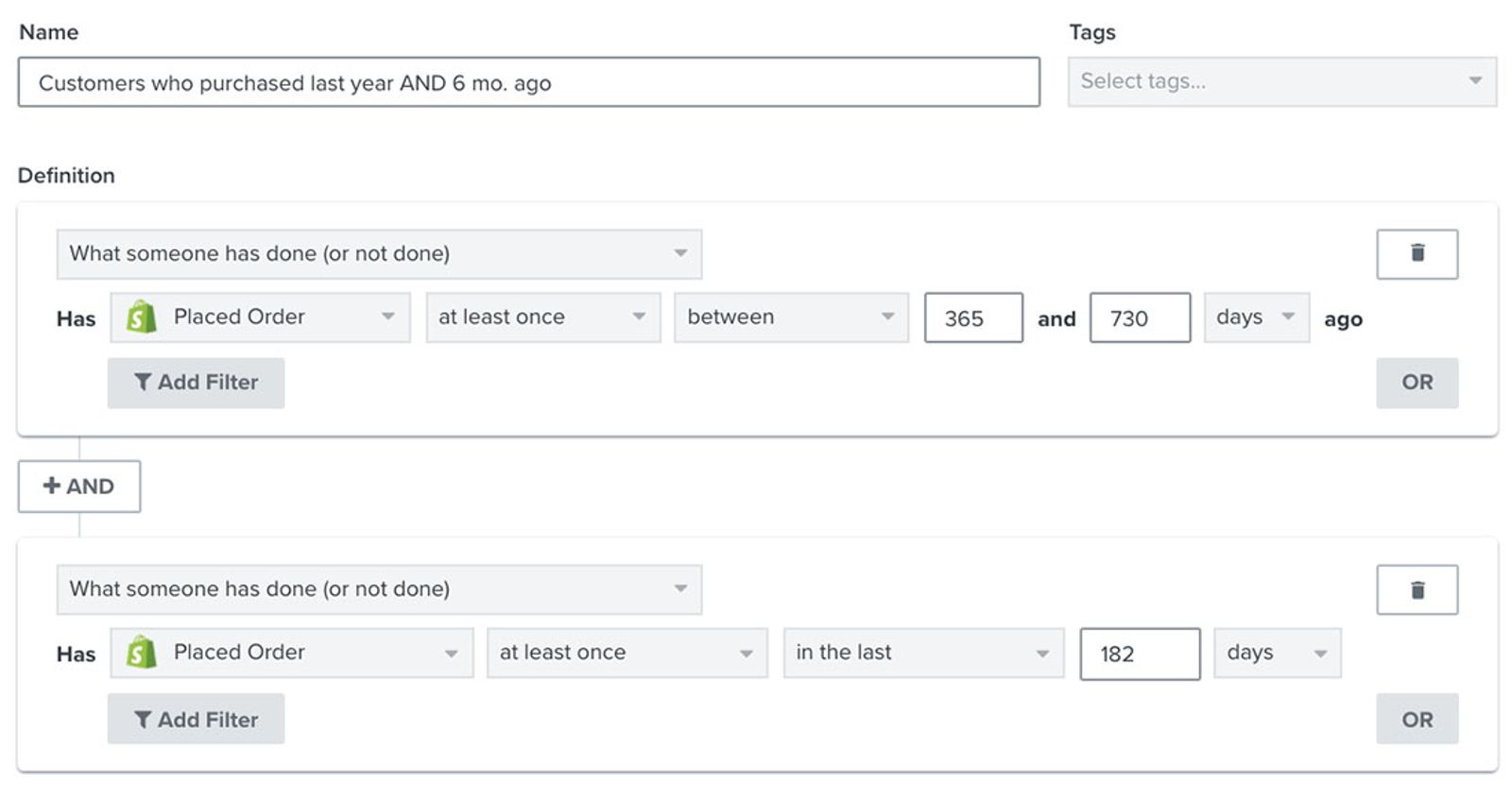
- Create a segment of customers who purchased last year AND within the last 6 months
- Create a segment of customers who purchased from your store last year
- Calculate
Note that you can craft your own custom timeframe if the one above does not work for your business model. For example, if you are a subscription business, you can cater to this timeline in a way that makes the most sense for your customer’s purchasing timelines.
1. Create a segment of customers who purchased from your store last year (between 365 to 730 days ago) who have also purchased recently (e.g., in the last 6 months). These are repeat customers from the past year. An example of this segment is shown below.
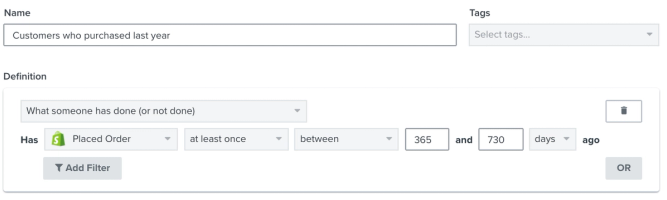
3. Now that you have your two segments prepared, you can begin to calculate your retention rate. Use the formula below for retention rate:
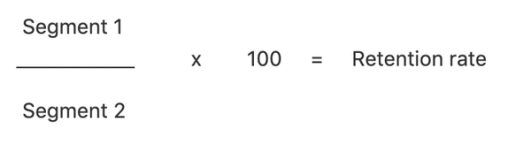
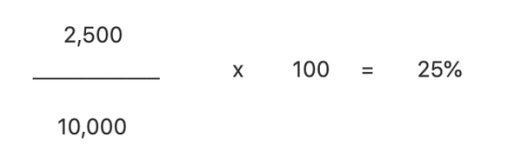
For example, if your first segment (of those who purchased last year and in the last six months) has 2,500 profiles included, and the number of profiles who purchased last year in total was 10,000. Your equation would be the following:
Additional resources
- How to calculate average order value (AOV)
Learn how to calculate your average order (AOV) or the total monetary value of your conversions (orders) divided by the number of conversions (orders that took place). Calculating your average order value (AOV) can be helpful when you want to add a condition to your segments to target high value or low value customers.
- How to segment by customer lifetime value (CLV)
Learn how to create a customer lifetime value (CLV) segment and export any key CLV information. CLV is part of Klaviyo's predictive analytics and can be a powerful tool to use in segmentation. It is the total amount, both past and predicted, that a customer will purchase from your brand over time. CLV segments allow you to group customers based on this amount so that you can send them relevant content and trigger segment-based flows. For example, you can use historic CLV to build a VIP welcome flow or use predicted CLV to send targeted campaigns to customers who will likely spend a certain amount over the course of a year.
- How to calculate revenue per recipient
Learn how to calculate revenue per recipient (RPR) and understand how each of your marketing channels is performing. RPR helps you to determine the success of a campaign or flow and is a great way to review individual channel performance and opportunities for growth.
- Understanding Klaviyo's predictive analytics
Learn more about the different types of predictive analytics data displayed in your account, the various ways Klaviyo computes this, and guidelines for how you can utilize this data.