Magento 2 data reference
Learn what data Klaviyo imports from your Magento 2 store when you integrate the two platforms. The initial historical sync imports up to 5 years of order and customer data, including information associated with past placed and fulfilled orders. Once enabled, the integration also syncs order and customer data every 30 minutes.
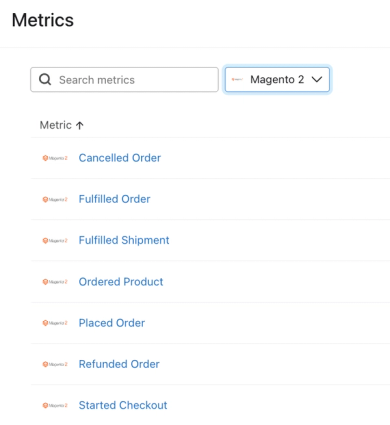
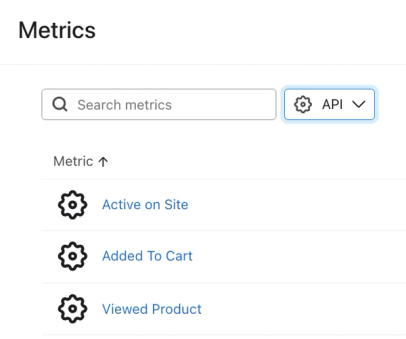
In Klaviyo, navigate to Analytics > Metrics in the left sidebar to view all of the metrics in your account; the metrics with a Magento 2 icon are the events synced from your Magento 2 integration. You will also see Klaviyo onsite tracking events with a gear icon; these are also tracked through the integration.
How Klaviyo determines Magento 2 metrics
Order metrics
Klaviyo records a Placed Order event for each order it syncs. It also uses the order’s current Status and status history in Magento 2 to record additional order metrics.
When an order is created or updated, Klaviyo checks its current status and status history. The table below shows the standard mappings. Orders with pending_payment or a custom status configured to be ignored are excluded.
Magento Order Status | Metrics triggered in Klaviyo |
complete | Placed Order and Fulfilled Order |
canceled, cancelled | Placed Order and Cancelled Order |
pay_aborted | Placed Order and Cancelled Payment |
closed | Placed Order and Refunded Order |
All other order statuses, except ignored statuses | Placed Order |
If you have custom order statuses that should not trigger a Placed Order metric, or do not align with the table above, please let us know so we can configure the custom statuses to ignore or map to additional order events.
Orders with a status of “pending_payment” will be ignored.
Started Checkout metric
With a standard Magento checkout, this event is triggered when a customer enters their contact and shipping information on the first page of the Magento checkout process and clicks Continue.
The Started Checkout event relies on a cart (called a quote in Magento) with an associated email address. Klaviyo syncs it only if the cart is still active and contains items when the sync runs.
If the customer completes the order before the cart syncs, the cart is no longer active and Klaviyo skips it. A Placed Order event is recorded when the order syncs, unless its status is ignored. A Started Checkout event that has already synced remains in Klaviyo. Note that it may take up to 1 hour for Started Checkout events to sync to Klaviyo.
Fulfilled Shipment metric
This metric is triggered when a new Shipment is created in your Magento 2 store.
Magento 2 metric data
This section covers the Magento 2 metrics and the data that is available for filtering when creating segments and flows.
Cancelled Order
This event is triggered when an order status is changed to cancelled or canceled in your Magento 2 store.
- ProductCategories
The categories of the products in the cancelled order. - Value
The value of the cancelled order. - Discounted
(True or False) The discount state of the cancelled order. - ProductNames
The names of the products in the cancelled order. - ItemCount
The number of line items in the order, not the total quantity of units. - OrderCurrencyCode
The currency code used with the cancelled order. - CartPriceRuleIDs
An array of Cart Price Rule IDs (numeric id strings) which include automatically applied rules and the rule for an applied coupon. - external_catalog_id
Used in catalog organization in Klaviyo.
Fulfilled Order
This event is tracked when you set an order status to complete in your Magento 2 store.
- ProductCategories
The categories of the products in the order. - Value
The value of the order. - Discounted
Whether the order is discounted or not. - ProductNames
The names of the products in the order. - ItemCount
The number of line items in the order, not the total quantity of units. - OrderCurrencyCode
The currency code used with the order. - external_catalog_id
Used in catalog organization in Klaviyo.
Fulfilled Shipment
This event is tracked when a new Shipment is created in your Magento 2 store.
- StoreName
The name of the store where the order was placed. - StoreID
The ID of the store where the order was placed. - BillingAddress
The billing address for the order. - Tracks
Information on shipment tracking. - external_catalog_id
Used in catalog organization in Klaviyo.
Ordered Product
Klaviyo records 1 Ordered Product event per unit ordered, up to 100 events per line item. For example, an order for 3 of the same T-shirt produces 3 Ordered Product events, each with a Quantity of 1. For products sold in fractional quantities, Klaviyo records 1 event with the ordered quantity.
- SKU
The SKU of the product. - OrderCurrencyCode
The currency code of the product. - Price
The value of the product. - Categories
The category of the product. - Discounted
(True or False) Whether a discount was applied to the product. - Quantity
The quantity represented by this event: 1 for whole-unit purchases, or the ordered quantity for products sold in fractional quantities. - Value
The value of the product. - ProductID
The ID of the product. - RootProductID
The ID of the parent product. - external_catalog_id
Used in catalog organization in Klaviyo.
Ordered Product metric has a number of other data fields available for tracking. View the raw data of an individual Ordered Product event to see all of the available data for this event.
Placed Order
This event is tracked when a user places an order.
- ProductCategories
The categories of the products in the order. - Value
The value of the order. - Discounted
Whether the order is discounted or not. - ProductNames
The names of the products in the order. - ItemCount
The number of line items in the order, not the total quantity of units. - OrderCurrencyCode
The currency code used with the order. - CartPriceRuleIDs
An array of Cart Price Rule IDs (numeric id strings) which include automatically applied rules and the rule for an applied coupon. - external_catalog_id
Used in catalog organization in Klaviyo.
Refunded Order
This event is triggered when an order’s status is closed in Magento 2. A partial refund that leaves the order in another status does not trigger Refunded Order through the standard status mapping.
- Value
The value of the order. - Discounted
Whether the order is discounted or not. - ProductNames
The names of all the products in the order. - ItemCount
The number of line items in the order, not the total quantity of units. - OrderCurrencyCode
The currency code used with the order. - ProductCategories
The categories of the products in the order. - CartPriceRuleIDs
An array of Cart Price Rule IDs (numeric id strings) which include automatically applied rules and the rule for an applied coupon. - external_catalog_id
Used in catalog organization in Klaviyo.
Started Checkout
This event is triggered when a customer with a known email address begins a checkout and the cart is still active with items when Klaviyo syncs it. On a standard checkout page, the customer enters their contact and shipping information and clicks Continue. If they complete checkout before the cart syncs, Klaviyo skips Started Checkout and records Placed Order when the order syncs, unless its status is ignored. Completing an order does not remove a Started Checkout event that has already synced.
- Value
The value of the order during the checkout. - ItemCount
The number of line items in the cart, not the total quantity of units. - Items
The items in the order. - ProductCategories
The categories of the products in the order. - ProductNames
The names of the products in the order. - StoreName
The name of the store where the order was started. - StoreID
The ID of the store where the order was started. - external_catalog_id
Used in catalog organization in Klaviyo.
Added To Cart
Please note that this metric is only tracked if you are using Klaviyo extension version 4.0.0 and above. This metric is tracked when a customer who has been cookied by Klaviyo adds an item to their cart.
It includes detailed information about the item that was added. This is useful when creating segments based on what products users have added to cart, or when building an abandoned cart flow. You can filter and target Added To Cart metrics based on the following criteria:
- MaskedQuoteId
MaskedQuoteId or Unique identifier for logged in customers. - AddedItemCategories
The categories to which the item belongs. - AddedItemProductName
The name of the product in your store (e.g., Red T-shirt). - AddedItemDescription
The description of the item. - AddedItemImageURLKey
The URL of the image of the item. - AddedItemPrice
The price of the item. - AddedItemProductID
The custom ID in your Magento 2 store of the product, e.g., 1234. - AddedItemSKU
The SKU of the item in your store (e.g., REDMEDIUMTSHIRT). - AddedItemURL
The URL of the item. - external_catalog_id
Used in catalog organization in Klaviyo. - integration_key
Your eCommerce platform (Magento 2).
Use the MaskedQuoteId value from the Added To Cart event to create a link that rebuilds the customer's cart when they return from an email on another device. Use the following URL:
{{ organization.url|trim_slash }}/reclaim/checkout/cart?quote_id={{ event.MaskedQuoteId }}Viewed Product
This metric is tracked when a customer Klaviyo can identify views a product on your site. You can filter and target Viewed Product metrics based on the following criteria:
- ProductID
The ID of the product. - Name
The name of the product. - SKU
The SKU for the product. - URL
The URL for the product. - Price
The price of the product. - FinalPrice
The final price after any discounts. - Categories
An array containing the categories the product belongs to. - ImageURL
The URL for the product's image. - external_catalog_id
Used in catalog organization in Klaviyo. - integration_key
Your eCommerce platform (Magento 2).
Active on Site
This metric is tracked when a customer Klaviyo can identify is active on your site. You can use Active on Site activity in segments and flows, but the event properties below are not available for segment or flow filters. You can inspect them in the event’s raw data:
- utm_medium
The medium for the utm tracking parameter (e.g., campaign). - kx_present
True when the kx parameter is present in the URL. The field is omitted when the parameter is absent. - os
The operating system of the user's device. - initial_page_path
The URL path of the initial page the user landed on. - browser
The user's browser type. - page
The URL of the page the user was active on. - utm_campaign
The UTM tracking parameter for the campaign. - utm_source
The UTM source (e.g., Klaviyo).
Synced customer data
Klaviyo creates or updates profiles from synced orders, customer records, and started checkouts. The following information is added when it is available in the source data:
- First and Last Name
- City, State/Region, Zip Code, Country
- Phone Number
- Magento Account Created (e.g., YYYY-mm-dd hh:mm:ss; 2015-05-21 13:04:00)
- Magento Customer Group (e.g., Wholesale)
- Magento Store (e.g., US Store)
- Date of Birth (e.g., YYYY-mm-dd; 1990-03-25)
- Gender
If you update the customer group in Magento 2, even after the original profile has been created in Klaviyo, the customer group will update in Klaviyo.
MagentoWebsiteID is synced when the customer or order has an associated Magento store. Suppressions are not copied into Klaviyo.
Klaviyo supports a custom media root URL for product images hosted at a different base URL. See the Magento 2 setup guide for configuration instructions.
Revenue value
When you use Magento 2’s Placed Order metric to measure revenue, cancelled and refunded orders are not subtracted automatically. This can make the revenue shown in Klaviyo differ from the revenue shown in Magento.
Additional resources
- Getting started with Magento 2.x (CE and EE)
Learn how to integrate Klaviyo with your Magento 2 CE or EE store. You'll need to install the Klaviyo extension in Magento, configure the extension and set up OAuth, then enable the integration in Klaviyo. This guide covers all required integration steps, as well as how to confirm your historical data sync is successful.
- Troubleshooting your Magento 2 integration
Learn how to solve issues with your Magento 2 OAuth setup by following the troubleshooting steps described below. If you are still encountering issues after running through these steps, please reach out on our Community or to our Support Team.