Understanding initial source tracking with JavaScript
You will learn
Learn where to find the Initial Source property on a profile and understand how it records the first website visit captured by Klaviyo's onsite tracking.
To collect this information, set up Klaviyo onsite tracking on your website. Klaviyo can capture the referring page and landing page before a visitor is identified, then associate that information with their profile when they are identified.
Accessing the initial source information
- Open a profile and select the Details tab.
- In the Information section of the profile, find How they found you. The Campaign field shows the profile's Initial Source value.
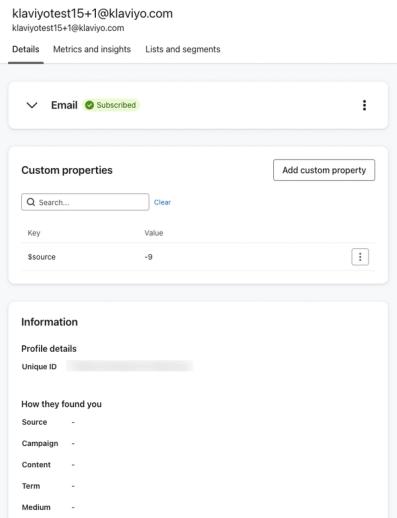
The separate Source field can show a search engine name, a referring domain, (direct), or the landing URL's utm_source value.
Possible values
The possible Initial Source values, shown next to Campaign, are:
- (direct)
The person either entered your site URL directly in their browser or we cannot tell where the person came from. - (referral)
The person came from another website by clicking a link on that site. - (organic)
Klaviyo recognized a search engine and search term in the referring URL. Search visits without a detectable search term can appear as (referral). - A custom campaign value
If the landing URL includesutm_campaign, its value appears here. For example,utm_campaign=spring_salesets Initial Source tospring_sale. Learn more about UTM tracking in Klaviyo.
If the landing URL contains utm_source, utm_medium, utm_term, or utm_content without utm_campaign, Campaign is blank. Missing values appear as a dash (-).
Initial source information stays the same on later visits. To see more recent referral information, check How they found you recently in the same Information section.
Additional resources
- Understanding message conversion tracking
Learn how conversion tracking works for email, SMS, and mobile push messaging and how to edit these settings. For each campaign and flow sent, Klaviyo automatically tracks conversions. This allows you to analyze the performance of your marketing channels and their individual success.
- Understanding UTM tracking in Klaviyo
Learn what UTM tracking is, how it works, and how you can use it in your Klaviyo messages to gain a deeper understanding of your marketing performance.
- Understanding cookies in Klaviyo
Learn more about how Klaviyo uses cookies as a part of our web tracking to gather information and help improve conversion rates and email performance. This article explains the specific cookie we use and its purposes so that you understand how customers are tracked. This information helps you understand how Klaviyo gathers data, and how this may impact customer privacy and compliance laws.