How to add a dynamic image to a push notification
You will learn
Learn how to add a dynamic image to a push notification.
Dynamic images are a great way to personalize your push notifications. For instance, you can show someone the exact product they favorited, started a checkout with, or bought.
Before you begin
You can use dynamic images in:
- Metric-triggered flows, using either event data (e.g., items from a checkout or placed order) or catalog tags for an event.
- Campaigns and list- and segment-triggered flows, but only when the image URL exists as a custom property on the recipient’s profile.
Also, note the following regarding push dynamic images:
- Only 1 dynamic image is allowed per push notification.
- Images must be under 1 MB.
- You can use conditional statements with dynamic images.
Want to request a feature for Klaviyo push notifications? Fill out this Google form to tell us about it!
Add a dynamic image to a push notification
- Select the message where you want to include your dynamic image.
- In the left sidebar, click Configure Content or Edit.
- Add or select the push notification in the flow.
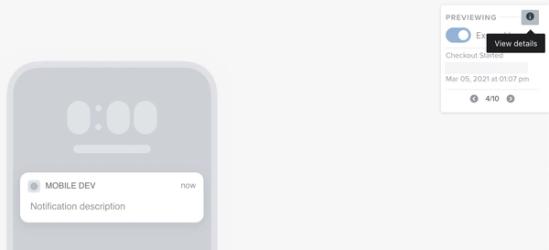
- Click the View details icon in the upper right-hand corner.
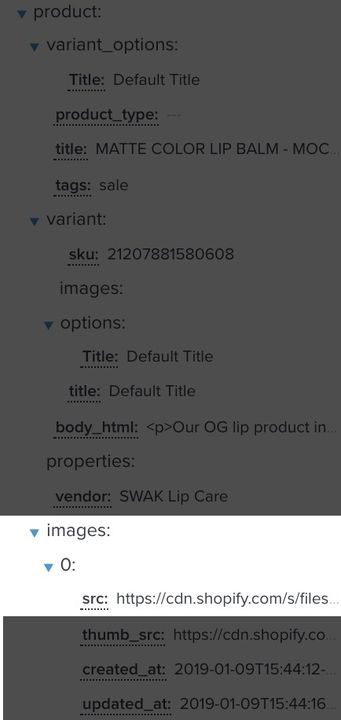
- Find the data source for the image you want to include.
- Click the data source for an image's first variable, which will typically end in 0.
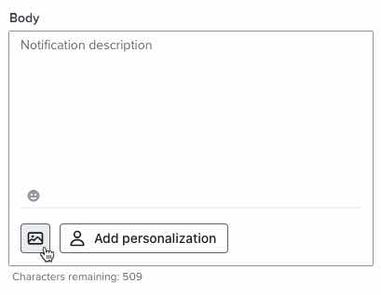
- On the left, click the Insert media icon in the Body box.
- Go to the Dynamic Image tab.
- Paste the dynamic variable or dynamic URL for the image.
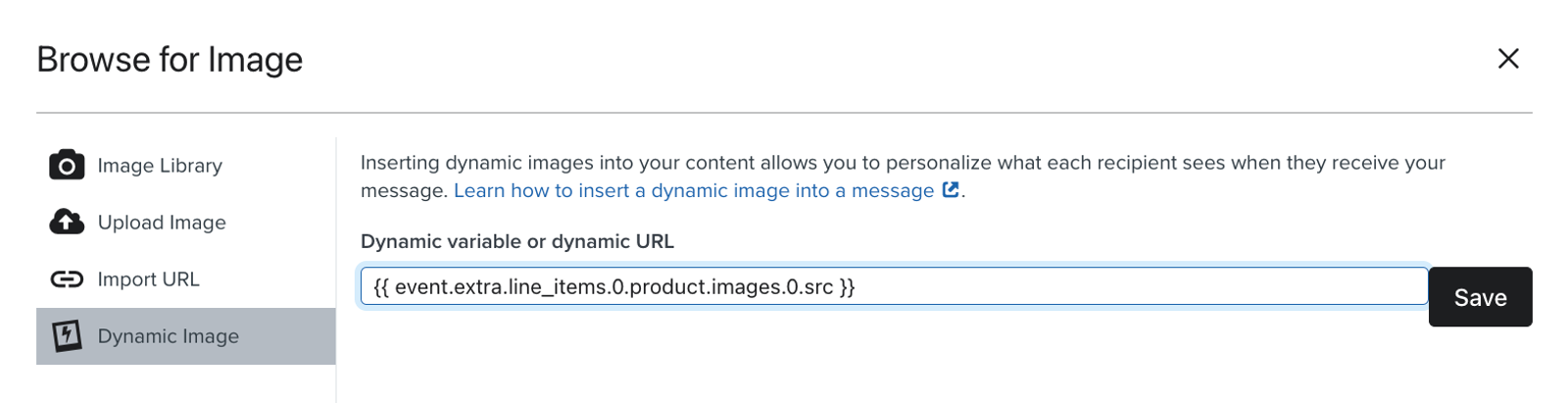
- Click Save.
- Check that the dynamic image was added correctly by making sure one appears in the preview screen.
Example of using catalog tags
You can also use catalog tags to add dynamic images in a rich push notification. To do so:
- Go to Analytics > Metrics.
- Select the metric you want to use (e.g., Ordered Product).
- Click Details for a specific event.
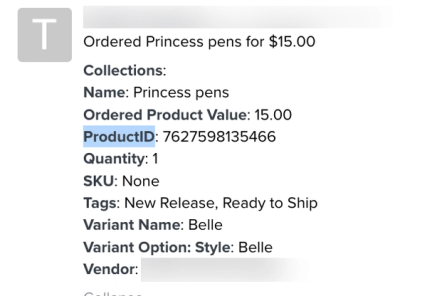
- Find either the SKU or product ID tag.
- Copy the label for the tag (except any parentheses or colon) so you have the exact spelling and capitalization.
In the example below, we copy "ProductID."
- Paste this somewhere you won't lose it.
- Navigate to a flow triggered by the same metric you just selected.
- Select the push notification where you want to include your dynamic image.
- In the left sidebar, click Configure Content or Edit.
- On the left, click the Insert media icon in the Body box.
- Go to the Dynamic Image tab.
- Paste in the following catalog tag:
{% catalog event.id %} {{catalog_item.featured_image.thumbnail.src}} {% endcatalog %} - Replace id in {% catalog event.id %} with the label you previously copied.
Example: {% catalog event.ProductID %} {{catalog_item.featured_image.thumbnail.src}} {% endcatalog %} - Click Save.
Example of using conditional statements for dynamic images
Dynamic images can use conditional statements.
Below is an example of an if/else statement to say that if there's a variant image, show that to recipients; else, use the default image:
{% if event.extra.line_items.0.product.variant.images.0.src %}{{ event.extra.line_items.0.product.variant.images.0.src }}{% else %}{{ event.extra.line_items.0.product.images.0.src }}{% endif %}
Note that the exact format for these statements depends on your integration, and you should not copy them from email templates.
Additional resources
- Understanding rich push notifications
Learn about rich push notifications in Klaviyo. Rich push notifications are available for both campaigns and flows.
- How to use event data to personalize email and SMS flows
Learn what dynamic event data is, when to use it, where to find it, and how to include it in your flow messages. Learn about the different actions your customers take, and how you can use that data for creating personalized messaging flows in Klaviyo. For instance, you could use event data in an abandoned cart flow message to show individuals what product they left behind, an image of the item, and more. This allows for a more personalized experience for the customer, as well as a higher chance of conversion.