How to use the Translation Settings Glossary
You must have a paid Klaviyo account and Smart Translations enabled to use this feature.
What a glossary does
A glossary tells Klaviyo to always translate specific words and phrases your way — brand names, product terms, or regional spelling — instead of leaving it to the default smart translation.
It's especially useful for:
- Brand and product names that shouldn't be translated at all, or that have an official localized form.
- Regional spelling, like translating "color" to "colour" for a British English audience.
- Store-specific terms — loyalty program names, size charts, or shipping terms your team has already translated by hand.
- URLs that need to point to a locale-specific version of your site.
Before you begin
A glossary is set for one source and target language at a time — for example, English → French. If you translate content into several languages, build a separate glossary for each pair.
Open glossary settings
- From any page, go to Settings → Translations.
- Select Glossary from the left-hand menu.
- Use the Source Language and Target Language menus at the top of the page to choose the language pair you want to manage.
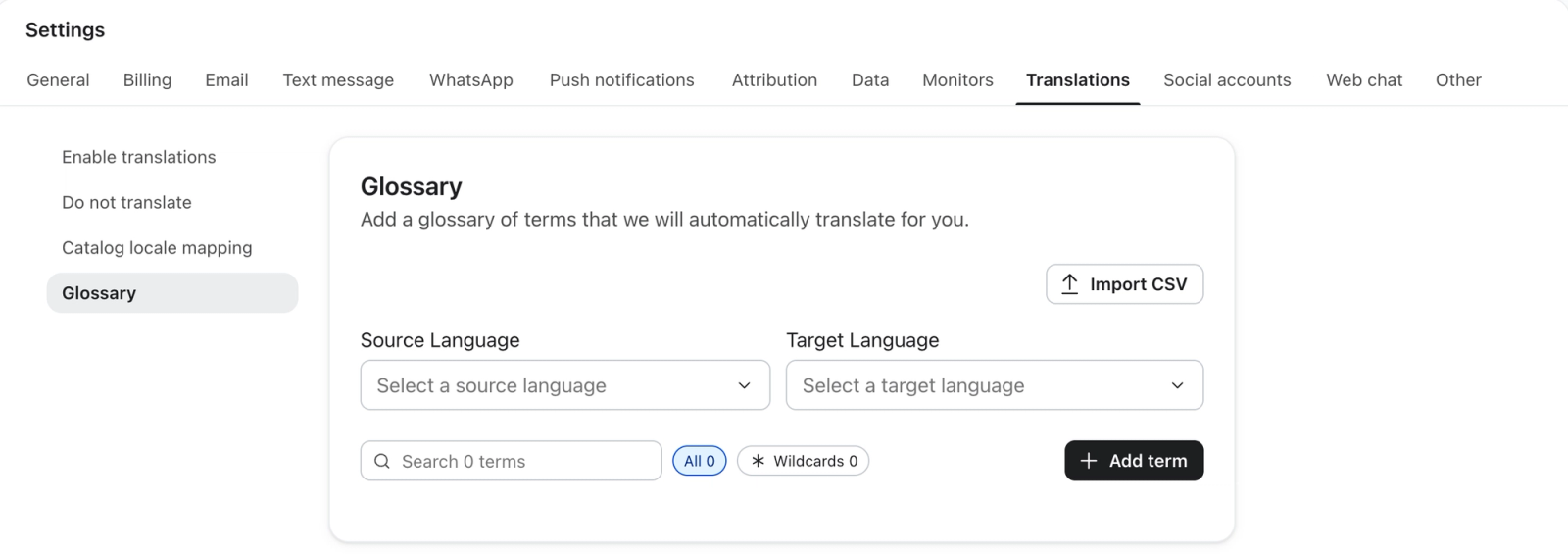
Normal glossary entries
A normal entry is a simple, one-to-one swap: the exact word, phrase, or URL you enter is replaced with the exact translation you provide. No patterns, no wildcards.
Replace a single word or phrase
- With the right language pair selected, click + Add term.
- Enter the word or phrase as it appears in your source content under Source term.
- Enter the exact translation you want to use under Translation.
- Click Save.
The term takes effect the next time matching content is automatically translated.
The term has to appear as a whole word — it won't match as part of a longer word (a rule for "Sale" won't touch "Salesforce"). Matching is also case-sensitive: if a term appears both capitalized and lowercase in your content ("Sale" and "sale"), add both as separate entries.
Replace one exact URL
Same idea as above, but the source term is a full URL — most often used to point a link at the locale-specific version of a page. Because it's an exact match, the destination can be completely different from the source; unlike a wildcard (below), it doesn't have to follow any pattern.
https://example.com/dog → https://example.fr/chien

The translated slug can be completely unrelated to the original — "dog" becomes "chien," not a rewritten version of "dog."
An exact URL entry only ever matches that exact URL. It won't accidentally catch a longer, different URL that happens to start the same way — https://example.com/dog/puppies and https://example.com/dog-toys are left completely untouched by the entry above.
Wildcard glossary entries
A wildcard entry uses an asterisk (*) to match a whole family of similar text or URLs at once, instead of listing every variation individually.
Match a pattern in ordinary text
Use an asterisk (*) in a source term to match any text in that position, instead of a full exact word. Wildcards show up most often in URLs (next section), but they work the same way in plain text too.
Brand* → Marque*

Turns "BrandPremium" into "MarquePremium" — "Premium" is carried straight through, untranslated.
A wildcard term can include only one `*`, and it must include some fixed text — a term that's only * isn't supported. Use the Wildcards filter above the term list to see every wildcard entry in the current glossary at a glance.
Match a pattern in a URL
The most common use of a wildcard: rewriting a whole family of URLs to a different domain or path, without listing every single page.
https://example.com/*→https://example-france.fr/*

Converts https://example.com/hello to https://example-france.fr/hello — and works exactly the same way for any other page under that domain.
This only works this cleanly because the * appears on both sides. What happens when it's only on one side — the source, or the target — is different, and covered in full below.
Wildcard on the source, the target, or both
A wildcard entry has two sides — the source term and the translation — and each side can either carry an asterisk or not. Which side has it changes the entry's behavior completely:
WHERE THE | WHAT HAPPENS | EXAMPLE |
Source only | The matched text is dropped entirely. Every match — no matter what it captures — is replaced with the one fixed translation. | Sale |
Target only | Not treated as a wildcard at all. Klaviyo only looks for a | Hello → Hola* |
Both |
| Brand* → Marque* |
"Source only" is what makes a fallback rule possible — sending every unmapped page to one safe destination, like a homepage, instead of a guess that might point somewhere that doesn't exist. "Both" is what makes a passthrough rule possible — assuming every page really does have a matching page at the same path on the other domain. Pick whichever matches how much of your site is actually translated.
Which rule wins: exact vs. wildcard
Once you're using both exact entries and wildcard entries, it matters which one "wins" when more than one could apply to the same piece of content. Two rules govern this, and they always apply — you don't need to configure anything for them to take effect.
An exact entry always beats a wildcard for the text it covers
If an exact entry and a wildcard entry could both apply to the same text, the exact entry wins — every time, even if the wildcard would only partly overlap with it. The wildcard still applies normally to everything else.
Glossary Entry | Applies To |
| Exact - this one page only |
| Wildcard fallback - every other page |
What a wildcard captures is always protected from every other rule
There's one important exception to rule 1: the part of the text that the * itself matches is carried through completely untouched — even if a separate, unrelated exact entry in the same glossary would otherwise match a word inside it.
.../blog/* → .../blog-fr/*
newsletter → bulletin (a separate, unrelated entry)

.../blog/newsletter-signup becomes .../blog-fr/newsletter-signup — the word "newsletter" inside the captured segment is not swapped for "bulletin," because it's part of what the wildcard matched, not separate text the exact entry can reach.
Import terms from a CSV
If you're bringing in a large glossary — from a spreadsheet, a translation vendor, or another store — you can import it in one pass instead of adding terms one at a time. That process, including the file format and import options, is covered in its own article: Import glossary terms from a CSV.
Find, edit, and remove terms
- Use the search field above the term list to find a term by name.
- Switch between
AllandWildcardsto filter the list down to just your pattern-matching entries. - Open the
⋮menu at the end of any row to edit or delete that term.
Good to know
- One glossary per language pair. Switching the Source or Target Language menu shows you a different glossary, not a filtered view of the same one.
- Matching is case-sensitive and whole-term. Add separate entries for different capitalizations if your content uses more than one.
- Changes apply going forward. Editing or removing a term doesn't rewrite content you've already translated — it takes effect the next time that content is machine-translated.
- Wildcards are limited to one per term, and need at least some fixed text alongside the
*. - Only the source term's
*makes an entry a wildcard. A*in the translation only does something if the source term has one too — otherwise it's just a literal character in your translation. - An exact entry always beats a wildcard for any text they both could apply to — even a partial overlap, not just an identical match. You don't need to remove a broader wildcard to special-case one page; just add an exact entry for it alongside the wildcard.
- What a wildcard captures is off-limits to other rules. The free-form part matched by
*always passes through untouched, even past an unrelated exact entry that would otherwise match a word inside it.